Ayodhya district town renamed as Bharat Nagar by state government
Source:the-statesman ↗
Why It Matters
The renaming of historic locations to restore their traditional and ancient identity is a prominent administrative trend in Uttar Pradesh. For UPPSC PCS Prelims, UP-specific geographical, cultural, and historical developments (such as the connection of Ayodhya/Nandigram to ancient heritage and state tourism initiatives) are highly relevant topics.
Summary
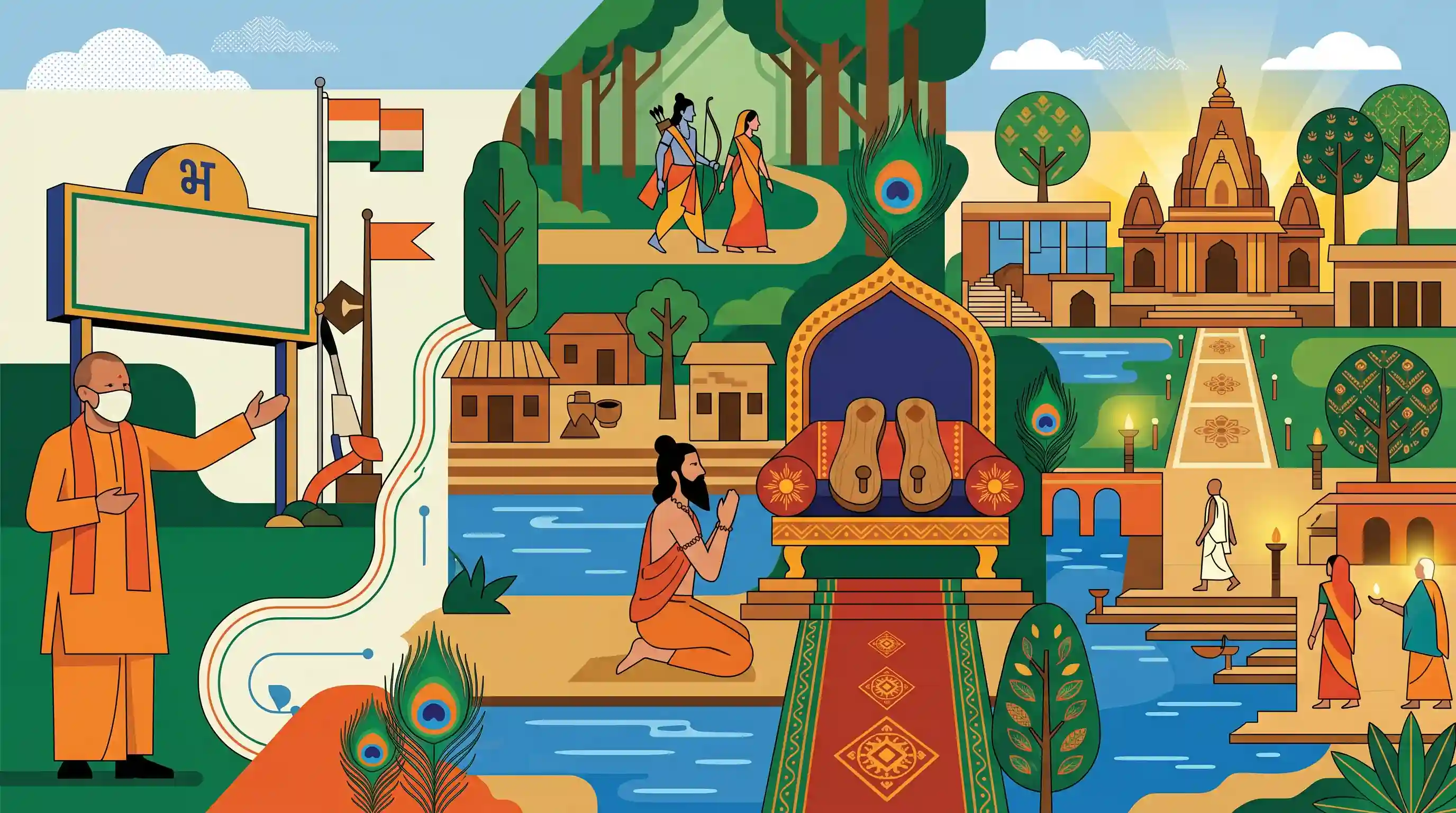
In July 2026, Uttar Pradesh Chief Minister Yogi Adityanath renamed the town of Bhadarsa in Ayodhya district to 'Bharat Nagar' to restore its mythological and historical connection to Nandigram (Bharat Kund), the place where Lord Shri Ram's brother Bharat performed penance and ruled Ayodhya with Lord Ram's wooden sandals (khadau) during the 14-year exile. The government is developing the Bharat Nagar-Bharat Kund region as a key religious tourism site.
Key Points
- In July 2026, the Uttar Pradesh government led by Chief Minister Yogi Adityanath renamed the town of Bhadarsa in Ayodhya district as 'Bharat Nagar'.
- The town is historically and traditionally associated with Nandigram (present-day Bharat Kund), which is the sacred place where Lord Shri Ram's younger brother, Bharat, performed penance and lived as an ascetic during Ram's 14-year exile.
- According to Hindu traditions, Bharat refused to rule Ayodhya from the palace, placed Lord Ram's sacred wooden sandals (khadau) on the throne to symbolize his authority, and administered the kingdom from a humble hut in Nandigram.
- Etymologically, 'Bhadarsa' is believed to be a distorted/corrupted form of historical names such as 'Bharat-Dasha', 'Bharat-Vaas', or 'Bharat-Sthan' which became official administrative records during the medieval and Nawabi periods.
- The Uttar Pradesh state government is developing the entire Bharat Nagar–Bharat Kund region as a major religious tourism destination.
Important Terms
Nandigram (Bharat Kund)

A sacred Ramayana-circuit site in Ayodhya district where Lord Rama's brother Bharat performed penance and ruled Ayodhya using Rama's wooden sandals (khadau) during the 14-year exile.
UPSC context
GS Paper I (Art and Culture: Indian Heritage) and GS Paper III (Tourism Infrastructure).
Nagar Panchayat
An urban local body constituted under the 74th Constitutional Amendment Act, 1992, specifically for transitional areas evolving from rural to urban characters.
UPSC context
GS Paper II (Polity: Local Self-Government and grassroots democracy).
Government of Uttar Pradesh
The subnational governing executive of Uttar Pradesh, headed by the Governor constitutionally and the Chief Minister administratively, managing state-level development and policies.
UPSC context
GS Paper II (Polity: State Executive and federal structure of India).
Religious Tourism
A form of tourism where travelers visit sacred places, temples, or pilgrimage centers for spiritual fulfillment, which acts as a major driver for local economic growth.
UPSC context
GS Paper I (Geography/Society) and GS Paper III (Economic Development: Tourism Infrastructure).
Prelims Trap
Renaming of municipal towns or districts within a State requires a parliamentary amendment under Article 3 of the Constitution.
Renaming a city is an executive action of the State government requiring a Union MHA NOC. Parliamentary law under Article 3/4 is only required for renaming or altering boundaries of *States* or UTs.
Static Concepts Connected
How are cities and railway stations renamed in India?
- State Executive Action: Unlike renaming states (Article 3), renaming a city is an executive action executed under the state government's authority.
- MHA Oversight: The state government must obtain a No Objection Certificate (NOC) from the Union Ministry of Home Affairs (MHA) before renaming.
- Central Consultations: The MHA consults the Ministry of Railways, Department of Posts, and the Survey of India to ensure no logistical clashes before issuing the NOC.
What is the historical significance of Saketa and the Kosala Kingdom?
- Mahajanapada Period: Kosala was one of the 16 Mahajanapadas of the 6th century BCE, with its capital at Shravasti, while Saketa (modern Ayodhya) was a key urban center.
- Buddhist Heritage: In Pali literature and Buddhist traditions, Saketa is recorded as a prosperous city visited frequently by Gautama Buddha.
Cross-Topic Patterns
Executive renaming vs. federal check
The requirement of a Central MHA 'No Objection' for renaming municipal entities shows how local identity curation remains subject to federal administrative oversight.
Tourism infrastructure as soft power
Integrating mythological sites like Bharat Kund into the Ramayana Circuit reflects India's focus on structured heritage-tourism corridors under the Swadesh Darshan Scheme.

MHA guidelines for renaming towns versus Article 3 state-renaming provisions likely to feature as a polity comparison question in 2026.
Linked PYQs · 1
Linked PYQs · 1
- 2020UPPSC_PRELIMSGS1
Which of the following cities of Uttar Pradesh is/are covered under the 'Heritage City Development and Augmentation Yojana (HRIDAY)' ? 1. Varanasi 2. Mathura 3. Prayagraj 4. Ayodhya Select the correct answer from the codes given below.
