Fiscal federalism and rising state borrowings in India
Source:The Hindu ↗
Why It Matters
It highlights the practical challenges of fiscal federalism in India, making it highly relevant for questions on Centre-State relations, the role of the Finance Commission, and the structural problems in government budgeting (GS2 and GS3).
Summary
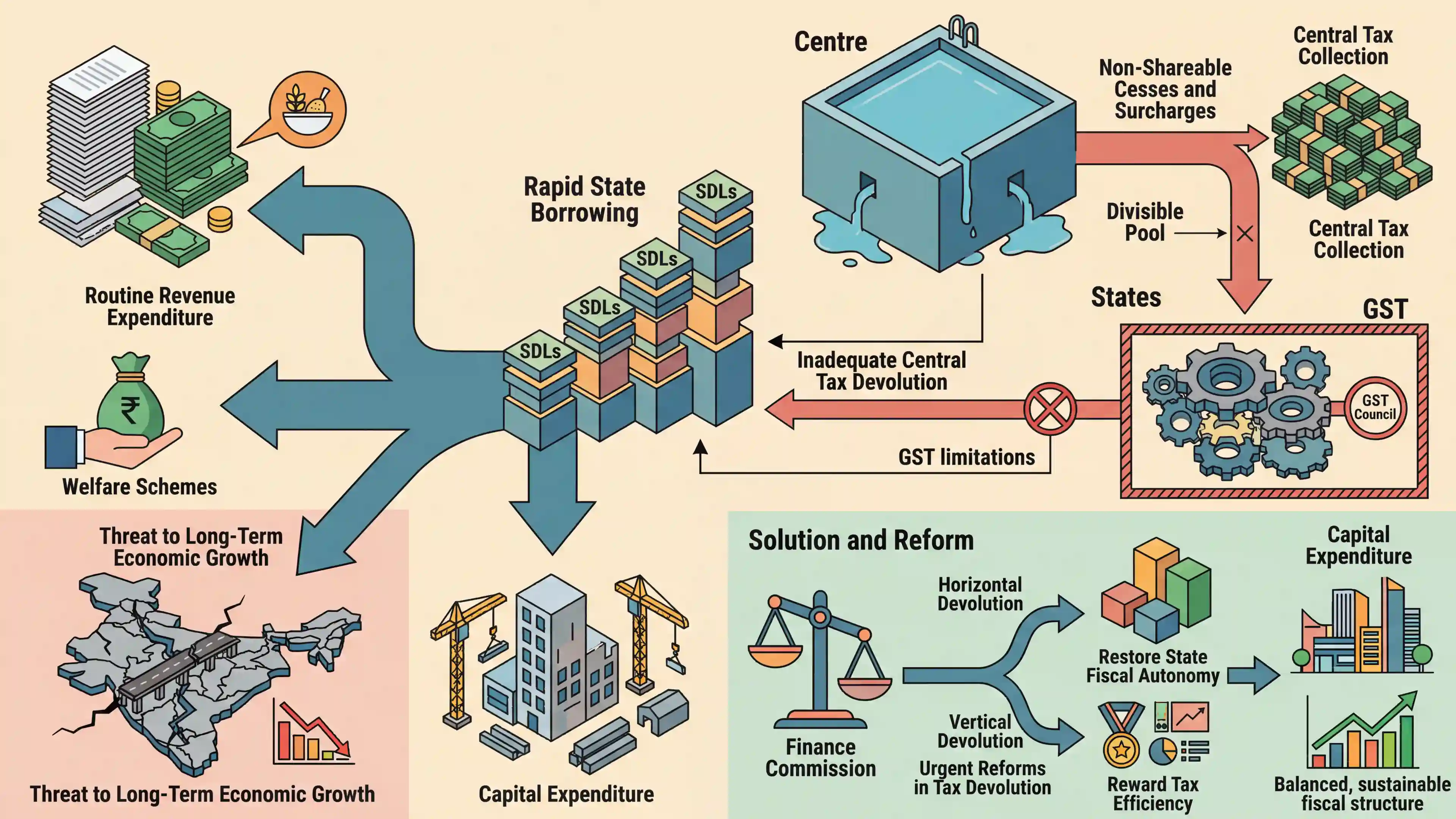
The rapid expansion of State Development Loans (SDLs) highlights a growing structural flaw in India's fiscal federalism, where states are borrowing heavily to finance routine revenue expenditures and welfare schemes. This trend is exacerbated by inadequate Central tax devolution, driven by the Centre's over-reliance on non-shareable cesses and surcharges, and the structural limitations imposed by the GST regime. The diversion of borrowings away from capital expenditure threatens long-term economic growth and infrastructure development. The situation demands urgent reforms in vertical and horizontal tax devolution mechanisms by the Finance Commission to restore state fiscal autonomy and reward tax efficiency.
Key Points
- Indian states are increasingly resorting to State Development Loans (SDLs) to fund day-to-day revenue expenditures instead of long-term capital investments.
- The fiscal imbalance accelerated post-COVID-19 as the Centre's increasing reliance on cesses and surcharges effectively shrank the divisible pool of taxes available to States.
- Although the 15th Finance Commission fixed the States' share at 41%, the actual devolution remains much lower, disproportionately affecting industrialized States with strong indirect tax bases.
- The implementation of GST has severed the traditional link between a State's economic performance and its tax revenue rewards.
- Using borrowings to fulfill welfare commitments restricts funds available for capital expenditure, hindering public infrastructure development and crowding out private investment.
- Addressing the issue requires bringing cesses and surcharges into the divisible tax pool and modifying horizontal devolution criteria to reward tax efficiency.
Important Terms
State Development Loans (SDLs)

Dated securities issued by state governments through RBI-managed auctions to finance fiscal deficits and budgetary requirements. They are a primary market-borrowing tool for states.
UPSC context
GS-III (Economy); relevant for state debt sustainability, borrowing limits, and the FRBM framework.
Finance Commission
A constitutional body (Article 280) appointed every five years to recommend the distribution of net tax proceeds between the Union and States.
UPSC context
GS-II (Polity/Federalism); tests knowledge of Article 280 and fiscal resource redistribution.
Fiscal Federalism
The constitutional division of taxation powers, spending responsibilities, and financial resources between the Union and State governments in India.
UPSC context
GS-II (Governance); core to Centre-State relations, cooperative federalism, and regional equity.
Cess and Surcharge
Additional taxes levied by the Centre for specific (cess) or general (surcharge) purposes. Under Article 270, these are excluded from the divisible tax pool.
UPSC context
GS-III (Fiscal Policy); tests understanding of the divisible pool and its impact on states' revenue.
Vertical and Horizontal Devolution
Vertical devolution is the share of central taxes given to states collectively; horizontal devolution is the distribution of that share among individual states.
UPSC context
GS-II (Governance); fundamental for understanding financial transfers and inter-state equity criteria.
Capital Expenditure
Government spending on creating long-term productive assets like infrastructure or reducing liabilities, as opposed to routine operational 'revenue' spending.
UPSC context
GS-III (Economy); essential for analyzing the quality of public spending and long-term growth.
Prelims Trap
"Cesses and surcharges are included in the divisible pool of taxes recommended by the Finance Commission."
Under Articles 270 and 271 of the Constitution, cesses (for specific purposes) and surcharges are explicitly excluded from the divisible pool of taxes, reducing the actual devolution to States.
Static Concepts Connected
What are State Development Loans (SDLs) and how are they managed?
- Nature of Instrument: Dated securities issued by State governments to meet their market borrowing requirements or fiscal deficits.
- Manager: They are facilitated, auctioned, and managed by the Reserve Bank of India on behalf of the states.
- SLR Status: SDLs qualify as eligible securities for banks to maintain their Statutory Liquidity Ratio (SLR) under the Banking Regulation Act.
How do Articles 270 and 271 govern the divisible pool of taxes?
- Article 270: Mandates the sharing of certain Union taxes and duties between the Centre and the States, forming the 'divisible pool'.
- Article 271: Empowers Parliament to increase taxes via surcharges, which go wholly to the Consolidated Fund of India and are not shared.
- Specific Cesses: Taxes levied for specific purposes under any law (cesses) are similarly excluded from the divisible tax pool.
Cross-Topic Patterns
GST regime vs. Industrialized States
GST's destination-based nature structurally benefits consumption-heavy states while severing the revenue link for industrialized manufacturing hubs like Tamil Nadu or Maharashtra.
Welfare commitments crowding out Capex
Using market borrowings (SDLs) for routine welfare (revenue expenditure) directly violates FRBM ideals, restricting state-level infrastructure creation and crowding out private investment.

Expect a Prelims multi-statement question linking Article 271 (surcharges), SDLs' SLR eligibility, and the 16th Finance Commission mandate.
Linked PYQs · 5
Linked PYQs · 5
- 2025MainsGS2
Examine the evolving pattern of Centre-State financial relations in the context of planned development in India. How far have the recent reforms impacted the fiscal federalism in India?
- 2021MainsGS3
Distinguish between Capital Budget and Revenue Budget. Explain the components of both these Budgets.
- 2023PrelimsGS1
Consider the following: 1. Demographic performance 2. Forest and ecology 3. Governance reforms 4. Stable government 5. Tax and fiscal efforts For the horizontal tax devolution, the Fifteenth Finance Commission used how many of the above as criteria other than population area and income distance?
- 2025PrelimsGS1
Which of the following statements with regard to recommendations of the 15th Finance Commission of India are correct? I. It has recommended grants of ₹ 4,800 crores from the year 2022-23 to the year 2025-26 for incentivizing States to enhance educational outcomes. II. 45% of the net proceeds of Union taxes are to be shared with States. III. ₹ 45,000 crores are to be kept as performance-based incentive for all States for carrying out agricultural reforms. IV. It reintroduced tax effort criteria to reward fiscal performance. Select the correct answer using the code given below.
- 2015PrelimsGS1
With reference to the Fourteenth Finance Commission, which of the following statements is/are correct? 1. It has increased the share of States in the central divisible pool from 32 percent to 42 percent. 2. It has made recommendations concerning sector-specific grants. Select the correct answer using the code given below.
