Maharashtra Police Dog Retirement and Care Policy
Source:theprint ↗
Why It Matters
Understanding state-level administrative decisions, welfare policies (even for service animals), and police force management is relevant for questions on Maharashtra's governance and public administration in the MPSC Prelims.
Summary
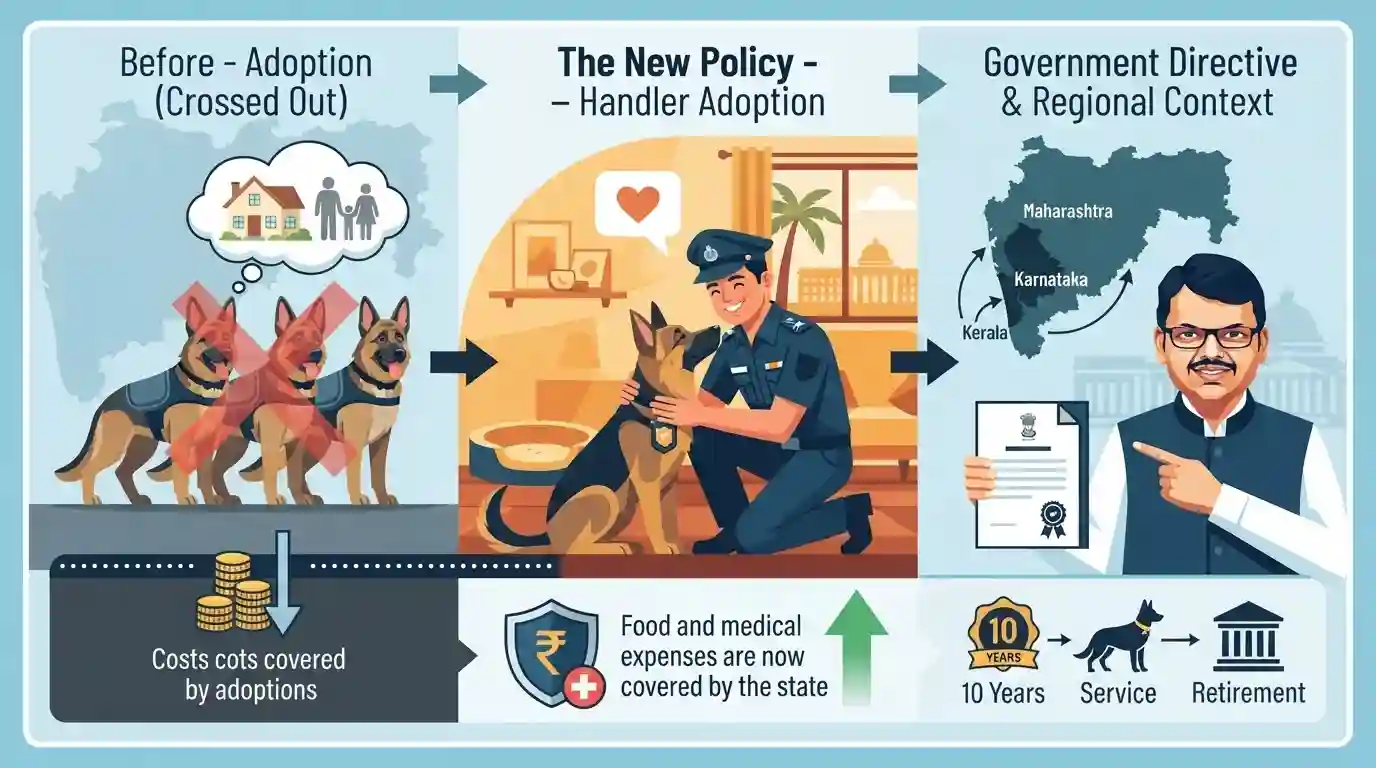
The Maharashtra government, led by Chief Minister Devendra Fadnavis, has announced a new retirement policy for police dogs. Instead of being placed for public adoption after their 10-year service, retired dogs will now be allowed to live with their handlers, with the state's Home Department covering their food and medical expenses. The move stems from observations that retired dogs often struggle to adapt to new environments without their familiar handlers. Maharashtra follows states like Karnataka and Kerala, which have already implemented similar post-service care models for police service animals.
Key Points
- The Maharashtra government introduced a new rule allowing police dogs retiring after 10 years of service to continue living with their handlers.
- The Maharashtra Home Department will fund the food, medical care, and upkeep of these retired police dogs.
- This decision stops the previous practice of placing retired police dogs up for public adoption, as some dogs struggled to adjust to new environments and unfamiliar owners.
- The move acknowledges the deep bond between police dogs and their handlers, who often train and work together from the dog's early years.
- Similar schemes providing financial assistance or departmental support for the retirement care of police dogs exist in Karnataka (2019) and Kerala (2021).
Important Terms
Maharashtra Home Department

The state ministry responsible for law and order and administering the police force. It recently introduced a policy to cover the food and medical expenses of retired police dogs.
UPSC context
GS-II (State Administration). Highlights policy-making roles regarding internal security, law enforcement, and police welfare measures in Maharashtra.
Maharashtra Police
The primary law enforcement agency of Maharashtra. It utilizes trained service animals for tracking, explosive detection, and evidence location, whose post-retirement welfare is now state-funded.
UPSC context
GS-III (Internal Security). Relevant for topics on state security forces, law enforcement infrastructure, and administrative reforms.
Bomb Detection and Disposal Squads
Specialized police units responsible for locating and safely defusing explosive devices. They work closely with trained sniffer dogs to secure critical landmarks and mitigate bomb threats.
UPSC context
GS-III (Internal Security). Crucial for understanding counter-terrorism infrastructure, disaster management, and the operational roles of service animals.
Mumbai Police
The police force serving Maharashtra's capital city. In 2017, they proactively proposed a "pension" scheme to the state government seeking financial assistance for retired sniffer dogs.
UPSC context
GS-II (Governance). Illustrates institutional initiatives, administrative reform proposals, and historical context for the state's new animal welfare policy.
Prelims Trap
Maharashtra is the first state in India to introduce a state-funded retirement care policy for police dogs.
Maharashtra is not the pioneer in this exact policy; it follows precedents already set by Karnataka (2019) and Kerala (2021).
Static Concepts Connected
What are the Constitutional provisions regarding animal welfare in India?
- Fundamental Duties: Article 51A(g) mandates every citizen to protect the natural environment and to have compassion for living creatures.
- Directive Principles: Article 48 directs the State to organize agriculture and animal husbandry on modern and scientific lines, protecting breeds.
- Concurrent List: 'Prevention of cruelty to animals' falls under the Concurrent List (Entry 17) of the Seventh Schedule, enabling both State and Union laws.
How is the State Police financially and administratively governed?
- State List: Police and public order are State subjects (Entry 1 and 2) under the Seventh Schedule, giving states exclusive administrative control.
- Home Department: The State Home Department is the nodal ministry responsible for the financial allocation, policy-making, and administrative oversight of the police forces.
Cross-Topic Patterns
Welfare over Utility in Governance
Connects to broader administrative ethics, reflecting a shift from treating state animals purely as operational assets to recognizing them as sentient beings needing compassion and post-service care.
Inter-State Policy Emulation
Demonstrates a common governance trend where successful welfare and administrative models originate in southern states like Kerala or Karnataka before being adopted by Maharashtra and others.

May appear as a factual statement in multi-liner questions regarding Maharashtra state administrative decisions or police reforms.
Linked PYQs · 2
Linked PYQs · 2
- 2015MPSC_PRELIMSGS1
The Animal Preservation (Amendment) Bill 1995 of the Government of Maharashtra which received Presidential assent a month before, excludes which of the following animals permitting their slaughter ?
- 2018MPSC_PRELIMSGS1
Government of Maharashtra's Sumatibai Sukalikar Udyogini Mahila Sakshamikaran Yojana is related to
