Telangana Governance Model Balancing Economic Growth and Welfare
Source:The Hindu ↗
Why It Matters
The article highlights the recurrent governance debate around balancing economic development with targeted welfare (or 'freebies'). It provides regional context (Telangana) on managing socio-economic disparities through state interventions while maintaining communal harmony, both of which are prominent themes in GS Paper 2 (Social Justice and Governance) and GS Paper 1 (Society).
Summary
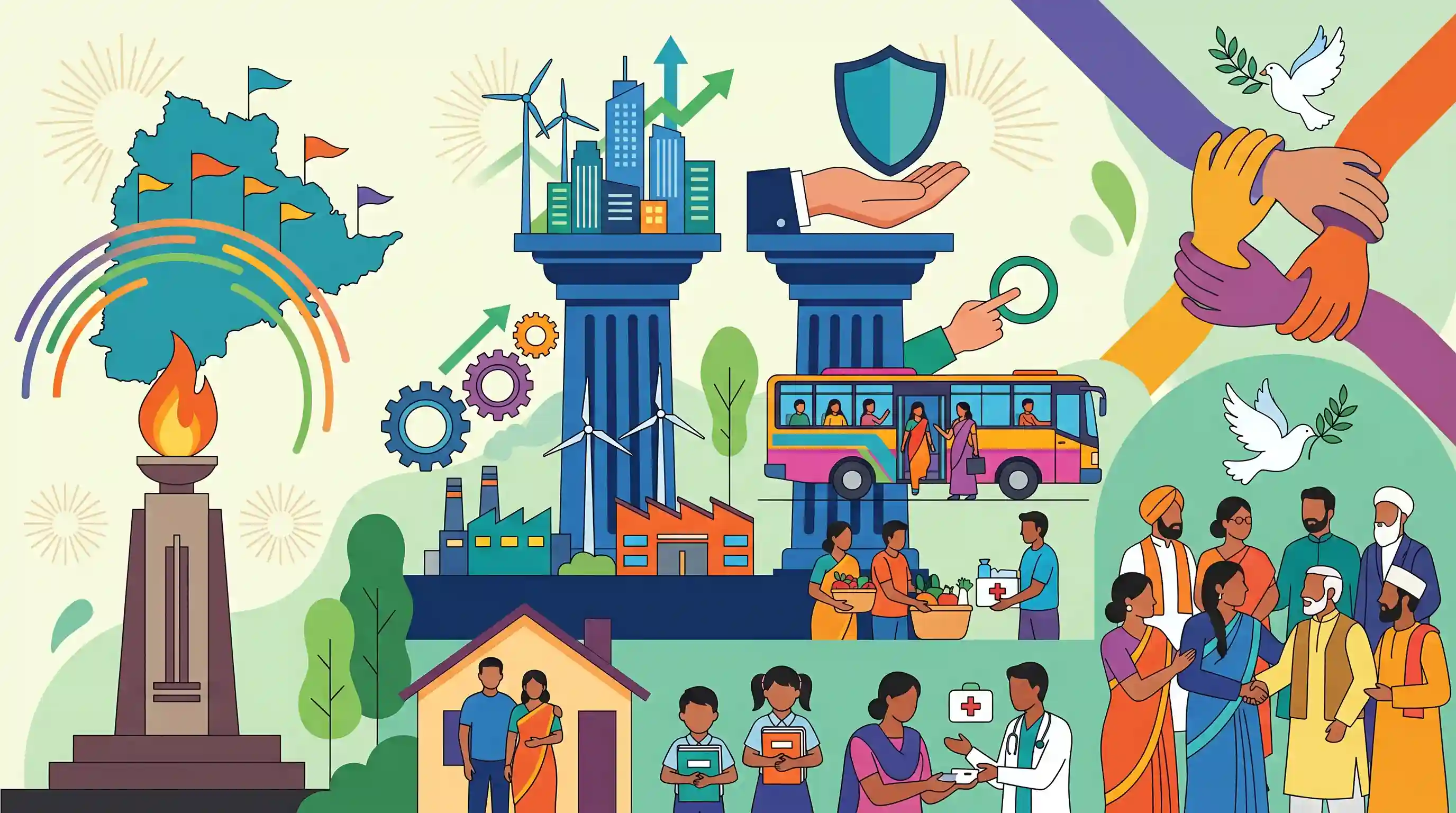
On Telangana State Formation Day, the Telangana Pradesh Congress Committee (TPCC) president underscored development and welfare as the twin pillars of the state's governance model. Highlighting the implementation of poll guarantees such as the free bus travel scheme, the address emphasized targeted welfare for marginalized sections alongside economic progress. Tributes were paid to the martyrs of the statehood movement, and the government's commitment to preserving communal harmony and secularism against divisive forces was strongly reiterated.
Key Points
- Development and welfare were emphasized as the twin pillars of governance during the Telangana State Formation Day celebrations.
- Tributes were paid to those who sacrificed their lives for Telangana statehood, acknowledging Sonia Gandhi's role in the state's creation.
- The state government remains committed to implementing its poll guarantees, prioritizing welfare measures for vulnerable sections.
- Maintenance of communal harmony and secular values was highlighted as a core governance priority to prevent divisive politics.
Important Terms
Maha Lakshmi Scheme

A Telangana government initiative providing free bus travel for women, girls, and transgender persons in state-run buses (TGSRTC), alongside monthly financial assistance and subsidized LPG cylinders.
UPSC context
GS Paper II (Welfare Schemes); tests knowledge of gender-based social justice and empowerment initiatives.
Telangana State Formation Day
Observed annually on June 2 to commemorate the 2014 creation of Telangana as India's 29th state, following a decades-long struggle for regional identity and self-governance.
UPSC context
GS Paper I (Post-independence consolidation); tests understanding of internal reorganization and regional movements.
Telangana Statehood Movement
The long-term socio-political struggle (notably 1969 and 2001-2014) for the bifurcation of Andhra Pradesh, driven by perceived economic neglect and a distinct cultural identity.
UPSC context
GS Paper I & II; relevant for questions on regionalism, linguistic states, and federalism.
Andhra Pradesh Reorganisation Act, 2014
The parliamentary act that legally created the state of Telangana by carving it out of Andhra Pradesh, outlining the distribution of assets, liabilities, and river waters.
UPSC context
GS Paper II (Polity); tests knowledge of Article 3 and the administrative mechanics of state bifurcation.
Welfare State
A governance concept where the state assumes primary responsibility for the social and economic welfare of its citizens through policies and the Directive Principles of State Policy.
UPSC context
GS Paper II (Governance/Constitution); central to understanding the role of DPSP in Indian governance.
Secularism
A constitutional principle where the state treats all religions equally (Sarva Dharma Sambhava), ensuring no state religion exists and protecting communal harmony.
UPSC context
GS Paper I & II; tested as a Basic Structure of the Constitution and a socio-cultural value.
Telangana Pradesh Congress Committee (TPCC)
The state-level unit of the Indian National Congress in Telangana, which manages party affairs and political campaigns within the state.
UPSC context
GS Paper II (Polity); relevant for understanding the organizational structure of national parties in a federal system.
Prelims Trap
State reorganization bills require the binding consent of the affected State Legislative Assemblies.
Under Article 3, the President must refer the bill to the state legislature for its views, but Parliament is absolutely not bound by those views.
Static Concepts Connected
What is the Constitutional procedure under Article 3 to form new states?
- Prior approval: Introduction of the bill in Parliament requires the prior recommendation of the President.
- State consultation: The President refers the bill to the concerned state legislature to express its views within a specified period, though these views are not binding.
- Simple majority: The bill must be passed by a simple majority in Parliament. It is not considered a Constitutional Amendment under Article 368.
How does welfare differ from 'freebies' in economic governance?
- Welfare provision: Targeted expenditure on public goods like health, education, and PDS that fundamentally builds human capital, equity, and long-term capacity.
- Freebies (Revadi): Untargeted distribution of private goods or utility waivers that drain state finances without creating long-term productive assets or economic multiplier effects.
Cross-Topic Patterns
Free transit and female workforce
Subsidized transport schemes connect state fiscal policy (GS3) directly to boosting Female Labour Force Participation (FLFP) and women's economic empowerment (GS1/GS2).
DPSP mandates vs FRBM targets
Implementing broad welfare guarantees highlights the continuous tension between achieving Article 38 (minimizing inequalities) and maintaining macroeconomic stability under state FRBM limits.

Expect a Mains GS2 question evaluating 'welfare vs freebies' through the dual lens of DPSP obligations and state FRBM fiscal limits.
Linked PYQs · 4
Linked PYQs · 4
- 2023MainsGS2
“Development and welfare schemes for the vulnerable, by its nature, are discriminatory in approach.” Do you agree? Give reasons for your answer.
- 2022MainsGS2
Besides the welfare schemes, India needs deft management of inflation and unemployment to serve the poor and the underprivileged sections of the society. Discuss.
- 2019MainsGS2
Performance of welfare schemes that are implemented for vulnerable sections is not so effective due to absence of their awareness and active involvement at all stages of policy process. Discuss.
- 2022MainsGS1
Are tolerance, assimilation and pluralism the key elements in the making of an Indian form of secularism? Justify your answer.
