Cauvery Tribunal Award Review Demand Climate Change Impact
Source:The Hindu ↗
Why It Matters
Illustrates the intersection of climate change, cooperative federalism, and inter-state water disputes, highlighting the need to adapt legal and institutional frameworks like water tribunals to modern environmental realities.
Summary
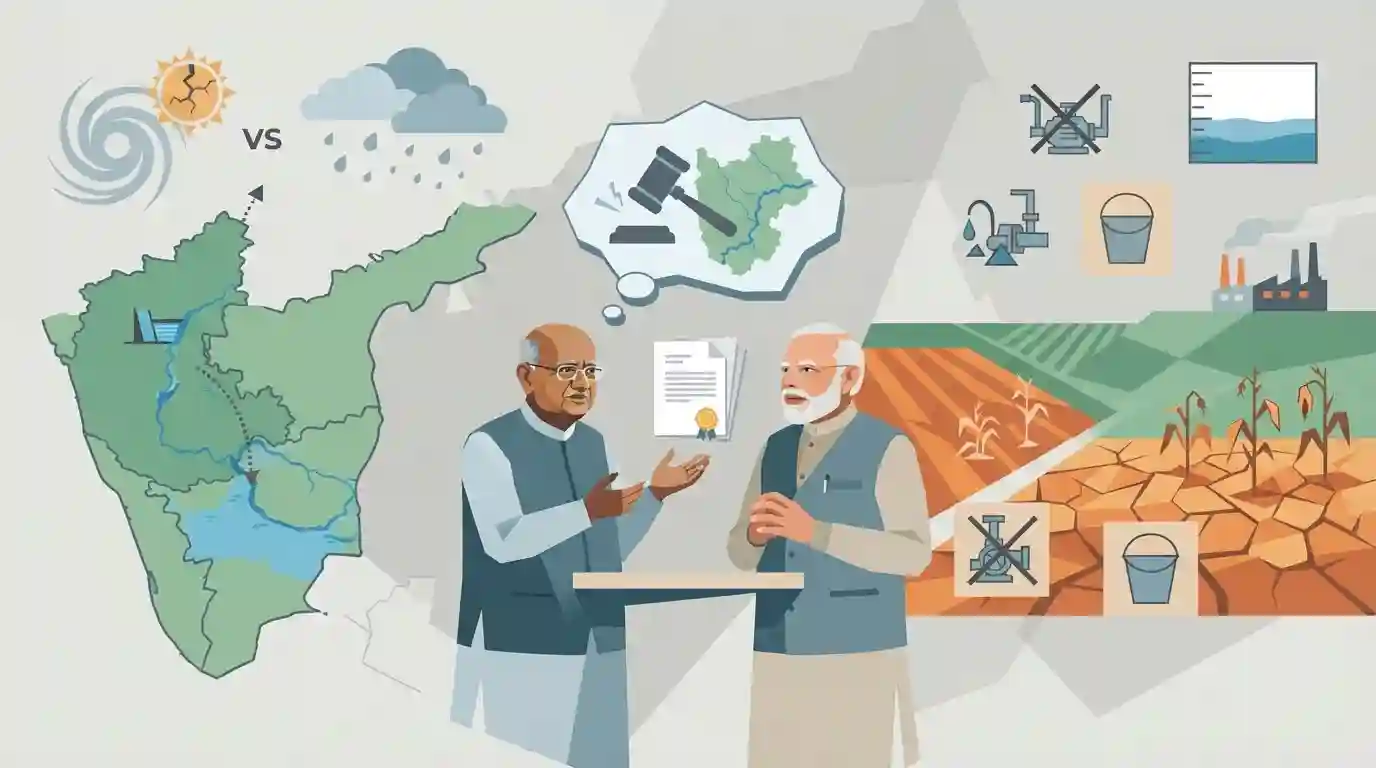
Former Prime Minister H.D. Deve Gowda has urged Prime Minister Narendra Modi to review the Cauvery Water Disputes Tribunal award, citing climate change impacts, changing monsoon patterns, and severe distress in water availability for basin states like Karnataka.
Key Points
- Former Prime Minister H.D. Deve Gowda wrote to Prime Minister Narendra Modi urging a review of the Cauvery Water Disputes Tribunal award.
- The appeal emphasizes the shifting climate patterns and reduced rainfall affecting inflows into reservoirs.
- Highlighting the inadequacies of traditional water-sharing formulas during climate-induced droughts and deficit rainfall years.
- Brings to the fore structural challenges in inter-state water governance and cooperative federalism in southern India.
Important Terms
Cauvery Water Disputes Tribunal

A statutory body established under Article 262 of the Constitution to adjudicate inter-state water sharing disputes regarding the Cauvery river system among riparian states.
UPSC context
UPSC Paper II (Polity & Governance - Federalism, Inter-state disputes). Tests understanding of water dispute resolution mechanisms in India.
Inter State River Water Disputes Act
Legislation enacted by Parliament empowering the central government to constitute tribunals for adjudicating disputes relating to waters of inter-state rivers and river valleys.
UPSC context
UPSC Paper II (Polity & Governance). Tests legal frameworks and statutory provisions for resolving inter-state water conflicts.
Supreme Court of India
The apex judicial body in India that holds original jurisdiction under Article 131 for inter-state disputes and appellate jurisdiction over water tribunal decisions.
UPSC context
UPSC Paper II (Polity - Judiciary). Tests constitutional powers of the Supreme Court in adjudicating or reviewing federal disputes.
Static Concepts Connected
What is the institutional framework for resolving inter-state river water disputes in India?
- Constitutional Basis: Enacted under Article 262 of the Constitution, empowering Parliament to adjudicate inter-state water disputes.
- ISRWD Act 1956: Empowers the Union Government to constitute ad-hoc tribunals for specific water disputes upon request from states.
- 2018 Amendment Act: Replaced ad-hoc tribunals with a permanent tribunal and dispute resolution committees to streamline adjudication.
Cross-Topic Patterns
Climate Change & Inter-State Federalism
Climate-induced hydrological shifts challenge static tribunal formulas, testing the resilience of cooperative federalism in managing shared river basins.

Cauvery/ISRWD Act mechanisms + climate change impacts likely to feature in a multi-statement Prelims question on river water governance.
Linked PYQs · 2
Linked PYQs · 2
- 2024MainsGS2
What changes has the Union Government recently introduced in the domain of Centre-State relations ? Suggest measures to be adopted to build the trust between the Centre and the States and for strengthening federalism.
- 2020PrelimsGS1
Which of the following Protected Areas are located in Cauvery basin ? 1. Nagarhole National Park 2. Papikonda National Park 3. Sathyamangalam Tiger Reserve 4. Wayanad Wildlife Sanctuary Select the correct answer using the code given below:
