Internal Security Directive Focuses on Detection of Illegal Migrants
Source:The Hindu ↗
কেন এটি গুরুত্বপূর্ণ
The directive links border management, legislative reforms, and high-tech security integration (such as AI on MAC platforms and bio-security frameworks) into a single strategic vision, which is highly relevant for the Mains GS3 Internal Security and Border Management syllabus.
সারসংক্ষেপ
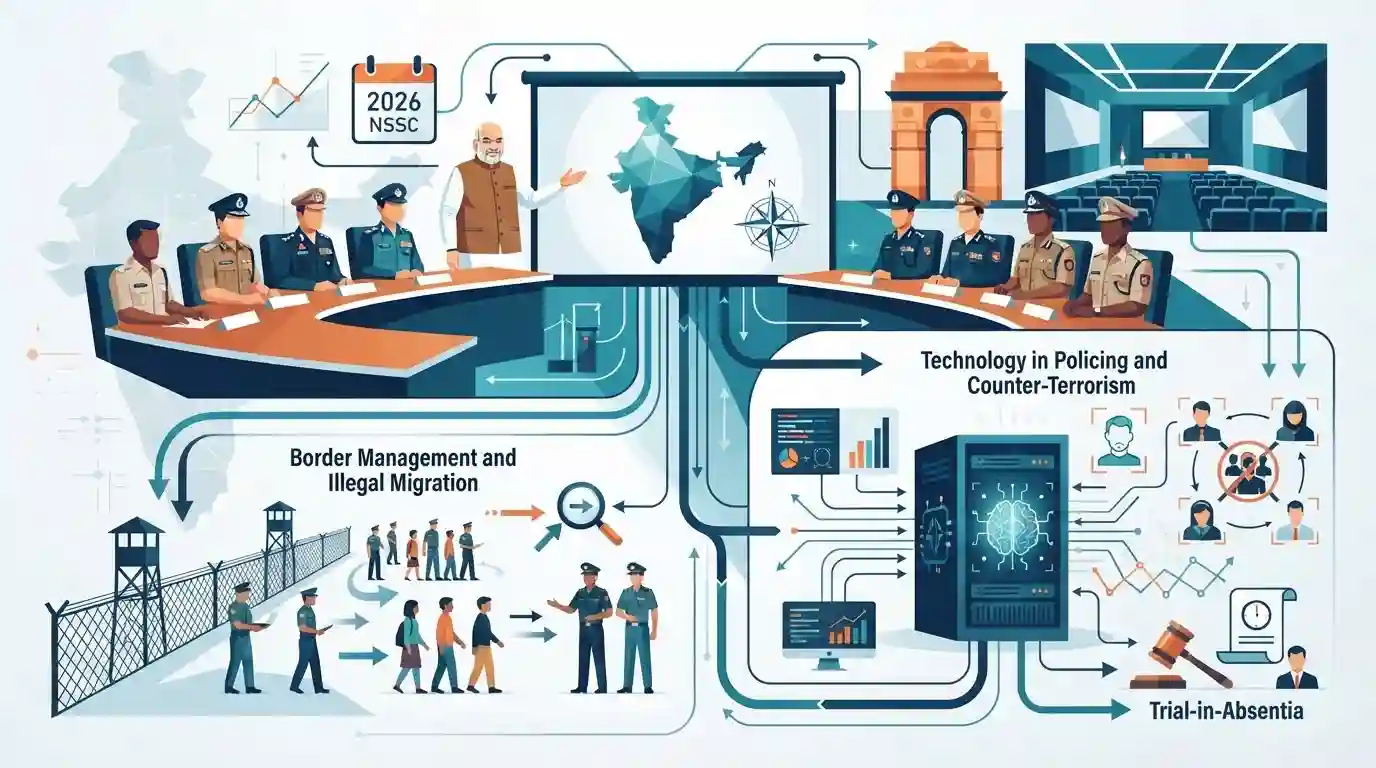
At the 9th National Security Strategies Conference (NSSC) 2026 in New Delhi, Union Home Minister Amit Shah urged security agencies and state police chiefs to proactively detect and deport illegal migrants, deploy AI-based analysis on MAC platforms, and utilize trial-in-absentia provisions to counter national security challenges.
মূল বিষয়
- Home Minister Amit Shah directed state and UT police chiefs to prioritize the detection and deportation of illegal migrants to secure national borders and internal security.
- The Ministry of Home Affairs is exploring the potential need for a legislative framework to address 'artificial' demographic changes arising from unchecked migration.
- Advocated for the use of Artificial Intelligence (AI) to analyze operational data on Multi Agency Centre (MAC) platforms to build standardized operating procedures (SOPs) against national security threats.
- Stressed the importance of the PRAHAAR scheme, expedited trials of fugitives using 'trial in absentia' provisions, and an integrated, comprehensive investigation approach under the Unlawful Activities (Prevention) Act (UAPA).
- The conference discussed multi-dimensional security challenges, including a bio-security framework, information warfare, securing the blue economy, and countermeasures against sub-aerial systems (drones).
গুরুত্বপূর্ণ শব্দ
National Security Strategies Conference (NSSC)

An annual MHA-led conference held since 2021 bringing together central and state security heads to devise coordinated solutions for emerging challenges like terrorism, cybercrime, and border infiltration.
UPSC context
GS-3 (Internal Security). Tests awareness of institutional mechanisms for coordinating national security and counter-terrorism responses.
PRAHAAR scheme
A Ministry of Home Affairs initiative aimed at countering terrorism and radicalization. It requires specialized training and strategic implementation by security personnel to neutralize internal security threats effectively.
UPSC context
GS-3 (Internal Security). Relevant for answers detailing strategic government initiatives to combat extremism and radicalization.
Multi Agency Centre (MAC)
A national counter-terrorism intelligence grid under the Intelligence Bureau (IB) that facilitates real-time intelligence fusion, sharing, and AI-based analysis among central and state law enforcement agencies.
UPSC context
GS-3 (Internal Security). Crucial for topics on intelligence sharing, counter-terrorism infrastructure, and deploying AI in policing.
Unlawful Activities (Prevention) Act (UAPA)
India's primary anti-terror legislation designed to prevent unlawful associations and terrorist activities. It grants authorities significant investigative powers and imposes stringent conditions for granting bail.
UPSC context
GS-2 (Polity) & GS-3 (Security). Tests understanding of counter-terrorism legal frameworks and their balance with fundamental rights.
Central Armed Police Forces (CAPFs)
Federal security forces operating under the Ministry of Home Affairs—including BSF, CRPF, and ITBP—tasked with border guarding, counter-insurgency, and maintaining internal security across India.
UPSC context
GS-3 (Internal Security). Important for analyzing the mandate of security forces and challenges in border management.
Intelligence Bureau (IB)
India's premier internal intelligence agency under the Ministry of Home Affairs. It is responsible for domestic intelligence gathering, monitoring security threats, and executing counter-intelligence operations.
UPSC context
GS-3 (Internal Security). Essential for questions on the national intelligence architecture and coordination among security agencies.
প্রিলিমস ফাঁদ
The Multi Agency Centre (MAC) is a statutory intelligence fusion body created by an Act of Parliament.
MAC is not statutory; it was established by executive decision post-Kargil under the Intelligence Bureau. It is not an independent legislative body.
সংযুক্ত স্থির ধারণা
What is the Multi Agency Centre (MAC) and its mandate?
- Origin: Established in 2001 based on the Kargil Review Committee recommendations to streamline counter-terror intelligence sharing.
- Nodal Agency: Functions under the Intelligence Bureau (IB) of the Ministry of Home Affairs, serving as a 24/7 central fusion hub.
- Membership: Integrates over 25 central and state-level agencies, including RAW, military intelligence, and state police forces.
What is 'Trial in Absentia' under the Bharatiya Nagarik Suraksha Sanhita (BNSS), 2023?
- Section 356: Enables courts to conduct criminal trials and pronounce judgments against declared proclaimed offenders who deliberately abscond.
- Legal Representation: Requires the state to appoint a defense advocate at state expense to ensure fair trial standards for the absent accused.
- Strict Safeguards: Can only commence after specific notification periods and verification that the accused cannot be found.
আন্তঃবিষয় প্যাটার্ন
Demographic changes + Federalism
Border-state demographics connect Internal Security with federal dynamics (Article 355), where states often contest unilateral central actions regarding border policing jurisdictions.
Blue Economy + Maritime Security
India's Sagar Mala and deep-ocean economic ambitions rely heavily on coastal security coordination between State Marine Police, Coast Guard, and the Indian Navy.

Questions may couple the constitutional validity of 'trial in absentia' under BNSS with operational security frameworks like MAC.
সংযুক্ত PYQ · 2
সংযুক্ত PYQ · 2
- 2014MainsGS3
How does illegal transborder migration pose a threat to India's security? Discuss the strategies to curb this, bringing out the factors which give impetus to such migration.
- 2020MainsGS3
Analyze internal security threats and transborder crimes along Myanmar, Bangladesh and Pakistan borders including Line of Control (LoC). Also discuss the role played by various security forces in this regard.
