US Economic Growth Amidst Protectionist Tariffs and Inflation Risks
Source:Indian Express ↗
Why It Matters
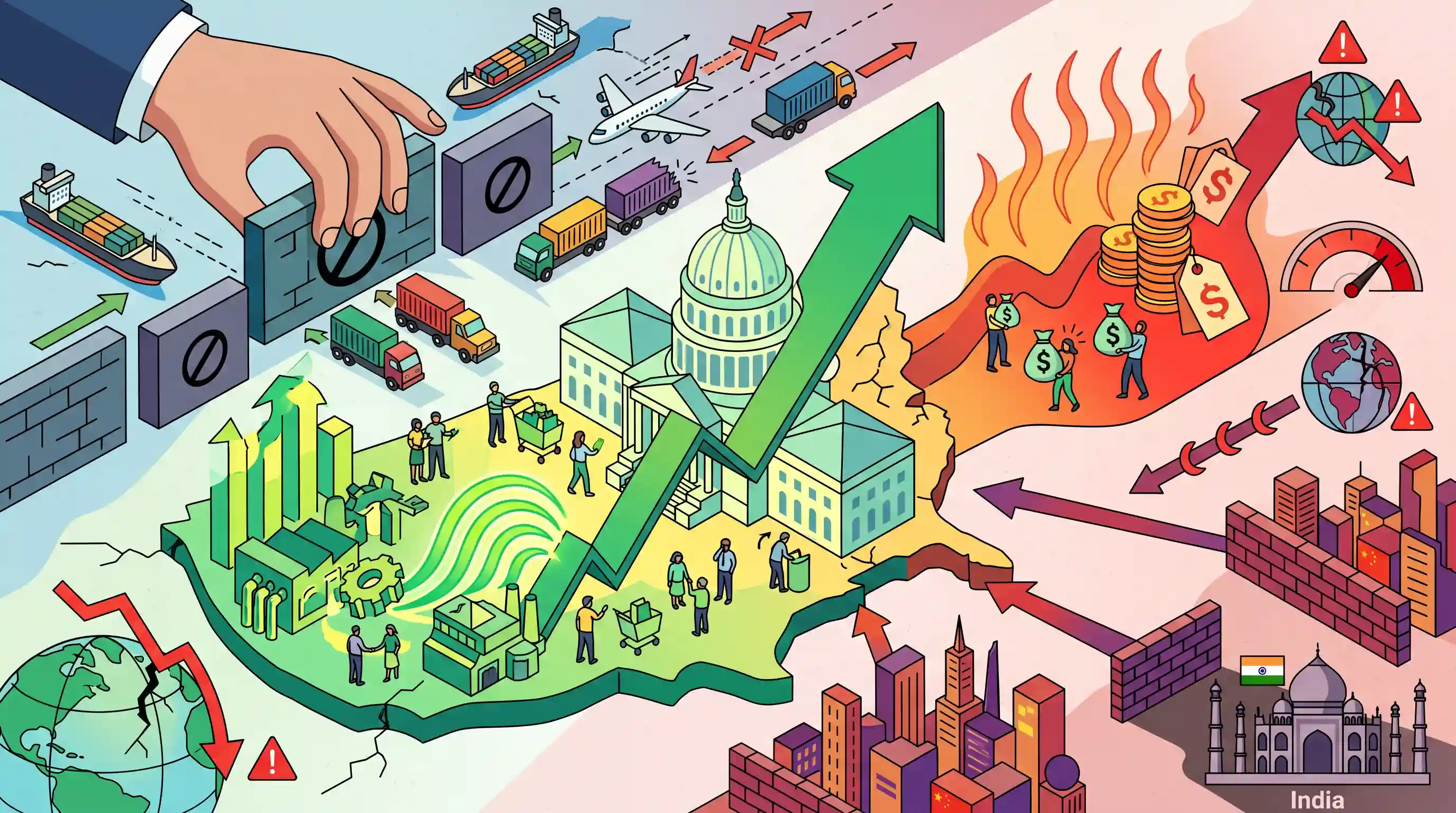
The sustainability of US economic growth amidst protectionist tariffs directly impacts global macroeconomic stability. Understanding the interplay between tariffs, inflation, and growth is crucial for analyzing challenges to free trade and preparing strategies to safeguard the Indian economy from external shocks.
Summary
Despite the imposition of aggressive tariffs by the Trump administration, the US economy has grown at its fastest pace in two years, largely due to strong domestic demand. However, experts warn that this short-term resilience may not be sustainable. The continuous reliance on protectionist trade policies risks reviving inflation, raising costs for consumers, and disrupting global supply chains. Furthermore, potential retaliatory measures from trading partners could dampen future growth prospects, posing significant macroeconomic challenges for the global economy and emerging markets like India.
Key Points
- The US economy has recorded its fastest pace of growth in two years, defying early predictions that protectionist tariffs would immediately stifle economic activity.
- The short-term resilience is likely driven by robust domestic consumption and investment.
- However, the growth may not be sustainable, as prolonged tariffs carry the risk of reigniting inflation and increasing input costs for businesses.
- The broader global economy, including India, faces challenges from rising protectionism, potential retaliatory trade measures, and disrupted global supply chains.
Important Terms
Trade Tariffs

Taxes imposed by a government on imported goods to increase their cost, thereby discouraging consumption and shielding domestic industries from foreign competition.
UPSC context
GS-3: Indian Economy and issues related to trade, resource mobilization, and inflation.
Protectionist Policies
Government measures, including tariffs, quotas, and subsidies, designed to favor domestic producers over foreign competitors to protect local jobs and industries.
UPSC context
GS-3: Effects of liberalization on the economy; GS-2: International relations and trade wars.
Retaliatory Tariffs
Taxes levied by a nation against a trading partner's exports as a direct response to tariffs previously imposed on its own goods.
UPSC context
GS-2: Bilateral relations; GS-3: International trade disputes and economic stability.
Federal Reserve
The central banking system of the United States whose monetary policy decisions, such as interest rate changes, dictate global capital flows and exchange rates.
UPSC context
GS-3: Monetary policy and its impact on FPI flows, Rupee stability, and capital flight.
World Trade Organization (WTO)
A multilateral intergovernmental organization that regulates international trade, enforces a rules-based system, and provides a forum for resolving trade disputes between members.
UPSC context
GS-2: Important International institutions; GS-3: Issues related to intellectual property and trade agreements.
Supply Chains
A complex global network of people, companies, and activities involved in moving a product from suppliers to customers, often vulnerable to trade barriers.
UPSC context
GS-3: Infrastructure, industrial growth, and supply chain resilience (Atmanirbhar Bharat).
Prelims Trap
"Imposing protective import tariffs generally decreases domestic inflation by promoting cheaper local manufacturing."
Tariffs actually act as a catalyst for cost-push inflation by increasing the landed cost of imported raw materials and intermediate goods for domestic producers.
Static Concepts Connected
How do protectionist tariffs and robust consumption trigger different types of inflation?
- Cost-Push Inflation: Tariffs increase the cost of imported raw materials and intermediate goods, forcing domestic producers to raise final product prices.
- Demand-Pull Inflation: Economic growth driven by rapid domestic consumption without corresponding supply-side expansion pulls overall price levels upward as demand outstrips supply.
What is the macroeconomic spillover of US inflation on emerging markets?
- Fed Rate Hikes: Sustained US inflation forces the Federal Reserve into a tighter monetary policy, leading to elevated interest rates.
- Capital Flight: Higher safe-haven yields in the US trigger Foreign Portfolio Investment (FPI) outflows from emerging markets like India.
- INR Depreciation: Heavy capital outflows weaken the Indian Rupee, making India's inelastic imports (like crude oil) more expensive and widening the CAD.
Cross-Topic Patterns
Unilateral Tariffs vs WTO Paralysis
Aggressive bilateral tariffs undermine the multilateral trading system, directly connecting to the ongoing systemic paralysis of the WTO's Appellate Body and the shift away from rules-based global trade.
US Inflation + Indian Monetary Policy
If US tariffs sustain high inflation and keep Fed rates elevated, the RBI's ability to cut domestic repo rates is constrained due to severe currency depreciation risks.

Expect a 2026 Prelims question linking US tariff-induced inflation to Federal Reserve rate hikes and FPI outflows from India.
Linked PYQs · 5
Linked PYQs · 5
- 2025MainsGS3
What are the challenges before the Indian economy when the world is moving away from free trade and multilateralism to protectionism and bilateralism? How can these challenges be met?
- 2018MainsGS3
How would the recent phenomena of protectionism and currency manipulations in world trade affect macroeconomic stability of India?
- 2018MainsGS2
What are the key areas of reform if the WTO has to survive in the present context of "Trade War', especially keeping in mind the interest of India?
- 2011PrelimsGS1
Economic growth is usually coupled with
- 2021PrelimsGS1
With reference to Indian economy, demand-pull inflation can be caused/ increased by which of the following? 1. Expansionary policies 2. Fiscal stimulus 3. Inflation-indexing wages 4. Higher purchasing power 5. Rising interest rates Select the correct answer using the code given below.
