Comparative Analysis of India Per Unit Space Launch Costs
Source:The Hindu ↗
Why It Matters
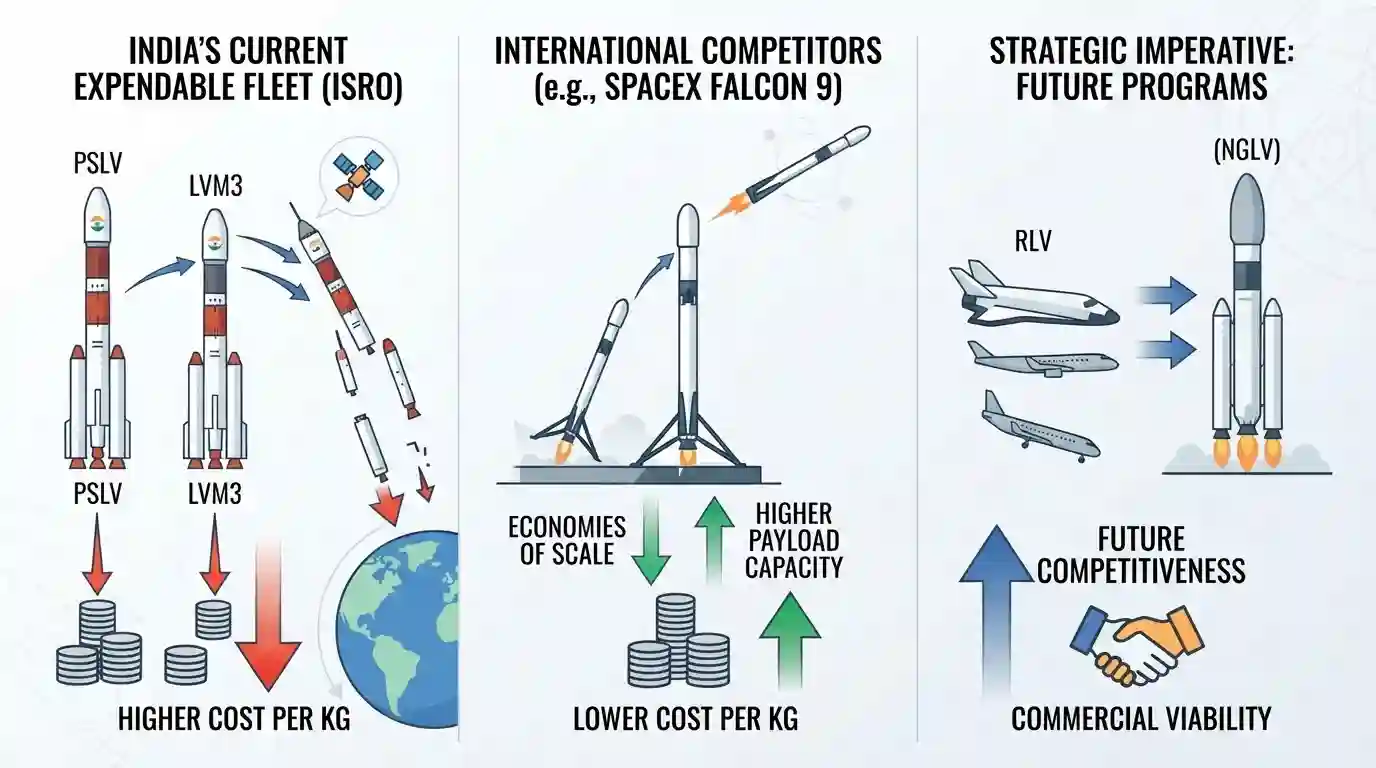
It challenges the mainstream narrative of India's 'low-cost' space sector, emphasizing that long-term commercial competitiveness requires transitioning from expendable rockets to reusable launch vehicles with higher payload capacities to achieve economies of scale.
Summary
A recent study reveals that despite India's reputation for cost-effective space missions, the per-unit space launch cost (cost per kilogram of payload) of ISRO's launch vehicles is currently the highest globally. The disparity arises because Indian rockets, such as the PSLV and LVM3, are expendable and have lower payload capacities compared to international competitors like SpaceX's Falcon 9, which utilize reusable rocket stages and heavy-lift capabilities to achieve economies of scale. This structural cost disadvantage underscores the strategic necessity for India to accelerate its Reusable Launch Vehicle (RLV) and Next-Generation Launch Vehicle (NGLV) programs to remain competitive in the lucrative commercial space market.
Key Points
- Paradox of Frugal Spacecraft: While India is widely celebrated for low-budget interplanetary missions (such as the Mars Orbiter Mission), the per-unit cost (cost per kilogram of payload) to launch objects into orbit using its current rockets is the highest globally.
- Lack of Reusability: Unlike global competitors such as SpaceX, which have drastically reduced costs by utilizing reusable first stages, ISRO's current operational fleet (PSLV, GSLV, LVM3) consists of expendable rockets, driving up the per-launch cost.
- Payload Capacity Constraints: ISRO's heaviest launch vehicle, LVM3, can carry around 10 tonnes to Low Earth Orbit (LEO), significantly less than international heavy-lifters, making it difficult to achieve economies of scale.
- Future Imperatives: To capture a larger share of the global commercial space market through NSIL, ISRO must prioritize and expedite the development of its Next-Generation Launch Vehicle (NGLV) and Reusable Launch Vehicle (RLV) technologies.
Important Terms
Indian Space Research Organisation (ISRO)

India's national space agency, operating under the Department of Space. It is responsible for developing space technology, executing satellite launches, and conducting planetary exploration to advance national development and scientific knowledge.
UPSC context
GS Paper 3 (Science & Technology); evaluates India's institutional capacity, achievements, and global competitiveness in space exploration.
NewSpace India Limited (NSIL)
The commercial arm of ISRO, established in 2019. It focuses on commercially exploiting India's space products, scaling up private industry participation, and providing global satellite launch services.
UPSC context
GS Paper 3 (Commercialization of Space); essential for topics on space sector reforms, space economy, and public-private partnerships.
Next-Generation Launch Vehicle (NGLV)
An upcoming three-stage, partially reusable heavy-lift rocket developed by ISRO. Designed to replace current expendable rockets, it aims to carry up to 30 tonnes to Low Earth Orbit, significantly reducing launch costs.
UPSC context
GS Paper 3 (Space Technology); critical for analyzing India's future space missions, including the Bharatiya Antariksh Station and lunar landings.
Reusable Launch Vehicle (RLV)
Advanced aerospace technology designed to return to Earth for refurbishment after a mission. By eliminating single-use rockets, RLVs drastically lower the per-kilogram cost of delivering payloads into space.
UPSC context
GS Paper 3 (Space Technology); vital for understanding how ISRO can overcome high per-unit launch costs and remain globally competitive.
Polar Satellite Launch Vehicle (PSLV)
ISRO's highly reliable, expendable medium-lift launch vehicle. Its smaller payload capacity distributes fixed launch costs over fewer kilograms, resulting in higher per-unit costs compared to modern heavy-lift reusable alternatives.
UPSC context
GS Paper 3 (Science & Technology); forms the baseline for comparing India's legacy space infrastructure with new cost-effective, reusable technologies.
SpaceX
A private American aerospace company that revolutionized the commercial space market by pioneering reusable rocket stages, dramatically reducing per-unit space launch costs through massive economies of scale.
UPSC context
GS Paper 3 (Science & Technology); serves as a benchmark in questions regarding global space privatization, competitiveness, and commercial viability.
Prelims Trap
ISRO's launch vehicles offer the lowest per-kilogram payload launch cost globally.
While India's missions (like Mangalyaan) are highly cost-effective overall, its per-unit launch cost to LEO is globally the highest due to expendable rockets and lower payload capacities.
Static Concepts Connected
How do ISRO's primary operational launch vehicles compare in payload capacity?
- PSLV: Known as the workhorse, it carries up to 1,750 kg to Sun-Synchronous Polar Orbits (SSPO) and operates as an expendable four-stage rocket.
- GSLV: Designed for geosynchronous missions, it carries around 2,200 kg to Geosynchronous Transfer Orbit (GTO) using an indigenous cryogenic upper stage.
- LVM3: ISRO's heaviest operational rocket, capable of lifting up to 4,000 kg to GTO and approximately 10,000 kg to Low Earth Orbit (LEO).
Why is ISRO shifting to Methalox propellant for the upcoming Next-Generation Launch Vehicle (NGLV)?
- Clean burning: Unlike Kerosene (RP-1), liquid methane burns very cleanly. This prevents soot accumulation, drastically reducing maintenance between flights and enabling rapid engine reusability.
- High efficiency: Liquid oxygen and liquid methane provide an excellent specific impulse (efficiency), improving the heavy-lifting capabilities needed for space station deployment.
- ISRU potential: Methane can theoretically be synthesized on Mars (via the Sabatier reaction), making it the fuel of choice for future deep-space interplanetary missions.
Cross-Topic Patterns
Space commercialization and NSIL
The push to increase India's global space economy share from 2% to 10% directly relies on NSIL leveraging private partnerships and the upcoming cost-efficient NGLV launches.
NGLV and the Bharatiya Antariksh Station
Establishing the Bharatiya Antariksh Station (BAS) by 2035 strictly requires the massive 30-tonne LEO capacity and reusability of the upcoming Next-Generation Launch Vehicle (Project Soorya).

Expect a multi-statement question contrasting ISRO's frugal mission costs with its high per-kg launch costs, alongside Pushpak/NGLV tech details.
Linked PYQs · 3
Linked PYQs · 3
- 2018PrelimsGS1
With reference to India's satellite launch vehicles, consider the following statements: 1. PSLVs launch the satellites useful for Earth resources monitoring whereas GSLVs are designed mainly to launch communication satellites. 2. Satellites launched by PSLV appear to remain permanently fixed in the same position in the sky, as viewed from a particular location on Earth. 3. GSLV Mk III is a four-staged launch vehicle with the first and third stages using solid rocket motors; and the second and fourth stages using liquid rocket engines. Which of the statements given above is/are correct?
- 2016MainsGS3
Discuss India's achievements in the field of Space Science and Technology. How the application of this technology has helped India in its socio-economic development?
- 2026PrelimsGS1
Consider the following statements with regard to involvement of private entities in India's space programme : 1. The Indian National Space Promotion and Authorisation Centre (IN-SPACe) is an autonomous agency formed to facilitate participation of private entities. 2. Agnikul Cosmos launched the world's first flight using 3D-printed rocket engine. 3. Skyroot Aerospace has developed liquid fuel for GSLV. Which of the statements given above is/are correct ?
