Analysis of India Per Unit Space Launch Cost Efficiency
Source:The Hindu ↗
কেন এটি গুরুত্বপূর্ণ
As the global space industry shifts toward heavy-lift and highly reusable launch vehicles, analyzing ISRO's cost-efficiency per kilogram is crucial. It underscores the urgent need for India's space program to transition to next-generation vehicles (NGLV, RLV) and deeply integrate private startups to capture a meaningful share of the global space economy.
সারসংক্ষেপ
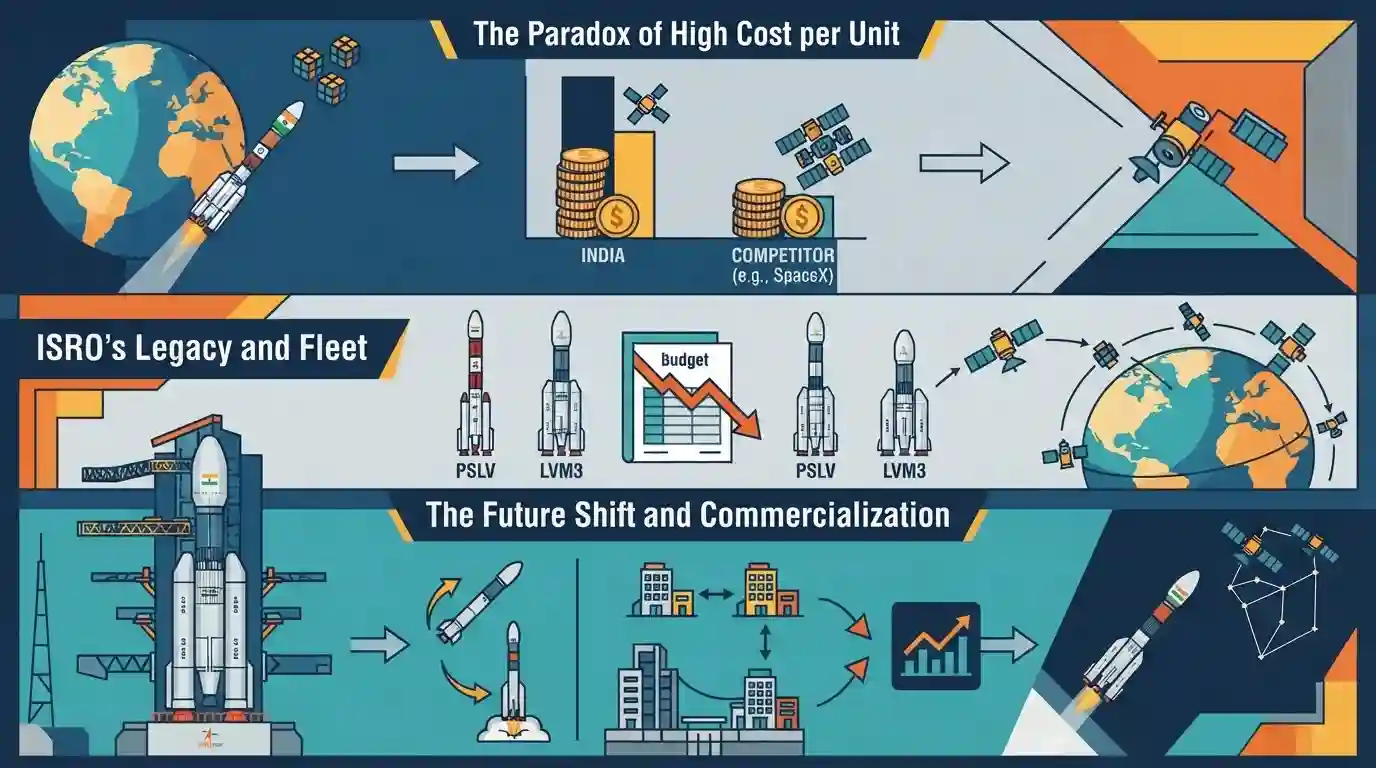
A recent study highlights that despite the Indian Space Research Organisation's (ISRO) global reputation for running a highly frugal space program, India currently has the highest per-unit space launch costs in the world. This paradox occurs because, although ISRO's overall mission costs are notably low, its primary launch vehicles—such as the PSLV and LVM3—have relatively small payload capacities compared to the heavy-lift rockets of international competitors like SpaceX. Consequently, the cost per kilogram of payload sent to orbit is higher. To remain competitive in the rapidly expanding commercial space market, India is shifting focus toward developing higher-capacity rockets, advancing Reusable Launch Vehicle (RLV) technologies, and integrating private aerospace companies into the launch ecosystem via agencies like IN-SPACe and NSIL.
মূল বিষয়
- A recent study has revealed that India's per-unit space launch cost (cost per kilogram of payload placed in orbit) is the highest globally, despite ISRO's reputation for highly frugal and low-cost space missions.
- The high per-unit cost is primarily driven by the relatively low payload capacity of India's workhorse rockets, such as the PSLV and LVM3, compared to heavy-lift vehicles operated by global players like SpaceX.
- While the absolute cost of an ISRO launch is low, dividing it by a much smaller payload mass results in a higher metric, reducing cost-competitiveness in the global commercial launch market.
- To address this efficiency gap and capture more of the global space economy, India is actively developing Reusable Launch Vehicles (RLVs), the heavy-lift Next Generation Launch Vehicle (NGLV), and promoting private space startups through IN-SPACe.
গুরুত্বপূর্ণ শব্দ
Reusable Launch Vehicle (RLV)

A launch system with stages that can be recovered and flown again. ISRO is developing RLV technology to drastically reduce space mission costs by ending the reliance on expendable rockets.
UPSC context
GS-3 Science & Tech. Highlights India's efforts to lower payload-to-orbit costs and remain globally competitive in commercial space.
Next Generation Launch Vehicle (NGLV)
ISRO's upcoming three-stage, partially reusable heavy-lift rocket capable of carrying a 30-tonne payload to Low Earth Orbit. It aims to offer high capacity at competitive global costs.
UPSC context
GS-3 Science & Tech. Important for India's upcoming heavy-lift needs, including the Bharatiya Antariksh Station and crewed lunar landings.
NewSpace India Limited (NSIL)
A commercial PSU under the Department of Space. It acts as ISRO's commercial arm, marketing launch services, commercializing technologies, and fostering industry participation in building operational launch vehicles.
UPSC context
GS-3 Space Commercialization. Tests understanding of how India monetizes space assets and scales its share in the global market.
Indian National Space Promotion and Authorisation Centre (IN-SPACe)
An autonomous, single-window nodal agency under the Department of Space. It regulates, promotes, and authorizes private sector participation in Indian space activities, granting them access to ISRO infrastructure.
UPSC context
GS-3 Indigenization & Private Sector. Key to understanding the regulatory framework enabling private aerospace start-ups in India.
Indian Space Research Organisation (ISRO)
India's premier national space agency, operating under the Department of Space. It focuses on research, exploration, and developing domestic space technologies like launch vehicles and satellite payloads.
UPSC context
GS-3 Science & Tech. Foundational knowledge for all space-related achievements, self-reliance initiatives, and India's evolving space ecosystem.
প্রিলিমস ফাঁদ
India's space program has the lowest per-kilogram launch cost globally due to its famously low-budget missions.
While absolute mission costs are low, India's low-payload capacity rockets make its cost-per-kilogram of payload placed in orbit the highest globally.
সংযুক্ত স্থির ধারণা
What distinguishes a semi-cryogenic engine from a standard cryogenic engine?
- Propellant difference: Standard cryogenic engines use liquid hydrogen (LH2) and liquid oxygen (LOX); semi-cryogenic engines replace LH2 with refined kerosene (ISROSENE).
- Storage & Handling: Kerosene is stable at room temperature, making semi-cryogenic engines much easier to store and handle than liquid hydrogen (-253°C).
- Thrust & Density: Kerosene is highly dense, allowing for smaller fuel tanks and higher thrust, though it has slightly lower specific impulse than hydrogen.
How do the roles of IN-SPACe and NSIL differ?
- IN-SPACe role: Acts as an autonomous, single-window nodal agency under DOS to promote, permit, and oversee private space sector activities in India.
- NSIL role: Functions as the commercial arm of ISRO, marketing launch services, acquiring technologies, and facilitating commercial satellite production.
আন্তঃবিষয় প্যাটার্ন
Space commercialization + Trade barriers
India's transition to private space launches intersects with global trade frameworks, where competitive pricing and technology transfer controls (like ITAR) dictate access to Western satellite launch markets.
Green spaceflight + Clean energy policies
The shift to methalox (NGLV) and semi-cryogenics highlights a broader environmental alignment, linking India's national clean energy goals with green space propulsion.

2026 exams will likely test the structural shift from 'absolute low-cost' to 'per-kg commercial scalability' via NGLV and NSIL/IN-SPACe.
সংযুক্ত PYQ · 3
সংযুক্ত PYQ · 3
- 2018PrelimsGS1
With reference to India's satellite launch vehicles, consider the following statements: 1. PSLVs launch the satellites useful for Earth resources monitoring whereas GSLVs are designed mainly to launch communication satellites. 2. Satellites launched by PSLV appear to remain permanently fixed in the same position in the sky, as viewed from a particular location on Earth. 3. GSLV Mk III is a four-staged launch vehicle with the first and third stages using solid rocket motors; and the second and fourth stages using liquid rocket engines. Which of the statements given above is/are correct?
- 2016MainsGS3
Discuss India's achievements in the field of Space Science and Technology. How the application of this technology has helped India in its socio-economic development?
- 2026PrelimsGS1
Consider the following statements with regard to involvement of private entities in India's space programme : 1. The Indian National Space Promotion and Authorisation Centre (IN-SPACe) is an autonomous agency formed to facilitate participation of private entities. 2. Agnikul Cosmos launched the world's first flight using 3D-printed rocket engine. 3. Skyroot Aerospace has developed liquid fuel for GSLV. Which of the statements given above is/are correct ?
