Southwest monsoon records deficit in Kerala despite early onset
Source:The Hindu ↗
Why It Matters
The article illustrates the complex micro-climatic factors—such as offshore troughs and trade wind variations—that can cause stark regional rainfall disparities even during a broadly 'excess' monsoon at a macro-regional level. This is crucial for GS1 geography concepts involving the spatial distribution of rainfall and GS3 disaster management.
Summary
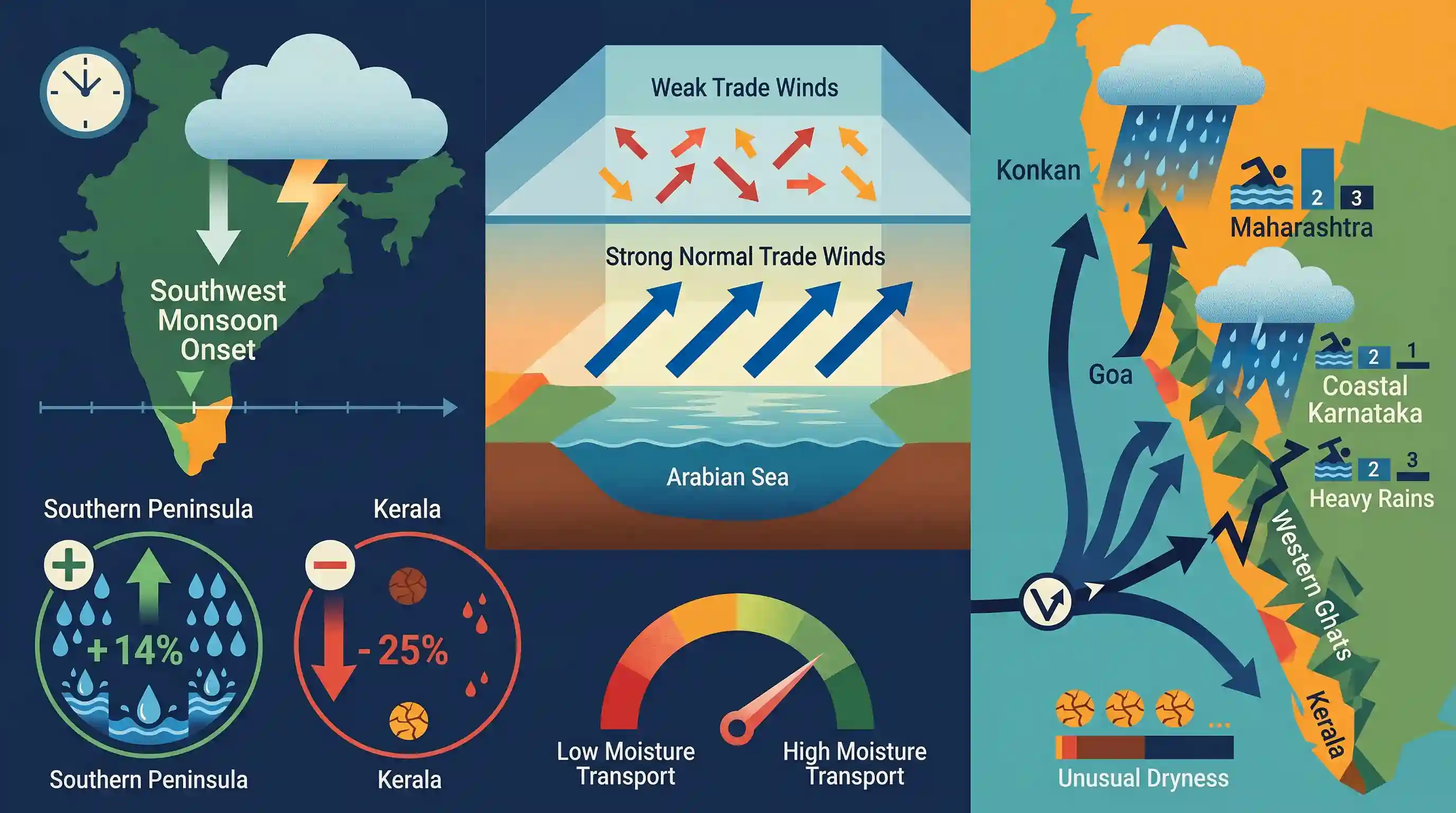
Despite an early onset, the southwest monsoon ended June with a 25% rainfall deficit in Kerala. This shortfall was caused by weak trade winds over the Arabian Sea and a skewed spatial distribution driven by an offshore trough extending from Maharashtra to the North Kerala coast. This trough diverted moisture, causing heavy rains in Konkan, Goa, and coastal Karnataka while leaving Kerala unusually dry. The situation highlights the complex local dynamics of the Indian monsoon, as the broader southern peninsula received 14% excess rainfall during the same period despite Kerala's deficit.
Key Points
- Despite an early arrival on May 30, the southwest monsoon ended June with a 25% rainfall deficit in Kerala.
- The deficit was largely driven by weak trade winds originating from the Arabian Sea, preventing adequate moisture transport to the state.
- An offshore trough extending from the Maharashtra coast to the North Kerala coast created a skewed spatial distribution, causing heavy rains in Konkan, Goa, and coastal Karnataka but leaving Kerala comparatively dry.
- In stark contrast, the southern peninsula as a whole recorded a 14% excess in June rainfall, underscoring significant regional disparities in the monsoon's performance.
Important Terms
Southwest Monsoon

A major rain-bearing system driven by seasonal wind reversal, providing the bulk of India's annual precipitation from June to September.
UPSC context
GS Paper I: Physical Geography of India; critical for understanding agricultural cycles and water resource management.
Offshore Trough
A shallow low-pressure area along India’s west coast that enhances localized rainfall during the monsoon by concentrating moisture and cloud formation.
UPSC context
GS Paper I: Climatology; tests knowledge of localized weather phenomena and monsoon mechanics.
Trade Winds
Tropical easterly winds that, after crossing the equator, are deflected by Coriolis force to become the moisture-rich southwest monsoon winds.
UPSC context
GS Paper I: World Physical Geography; focuses on global wind systems and their regional impacts.
India Meteorological Department (IMD)
The national agency under the Ministry of Earth Sciences responsible for meteorological observations, weather forecasting, and disaster warnings.
UPSC context
GS Paper III: Disaster Management; tests institutional frameworks for climate monitoring and hazard mitigation.
Long Period Average (LPA)
The 50-year average of rainfall used as a benchmark to classify seasonal precipitation as normal, deficient, or excess.
UPSC context
GS Paper III: Indian Economy and Agriculture; relevant for food security and drought planning.
Monsoon Onset
The formal arrival of monsoon in Kerala, declared by IMD based on rainfall at 14 stations, wind depth, and outgoing longwave radiation.
UPSC context
GS Paper I: Important Geophysical phenomena; tests precision in understanding atmospheric criteria.
Prelims Trap
An early onset of the Southwest monsoon guarantees surplus or normal rainfall for the season.
Early onset only indicates the timing of arrival. The actual quantum of rainfall depends on subsequent factors like offshore trough positioning, trade wind strength, and active/break cycles.
Static Concepts Connected
What is an offshore trough and how does it affect the Indian monsoon?
- Shallow Low Pressure: It is a shallow trough of low pressure that typically extends along the western coast of India during the southwest monsoon season.
- Moisture Concentration: It dictates spatial distribution by concentrating moisture, causing heavy orographic rainfall in areas where the trough is most active.
- Spatial Disparity: A skewed trough can cause intense rain in Konkan and coastal Karnataka while leaving southern regions like Kerala unusually dry despite an early monsoon onset.
What are the primary causes of 'breaks' in the Southwest Monsoon?
- Monsoon Trough Shift: The main monsoon trough shifts northward closer to the Himalayan foothills, drastically reducing rainfall across the central plains.
- Weak Offshore Trough: The weakening or temporary disappearance of the offshore trough along the Western Ghats suppresses moisture convergence and coastal rainfall.
- Reduced Depressions: A significant decline in the frequency of monsoon depressions forming over the Bay of Bengal reduces the inland penetration of moisture.
Cross-Topic Patterns
Monsoon Variability & Kharif Sowing
Spatial deficits in early monsoon months directly impact Kharif sowing cycles, forcing farmers to delay planting water-intensive crops like paddy, explicitly linking climatological phenomena to agricultural economics.
Orographic Rainfall & Western Ghats Ecology
Altered rainfall distribution along the western coast impacts the ecologically sensitive Western Ghats, affecting localized biodiversity and increasing landslide vulnerability in areas receiving sudden excess moisture.

Expect a 2026 prelims question testing the difference between temporal 'monsoon breaks' and spatial anomalies caused by offshore troughs.
Linked PYQs · 3
Linked PYQs · 3
- 2014PrelimsGS1
The seasonal reversal of winds is the typical characteristic of
- 2017PrelimsGS1
With reference to 'Indian Ocean Dipole (IOD)' sometimes mentioned in the news while forecasting Indian monsoon, which of the following statements is/are correct? 1. IOD phenomenon is characterised by a difference in sea surface temperature between tropical Western Indian Ocean and tropical Eastern Pacific Ocean. 2. An IOD phenomenon can influence an El Nino's impact on the monsoon. Select the correct answer using the code given below:
- 2023MainsGS1
Why is the South-West Monsoon called 'Purvaiya' (easterly) in Bhojpur Region? How has this directional seasonal wind system influenced the cultural ethos of the region?
