Urban Flooding Challenges Due to Waste Dumping
Source:Indian Express ↗
Why It Matters
Urban flooding has become an annual disaster in major Indian cities. Understanding the interplay between climate change, inadequate infrastructure, solid waste mismanagement, and lack of civic sense is crucial for the UPSC Mains examination across GS1 (Urbanization), GS2 (Local Governance), and GS3 (Disaster Management & Environment).
Summary
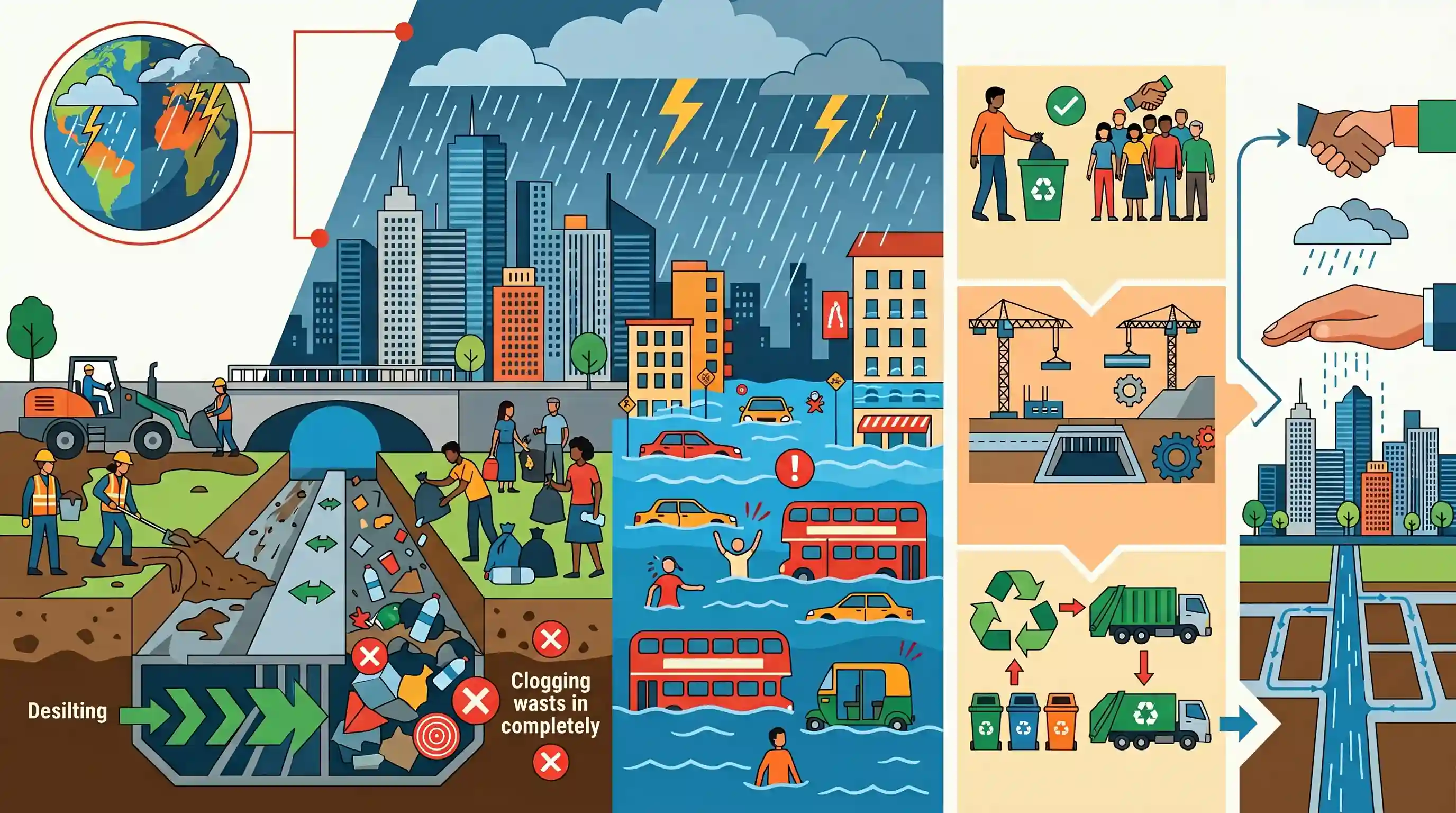
The article discusses the recurring challenge of urban flooding in cities like Mumbai, significantly worsened by erratic rainfall patterns linked to climate change. A major contributing factor to this disaster is the persistent dumping of garbage into stormwater drains by citizens, which negates the pre-monsoon desilting efforts undertaken by municipal authorities. This clogging leads to rapid waterlogging, paralyzing urban mobility and causing immense distress. The situation highlights the urgent need for a holistic approach to flood mitigation that combines robust solid waste management, infrastructure upgrades by local bodies, and heightened civic responsibility among urban residents.
Key Points
- Erratic rainfall driven by climate change has emerged as a major challenge for urban flood mitigation in Indian cities.
- Despite regular desilting efforts by municipal corporations, citizens continually dump garbage into stormwater drains, severely compromising their drainage capacity.
- The resulting clogging causes extensive waterlogging during monsoons, causing severe disruptions to city life, economy, and public health.
- The issue exposes a significant gap in civic sense and highlights the limitations of urban local bodies when infrastructure management is not supported by public cooperation.
- A sustainable solution necessitates strict enforcement of solid waste management protocols, upgrading drainage infrastructure, and promoting active citizen participation in urban governance.
Important Terms
Urban Flooding

A man-made disaster occurring when intense rainfall overwhelms drainage capacity in densely populated areas, often exacerbated by rapid urbanization and loss of wetlands.
UPSC context
GS 3 (Disaster Management) and GS 1 (Geography/Urbanization); evaluates planning failures and mitigation strategies.
Solid Waste Management Rules, 2016
Statutory guidelines mandating scientific waste disposal, source segregation into three categories, and user fees, superseding the 2000 rules to improve municipal cleanliness.
UPSC context
GS 3 (Environment) and GS 2 (Governance); critical for understanding pollution and operational flood prevention.
Urban Local Bodies (ULBs)
Constitutional entities established under the 74th Amendment (1992) responsible for urban planning, public health, and basic infrastructure like drainage and sanitation.
UPSC context
GS 2 (Polity/Governance); tests decentralization, municipal accountability, and implementation of local disaster plans.
Stormwater Drainage System
Infrastructure designed to carry excess rainfall and surface runoff from impervious urban surfaces to natural water bodies to prevent inundation.
UPSC context
GS 3 (Infrastructure); its poor design or maintenance is the primary physical driver of waterlogging.
Desilting
The technical process of removing accumulated silt, garbage, and debris from drains to restore their water-carrying capacity before the monsoon.
UPSC context
GS 3 (Disaster Management); an essential operational preparedness measure for flood-risk reduction.
Climate Change Adaptation
The process of adjusting urban systems and infrastructure to reduce vulnerability and build resilience against climate-induced shocks like erratic rainfall.
UPSC context
GS 3 (Environment/Disaster Management); focuses on future-proofing cities against non-stationary climate risks.
Prelims Trap
NDMA groups urban and rural flooding under a single comprehensive flood management framework.
NDMA actually treats urban flooding as a distinct disaster. Urban concretization alters catchment dynamics, increasing flood peaks up to 8 times, requiring separate mitigation strategies.
Static Concepts Connected
What distinguishes NDMA's approach to Urban Flooding from general flooding?
- Nodal Ministry: The Ministry of Housing and Urban Affairs (MoHUA) is the nodal ministry for urban flooding, whereas riverine floods fall under the Ministry of Jal Shakti.
- IDF Curves: Mandates updating legacy Intensity-Duration-Frequency (IDF) curves to account for short, high-intensity rainfall bursts induced by climate change.
- Catchment dynamics: Recognizes that urban catchments are heavily paved, meaning runoff occurs much faster, increasing flood peaks by 1.8 to 8 times compared to rural areas.
What are the core mechanisms of the 'Sponge City' model for urban areas?
- Permeable surfaces: Replacing impervious concrete with porous materials like permeable pavements and porous asphalt to facilitate natural groundwater recharge.
- Green infrastructure: Deploying rain gardens, bioswales, and urban wetlands to naturally absorb, filter, and slow down stormwater runoff.
Cross-Topic Patterns
SWM Rules + Climate-induced Urban Flooding
Poor civic compliance with Solid Waste Management Rules directly paralyzes drainage infrastructure, acting as a severe anthropogenic multiplier to climate-driven high-intensity rainfall.
74th Amendment + Fragmented Disaster Response
Disjointed coordination between municipal solid waste and stormwater departments exposes governance gaps, testing the efficacy of the 74th Constitutional Amendment Act.

Expect a prelims statement swapping nodal ministries (Jal Shakti vs MoHUA) for riverine vs urban floods alongside Sponge City concepts.
Linked PYQs · 4
Linked PYQs · 4
- 2024MainsGS3
Flooding in urban areas is an emerging climate-induced disaster. Discuss the causes of this disaster. Mention the features of two such major floods in the last two decades in India. Describe the policies and frameworks in India that aim at tackling such floods.
- 2020MainsGS1
Account for the huge flooding of million cities in India including the smart ones like Hyderabad and Pune. Suggest lasting remedial measures.
- 2018MainsGS3
What are the impediments in disposing the huge quantities of discarded solid wastes which are continuously being generated? How do we remove safely the toxic wastes that have been accumulating in our habitable environment?
- 2024MainsGS2
Analyse the role of local bodies in providing good governance at local level and bring out the pros and cons merging the rural local bodies with the urban local bodies.
