Defeat of Constitution Amendment Bill Linking Delimitation and Quota
Source:The Hindu ↗
Why It Matters
The defeat of the 131st Amendment Bill is a critical case study for UPSC aspirants on the interplay between Article 368 (Constitutional Amendments), federalism, and delimitation. It highlights the demographic fault lines in India's federal structure, where southern states fear political marginalization due to their successful population control, contrasting with the population growth in northern states. This incident is highly relevant for GS Paper II questions on federal challenges, parliamentary functioning, and women's representation.
Summary
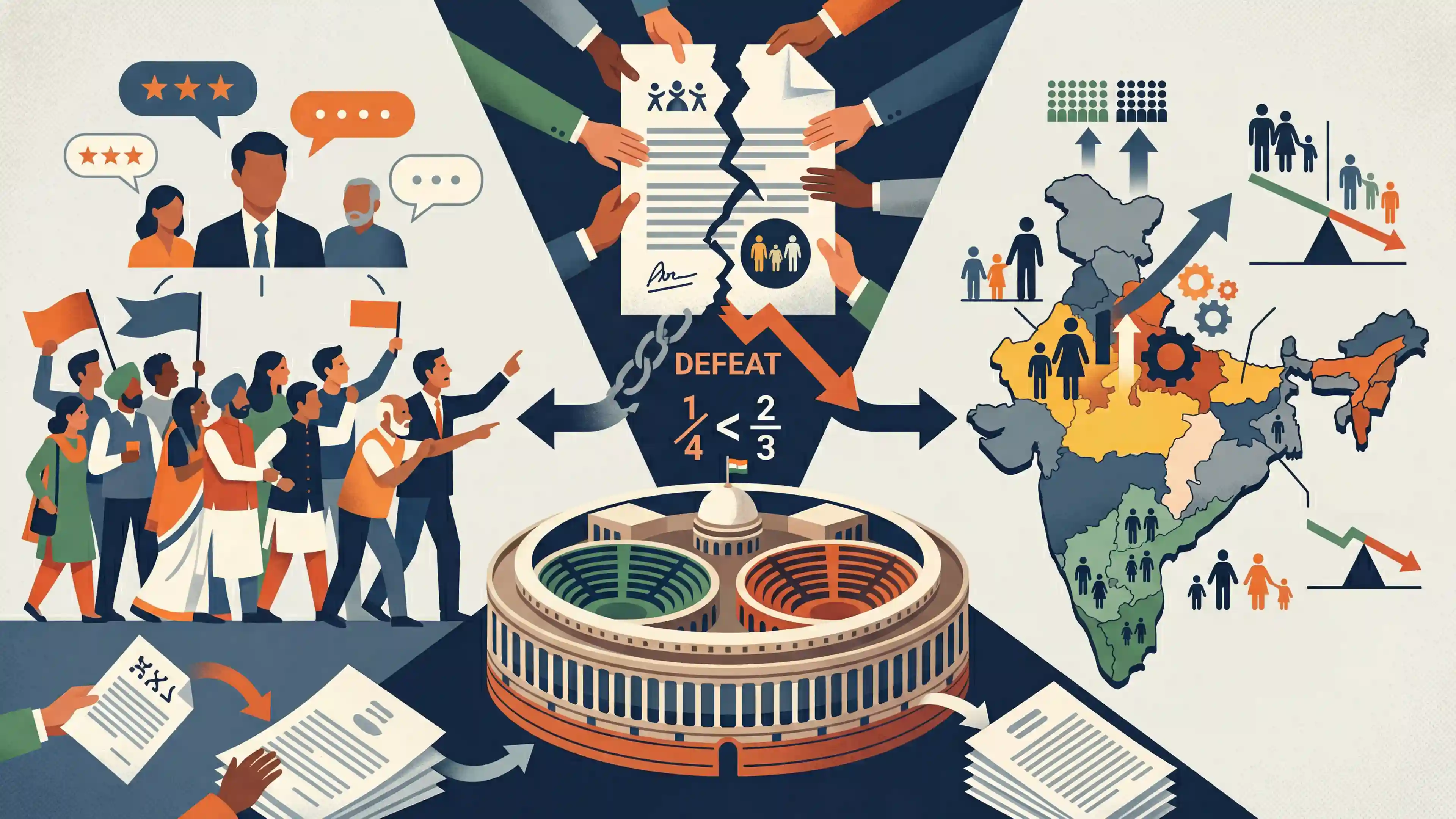
The editorial analyses the defeat of the Constitution (131st Amendment) Bill, 2026, which failed to achieve the requisite two-thirds majority in Parliament. The legislation sought to tie the implementation of women's reservation to a fresh delimitation process based on the 2011 Census. This linkage provoked strong opposition, particularly from the INDIA bloc, as it would have disproportionately benefited the demographically expanding Hindi heartland while penalizing southern, eastern, and northeastern states for their successful population control measures by reducing their relative Lok Sabha representation. The government's failure to provide statutory guarantees—offering only verbal assurances of expanded seat allocations—led to the bill's collapse and the subsequent withdrawal of related delimitation bills, highlighting the deep federal anxieties surrounding demographic representation.
Key Points
- The Constitution (131st Amendment) Bill, 2026, was defeated in Parliament because it failed to secure the necessary two-thirds majority required for constitutional amendments.
- The bill controversially linked the implementation of women's legislative reservation to a new delimitation exercise based on the 2011 Census.
- The proposed delimitation threatened to reduce the proportional representation of southern, eastern, and northeastern states in the Lok Sabha, effectively penalizing them for their historical success in population control compared to Hindi heartland states.
- Despite verbal assurances from the Union Home Minister that southern states' seat shares would be protected in an expanded 816-member Lok Sabha, the opposition INDIA bloc rejected the proposal.
- Consequently, the government was forced to shelve companion legislation, including the Delimitation Bill and the Union Territories Laws (Amendment) Bill.
Important Terms
Constitution (131st Amendment) Bill, 2026

A 2026 legislative proposal linking women’s reservation to fresh delimitation based on the 2011 Census and expanding Lok Sabha seats to 850.
UPSC context
GS Paper II: Indian Constitution—Amendments. Tests understanding of legislative linkages between gender quotas, census data, and seat reallocation.
Delimitation
The process of redrawing boundaries of territorial constituencies for Lok Sabha and State Assemblies to ensure population-proportionate representation, governed by Articles 82 and 170.
UPSC context
GS Paper II: Parliament and State Legislatures. Tests knowledge of electoral geography, representation principles, and the role of the Delimitation Commission.
Article 368
The constitutional provision outlining Parliament's power and the specific procedures, including special majorities, required to amend any part of the Indian Constitution.
UPSC context
GS Paper II: Significant provisions and basic structure. Vital for understanding the balance between constitutional rigidity and flexibility.
Special Majority
A voting requirement under Article 368 necessitating a majority of the total membership of each House and two-thirds of those present and voting.
UPSC context
GS Paper II: Conduct of business. Tests technical knowledge of parliamentary voting procedures for constitutional vs. ordinary bills.
Federal Structure
The principle of power-sharing between Centre and States, currently challenged by demographic disparities where southern states fear political marginalization due to lower population growth.
UPSC context
GS Paper II: Issues and challenges pertaining to the federal structure. Tests ability to analyze inter-state equity and cooperative federalism.
Prelims Trap
The total number of Lok Sabha seats allocated to each state is currently frozen based on the 2001 Census data.
The total number of seats is frozen based on the 1971 Census. The 2001 Census was only used to readjust territorial constituency boundaries without altering total seats.
Static Concepts Connected
How is the delimitation of Lok Sabha constituencies constitutionally governed?
- Article 82: Mandates Parliament to enact a Delimitation Act after every Census to readjust Lok Sabha seats and territorial boundaries.
- 1971 Census freeze: The 42nd Amendment (1976) froze the total number of Lok Sabha seats based on 1971 data to encourage population stabilization.
- 84th Amendment (2001): Extended the freeze on the total number of Lok Sabha seats until the publication of the first Census taken after the year 2026.
What is the procedure for amending federal provisions under Article 368?
- Special Majority: Requires a majority of the total membership and two-thirds of members present and voting in each House of Parliament.
- State Ratification: Amendments altering state representation in Parliament (like delimitation) must be ratified by the legislatures of at least one-half of the states.
Cross-Topic Patterns
Demographic penalty vs. Federalism
Southern states face a 'demographic penalty'—losing relative political influence in Parliament as a consequence of successfully implementing the Centre's population stabilization policies compared to the Hindi heartland.
Women's Quota and Delimitation
The 106th Amendment (2023) tied 33% women's reservation to the next delimitation exercise, entangling a major gender justice reform with deep-seated federal and demographic anxieties.

Post-2026 delimitation, the demographic penalty on southern states, and women's reservation is a highly probable 2026 Mains question.
Linked PYQs · 3
Linked PYQs · 3
- 2024PrelimsGS1
As per Article 368 of the Constitution of India, the Parliament may amend any provision of the Constitution by way of : 1. Addition 2. Variation 3. Repeal Select the correct answer using the code given below:
- 2022PrelimsGS1
Consider the following statements: 1. A bill amending the Constitution requires a prior recommendation of the President of India. 2. When a Constitution Amendment Bill is presented to the President of India, it is obligatory for the President of India to give his/her assent. 3. A Constitution Amendment Bill must be passed by both the Lok Sabha and the Rajya Sabha by a special majority and there is no provision for joint sitting. Which of the statements given above are correct?
- 2023MainsGS2
Discuss the contribution of civil society groups for women's effective and meaningful participation and representation in state legislatures in India.
