Constitutional Amendment Bill Defeat and Delimitation Concerns
Source:The Hindu ↗
Why It Matters
The defeat of a constitutional amendment bill is a rare procedural event. It brings to the forefront a critical debate in Indian federalism: balancing representation based on population size with the necessity of preserving the political weight of states that have successfully stabilized population growth. Understanding Article 368 procedures, delimitation implications, and the role of demographic disparities is highly relevant for GS-2.
Summary
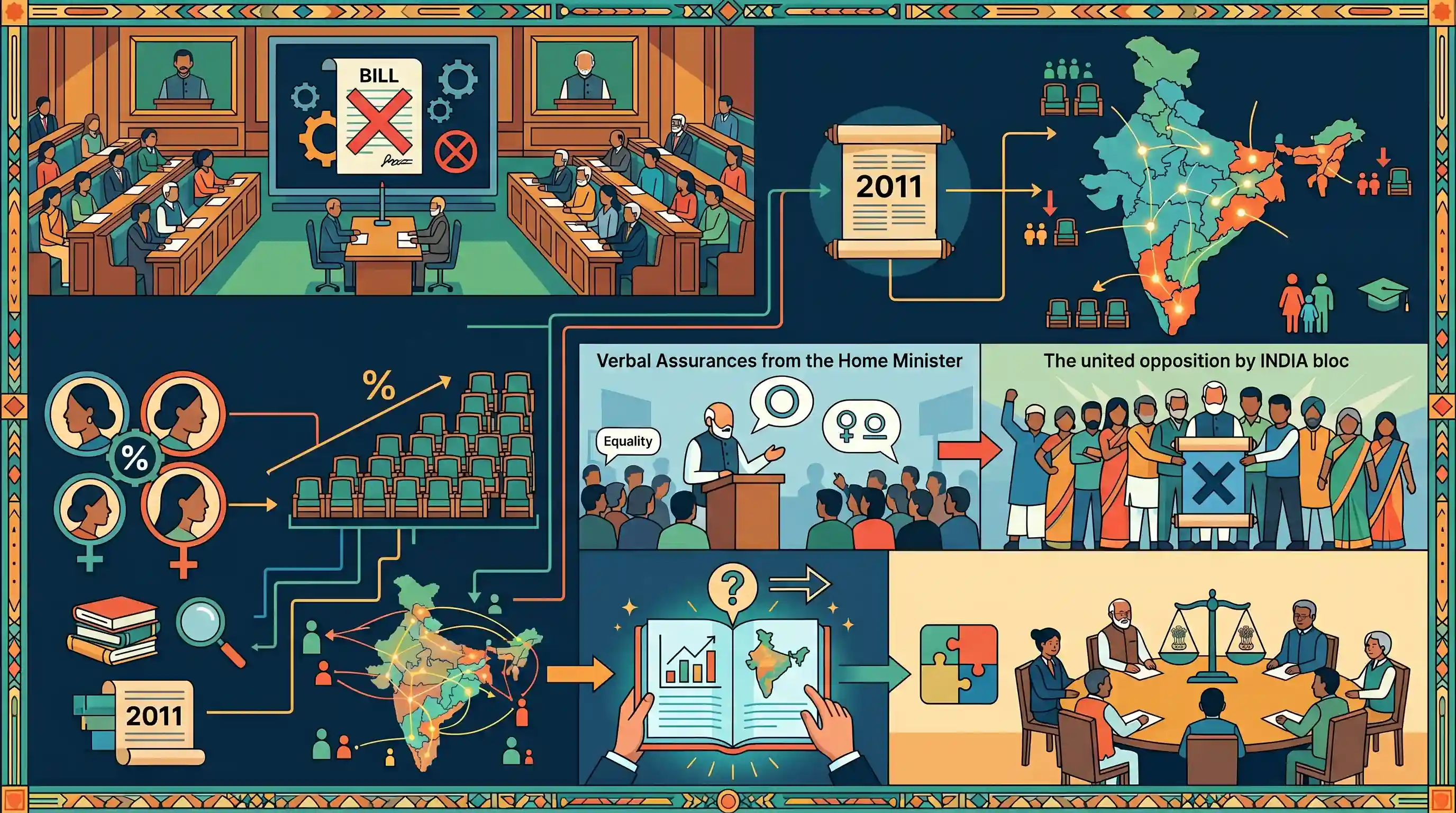
The Constitution (131st Amendment) Bill, 2026, aimed at facilitating the expansion of the Lok Sabha and linking it to women's reservation, was defeated after failing to secure a two-thirds majority in Parliament. The editorial supports this outcome, critiquing the government's approach of basing future delimitation on the 2011 Census. This mandate threatened to undermine the political representation of southern, eastern, and northeastern states, effectively penalizing them for successful demographic management. Despite verbal assurances from the Home Minister regarding proportional parity in an expanded 816-member Lok Sabha, a united opposition by the INDIA bloc resulted in the Bill's failure. The editorial advises the government to await the upcoming 2026-27 Census data and refer the interconnected issues of delimitation and women's reservation to a parliamentary committee to forge a genuine federal consensus.
Key Points
- The Constitution (131st Amendment) Bill, 2026 failed to secure the required two-thirds majority in Parliament, receiving 298 votes against the 352 needed.
- The Bill sought to link the implementation of women's reservation to a delimitation exercise based on the 2011 Census.
- Basing delimitation on the 2011 Census threatened to reduce the proportional representation of southern, eastern, and northeastern states, penalizing them for effective population control.
- Companion bills, the Delimitation Bill and Union Territories Laws (Amendment) Bill, were shelved following the constitutional amendment's defeat.
- The Home Minister offered verbal guarantees to maintain proportionate representation for southern states in a proposed 816-member Lok Sabha, which failed to reassure the opposition INDIA bloc.
- The editorial suggests that delimitation and women's reservation should be deferred until the 2026-27 Census is completed, alongside achieving broader political consensus.
Important Terms
Constitution (131st Amendment) Bill, 2026

A legislative proposal to expand the Lok Sabha to a maximum of 850 seats and operationalize women’s reservation by using the 2011 Census for seat delimitation.
UPSC context
GS II: Constitutional Amendments. Tests understanding of parliamentary procedures and the intersection of demography and representation.
Delimitation
The process of redrawing boundaries for Lok Sabha and Assembly constituencies to reflect population changes, ensuring the principle of 'one person, one vote' across territorial units.
UPSC context
GS II: Elections. Relevant for federalism debates and the impact of demographic shifts on representational democracy.
Article 368
The constitutional provision outlining Parliament's power to amend the Constitution, requiring a 'special majority' (two-thirds present and voting) for structural changes.
UPSC context
GS II: Indian Constitution. Key for understanding checks and balances that prevent unilateral structural changes by the executive.
Nari Shakti Vandan Adhiniyam
The 106th Constitutional Amendment Act, 2023, which reserves 33% of seats for women in legislatures, initially contingent upon a post-census delimitation exercise.
UPSC context
GS II: Social Justice/Governance. Vital for discussing political empowerment and the legislative hurdles in implementing gender quotas.
Delimitation Commission
An independent, high-powered body appointed by the President to redraw constituency boundaries; its orders carry the force of law and are non-justiciable.
UPSC context
GS II: Statutory Bodies. Tests knowledge of the mechanisms used to ensure impartial and data-driven electoral boundary adjustments.
Cooperative Federalism
A collaborative governance model where the Union and States jointly resolve issues, ensuring regional interests are respected in national policy-making and representation.
UPSC context
GS II: Federalism. Important for analyzing regional parity and the political fallout of population-based seat allocation.
Prelims Trap
"Amendments altering state representation in Parliament require only a special majority."
Under Article 368(2)(d), any amendment modifying state representation in Parliament (like altering Lok Sabha seat allocations) also requires ratification by at least half of the state legislatures.
Static Concepts Connected
What are the constitutional mechanisms governing the Delimitation exercise?
- Article 82: Mandates Parliament to enact a Delimitation Act after every Census to readjust Lok Sabha constituencies and uphold "one person, one vote".
- 84th Amendment (2001): Extended the freeze on inter-state Lok Sabha seat allocation (based on 1971 data) until the first census post-2026 to encourage population control.
- Article 329(a): Grants judicial immunity, barring Delimitation Commission orders relating to constituency boundaries or seat allotments from being challenged in any court.
When is State Ratification required for Constitutional Amendments?
- Federal Provisions: Required for changing federal structures, including state representation in Parliament, 7th Schedule lists, Article 368 itself, or Supreme/High Court provisions.
- Ratification Threshold: Along with a special majority in Parliament, the amendment requires consent via a simple majority from at least half of the state legislatures.
Cross-Topic Patterns
Demography vs Fiscal & Political Federalism
The South's penalty in delimitation mirrors debates from the 15th Finance Commission, where Southern states heavily protested the use of 2011 Census population data for horizontal tax devolution.
Women's Quota tied to Delimitation
The 106th Amendment (Nari Shakti Vandan Adhiniyam) explicitly conditioned the implementation of the 33% women's reservation in the Lok Sabha on the completion of the subsequent delimitation exercise.

Expect a 2026 Mains question on the North-South demographic divide's impact on federalism, and Prelims statements mixing Art 82 & 329(a).
Linked PYQs · 3
Linked PYQs · 3
- 2019MainsGS2
“Parliament's power to amend the Constitution is a limited power and it cannot be enlarged into absolute power." In the light of this statement explain whether Parliament under Article 368 of the Constitution can destroy the Basic Structure of the Constitution by expanding its amending power?
- 2025MainsGS2
Indian Constitution has conferred the amending power on the ordinary legislative institutions with a few procedural hurdles. In view of this statement, examine the procedural and substantive limitations on the amending power of the Parliament to change the Constitution.
- 2023MainsGS2
Discuss the contribution of civil society groups for women's effective and meaningful participation and representation in state legislatures in India.
