SEBI Study Reports First Decline in Derivatives Traders in Four Years
Source:The Hindu ↗
આ શા માટે મહત્વનું છે
The surge of retail participation in highly speculative financial derivatives (like Futures and Options) poses systemic risks to household savings. SEBI's interventions illustrate the critical role of market regulators in safeguarding investor interests while managing capital market stability, a core theme in the GS-3 Economy syllabus.
સારાંશ
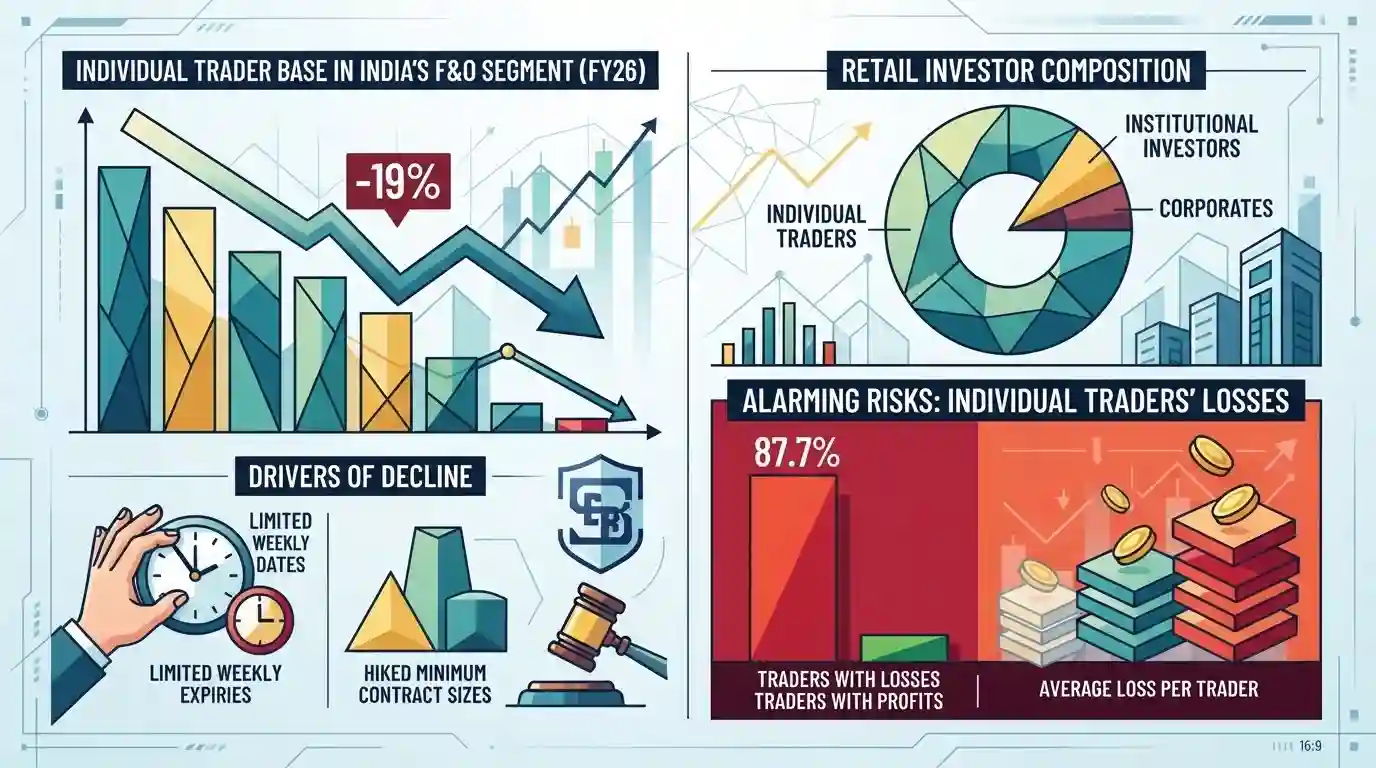
A recent SEBI study revealed that the individual trader base in India's equity derivatives (Futures and Options) segment fell by 19% in FY26, the first such decline in four years. This drop is largely attributed to SEBI's stringent regulatory measures, such as limiting weekly index expiries and hiking minimum contract sizes, aimed at curbing excessive speculation. However, retail investors still form the bulk of the market. The study highlighted alarming risks, noting that nearly 87.7% of individual traders suffered losses, with the average loss per trader increasing compared to previous years.
મુખ્ય મુદ્દા
- The number of individual traders in the equity derivatives segment (Futures and Options) fell by 19% in FY26, marking the first decline in four years.
- Despite the decline in the overall participant base, retail traders continue to constitute the largest cohort in the derivatives market.
- SEBI introduced several regulatory measures to curb speculative trading, including restricting weekly index expiries to one per exchange and raising the minimum contract value to ₹15-₹20 lakh.
- A significant 87.7% of individual traders in the F&O segment incurred net losses during the financial year, with the average loss per trader increasing despite a drop in total aggregate losses.
- The data underscores a persistent trend of retail wealth destruction in high-risk derivative trading, prompting ongoing regulatory intervention.
મહત્વપૂર્ણ શબ્દો
Securities and Exchange Board of India (SEBI)

The statutory regulator established under the SEBI Act, 1992, to protect investors, develop, and regulate India’s securities and capital markets.
UPSC context
GS Paper III (Regulatory Bodies); tests capital market reforms, investor protection, and financial stability.
Derivatives
Financial contracts whose value is derived from an underlying asset like stocks, commodities, currencies, or indices, used for risk hedging or speculation.
UPSC context
GS Paper III (Indian Economy); tests financial market instruments, systemic risks, and regulatory frameworks.
Futures and Options (F&O)
The two main types of equity derivatives where Futures bind parties to trade at a set future date/price, while Options grant the right without obligation.
UPSC context
GS Paper III (Capital Market); tests high-risk speculation, retail participation trends, and regulatory mitigation.
Capital Market
A financial market where long-term debt and equity securities, such as stocks and bonds, are issued, bought, and sold to raise funds.
UPSC context
GS Paper III (Mobilization of Resources); tests knowledge of investment channels and difference from short-term money markets.
Retail Investors
Individual, non-institutional investors who trade securities or mutual funds in smaller quantities, usually through personal brokerage accounts.
UPSC context
GS Paper III (Indian Economy); tests financial inclusion, market democratization, and regulatory safety nets.
પ્રિલિમ્સ ટ્રેપ
Short-term weekly index options are classified as money market instruments and regulated by the Reserve Bank of India.
Equity derivatives, regardless of their short weekly expiry cycles, are capital market instruments under SEBI's purview, not RBI money market instruments.
સંલગ્ન સ્થિર ખ્યાલો
How do Capital Markets differ from Money Markets in India?
- Maturity Profile: Money markets deal with short-term debt (maturity under one year); capital markets manage long-term equity and debt financing.
- Regulatory Ambit: The Reserve Bank of India (RBI) regulates money markets; the Securities and Exchange Board of India (SEBI) regulates capital markets.
What are financial derivatives and their primary types?
- Core Definition: Financial contracts whose value is derived from underlying assets like equities, commodities, currencies, or indices.
- Futures vs Options: Futures bind both parties to execute at a set price/date; Options give the buyer the right, but not the obligation, to trade.
આંતર-વિષય પેટર્ન
Household savings vs capital formation
The shift of retail savings from bank deposits to speculative F&O risks stalling productive capital formation in the real economy.
Retail Direct Scheme vs F&O spec
Despite RBI efforts to democratize risk-free sovereign debt via Retail Direct, retail investment remains heavily skewed toward speculative capital market derivatives.

Conceptual questions contrasting SEBI vs RBI regulatory ambits and the classification of derivatives as capital market instruments.
સંલગ્ન PYQ · 3
સંલગ્ન PYQ · 3
- 2023PrelimsGS1
Consider the following markets: 1. Government Bond Market 2. Call Money Market 3. Treasury Bill Market 4. Stock Market How many of the above are included in capital markets?
- 2024PrelimsGS1
With reference to the Indian economy, "Collateral Borrowing and Lending Obligations" are the instruments of:
- 2021PrelimsGS1
With reference to India, consider the following statements : 1. Retail investors through demat account can invest in 'Treasury Bills' and 'Government of India Debt Bonds' in primary market. 2. The 'Negotiated Dealing System- Order Matching' is a government securities trading platform of the Reserve Bank of India. 3. The 'Central Depository Services Ltd.' is jointly promoted by the Reserve Bank of India and the Bombay Stock Exchange. Which of the statements given above is/are correct?
