MeToo Movement Implementation Gaps in POSH Act and Workplace Ethics
Source:Indian Express ↗
Why It Matters
The effectiveness of laws like the POSH Act and the societal impact of movements like #MeToo are critical for analyzing the persistent gap between legislative intent and social reality. This highlights the intersection of patriarchy, legal frameworks, and institutional ethics, which is highly relevant for GS1 (Society), GS2 (Social Justice), and GS4 (Ethics).
Summary
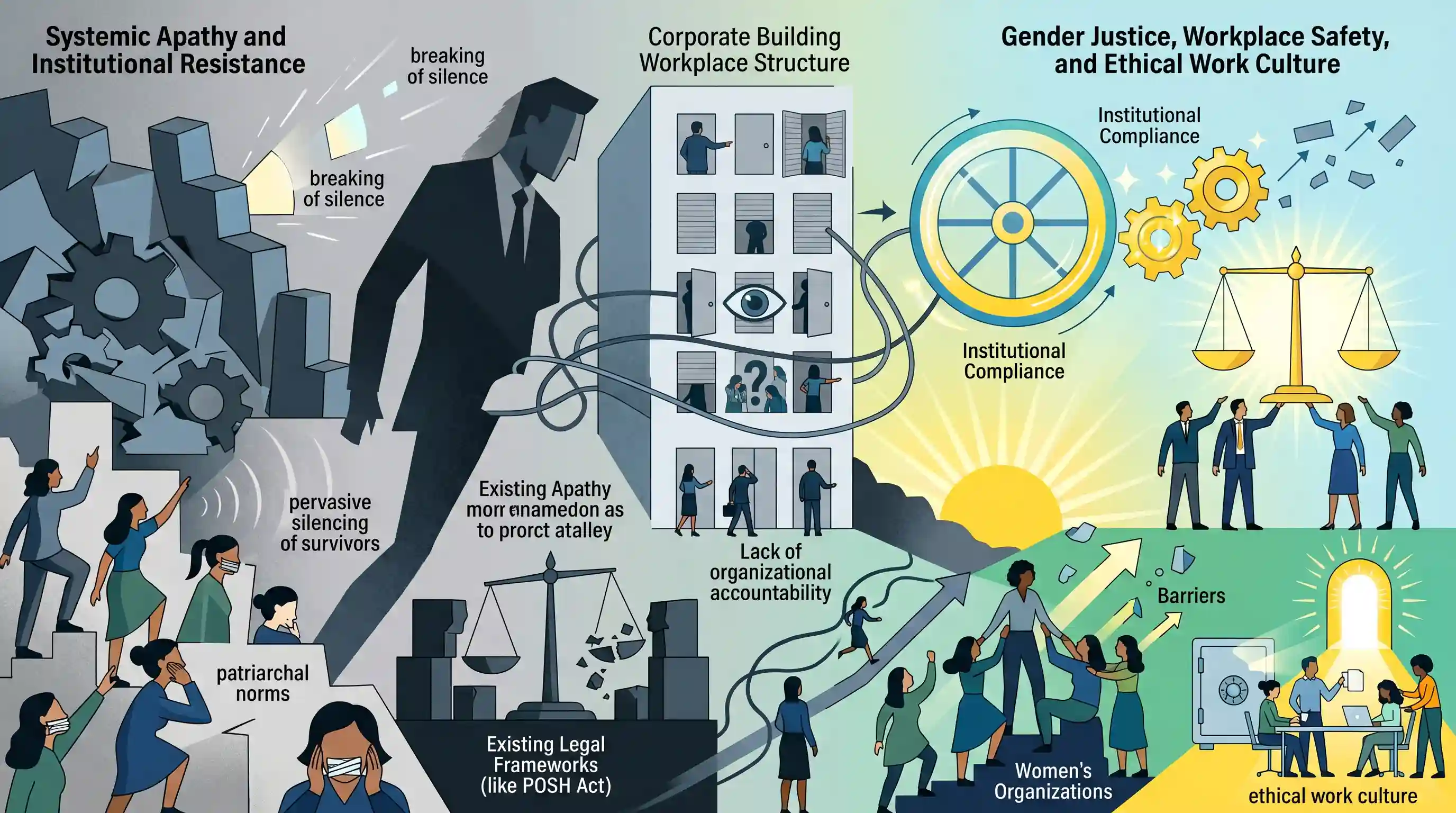
Derek O’Brien reflects on the trajectory of the #MeToo movement, highlighting how the brief breaking of silence around sexual harassment has been overshadowed by returning systemic apathy and institutional resistance. Despite existing legal frameworks like the POSH Act, women continue to face significant barriers in seeking justice due to deeply entrenched patriarchal norms, lack of organizational accountability, and the pervasive silencing of survivors. The article underscores the urgent need for a fundamental shift in societal attitudes, alongside stronger institutional compliance, to ensure genuine gender justice, workplace safety, and an ethical work culture.
Key Points
- The #MeToo movement temporarily shattered the silence around sexual harassment, but systemic apathy has led to its resurgence.
- Despite the legal mandate of the Prevention of Sexual Harassment (POSH) Act, 2013, enforcement remains weak and institutional reporting mechanisms are often ineffective.
- Entrenched patriarchy continues to influence workplace dynamics, discouraging survivors from speaking out and restricting the equitable participation of women.
- There is a pressing ethical mandate for organizations to foster a compliance-based, value-driven work culture that prioritizes women's safety.
- Achieving lasting gender justice requires sustained structural reforms and a shift in societal attitudes, moving beyond brief moments of collective outrage.
Important Terms
Prevention of Sexual Harassment (POSH) Act, 2013

A 2013 law providing a legal framework to protect women from workplace sexual harassment, mandating prevention, prohibition, and redressal mechanisms across organized and unorganized sectors.
UPSC context
GS Paper II: Social Justice/Laws for Vulnerable Sections. Essential for questions on women's safety, workplace ethics, and legislative protection.
Vishakha Guidelines
1997 Supreme Court guidelines (Vishakha v. State of Rajasthan) that first defined sexual harassment and mandated workplace safety protocols, serving as the precursor to the POSH Act.
UPSC context
GS Paper II: Judiciary/Social Justice. Tests knowledge of judicial activism and the evolution of women's rights in India.
Internal Complaints Committee (ICC)
A mandatory internal body required by the POSH Act in organizations with 10 or more employees to receive and inquire into sexual harassment complaints.
UPSC context
GS Paper II: Governance/Social Justice. Tests understanding of institutional mechanisms for grievance redressal and corporate accountability.
Local Complaints Committee (LCC)
A district-level body constituted by the District Officer to address sexual harassment complaints from the unorganized sector or establishments with fewer than 10 employees.
UPSC context
GS Paper II: Social Justice. Crucial for discussing protection for the informal workforce and decentralized justice mechanisms.
Gender Justice
The fair and equitable treatment of all genders in social, political, and legal spheres, ensuring equal access to resources, opportunities, and decision-making.
UPSC context
GS Paper I: Society/Women's Issues; GS Paper II: Social Justice. A core theme for essays and social empowerment topics.
Social Empowerment
The process of increasing the autonomy, self-determination, and access to resources for marginalized groups (like women) to ensure their full participation in society.
UPSC context
GS Paper I: Social Empowerment. Tests theoretical and practical understanding of uplifting vulnerable sections of society.
Substantive Equality
A concept focusing on achieving equal outcomes and addressing structural disadvantages rather than just providing formal legal equality (equal treatment).
UPSC context
GS Paper II: Social Justice/Constitution. Tests deep understanding of Article 14-15 and affirmative action for marginalized groups.
Prelims Trap
The POSH Act 2013 applies exclusively to women employed in the formal or organized sector.
The POSH Act explicitly includes the unorganized sector. District Officers must constitute Local Committees (LCs) to receive complaints from women in informal employment or firms with under 10 employees.
Static Concepts Connected
What is the grievance redressal structure under the POSH Act 2013?
- Internal Committee (IC): Mandatory for all workplaces with 10 or more employees. It must be headed by a senior female employee and include an external member.
- Local Committee (LC): Set up at the district level by a designated District Officer to handle complaints from the unorganized sector or firms with fewer than 10 employees.
- Civil Court Powers: Both ICs and LCs possess the powers of a civil court under the Code of Civil Procedure for summoning individuals and requiring document discovery.
What is the difference between legal and ethical compliance in corporate governance regarding POSH?
- Legal Compliance: Focuses on the minimum statutory requirement, such as merely forming an IC on paper and filing annual reports, often leading to systemic apathy.
- Ethical Mandate: Focuses on fostering psychological safety, actively dismantling patriarchal norms, ensuring non-retaliation, and establishing a value-driven work culture.
Cross-Topic Patterns
FLFPR and Workplace Safety
India's urban female labor force participation is constrained by safety concerns. Ineffective POSH enforcement directly undercuts economic empowerment initiatives and demographic dividend goals.
Digital Solidarity and Corporate Accountability
Movements like #MeToo act as modern digital social capital. They bypass traditional institutional hierarchies, forcing corporate governance structures to address ethical blind spots.

Expect a GS II mains question linking the poor enforcement of the POSH Act to the stagnation of India's urban Female Labour Force.
Linked PYQs · 5
Linked PYQs · 5
- 2014MainsGS1
How does patriarchy impact the position of a middle class working woman in India?
- 2023MainsGS2
Explain the constitutional perspectives of Gender Justice with the help of relevant Constitutional Provisions and case laws.
- 2025MainsGS2
Women's social capital complements in advancing empowerment and gender equity. Explain.
- 2024MainsGS4
In Indian culture and value system, an equal opportunity has been provided irrespective of gender identity. The number of women in public service has been steadily increasing over the years. Examine the gender-specific challenges faced by female public servants and suggest suitable measures to increase their efficiency in discharging their duties and maintaining high standards of probity.
- 2025MainsGS4
It is said that for an ethical work culture, there must be code of ethics in place in every organisation. To ensure value-based and compliance-based work culture, what suitable measures would you adopt in your work place?
