Public Sector Vacancies: Governance Challenges and Job Shortfalls
Source:Indian Express ↗
Why It Matters
Public sector employment is a critical area for UPSC aspirants, linking governance (GS2) with economic challenges like unemployment, informalization of labor, and the demographic dividend (GS3). Understanding the impact of vacancies on state capacity and service delivery is essential for both Mains answers and essay arguments.
Summary
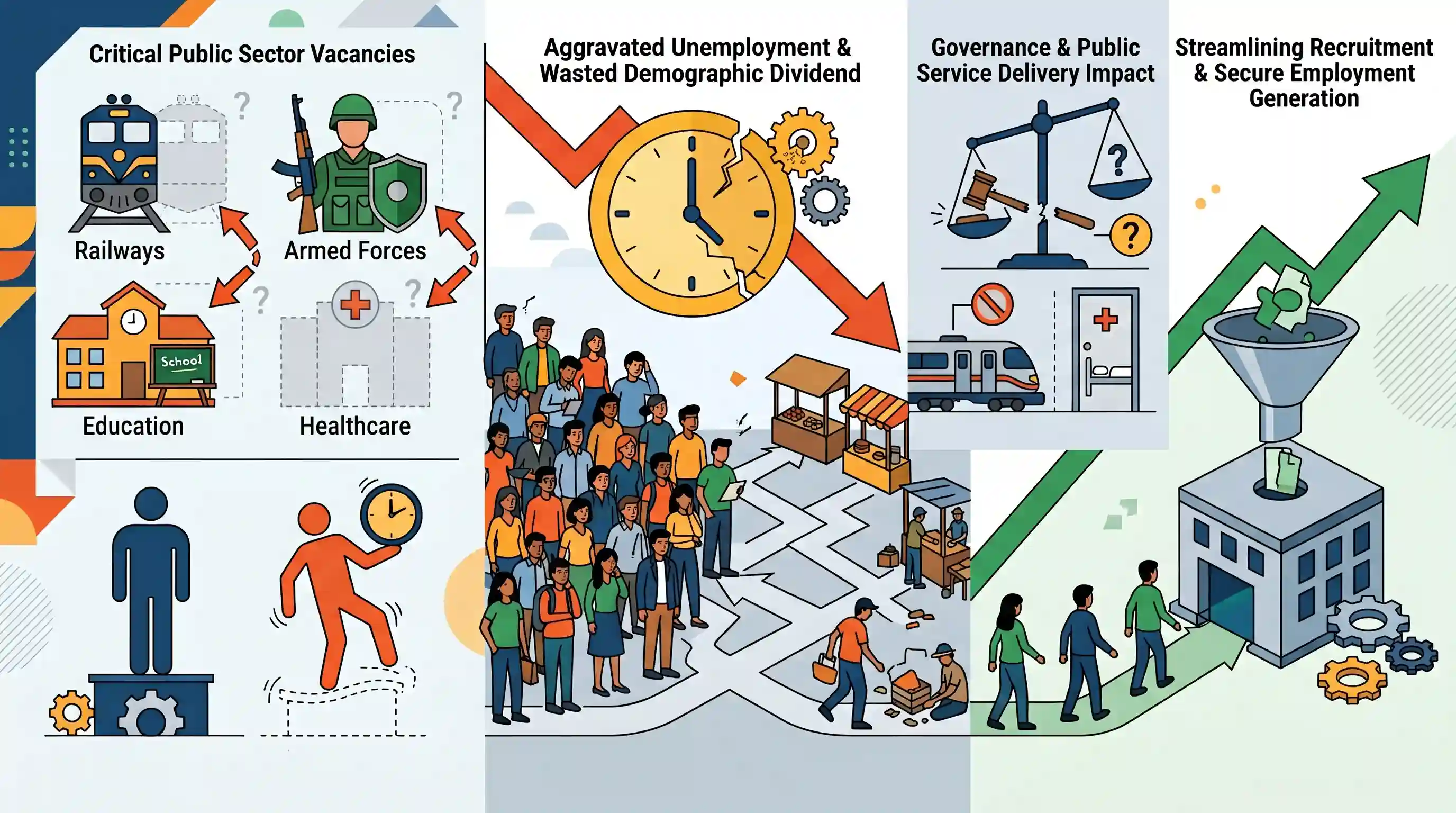
Derek O’Brien’s article highlights the alarming extent of public sector vacancies across critical Indian departments like the Railways, Armed Forces, education, and healthcare. This massive shortfall not only compromises governance, public safety, and service delivery but also aggravates the country's broader unemployment crisis. Furthermore, the increasing trend of replacing permanent roles with contractual positions is eroding job security and formal employment opportunities for the youth. The author warns that failing to fill these vacancies in a timely manner squanders India's demographic dividend, urging the government to streamline its recruitment processes and commit to robust, secure employment generation in the public sector.
Key Points
- There is an alarming number of unfilled vacancies in crucial public sector domains, including Railways, defense, education, and healthcare.
- Prolonged vacancies severely hamper governance, public safety, and the effective delivery of essential services.
- The government's increasing reliance on contractual labor over permanent hiring undermines job security and the quality of formal employment.
- India's demographic dividend risks turning into a demographic disaster if adequate formal public sector jobs are not generated to absorb the youth.
- A systemic overhaul of recruitment agencies and timely, transparent hiring processes are essential to address the public employment crisis.
Important Terms
Demographic Dividend

Economic growth potential resulting from shifts in population age structure, specifically when the working-age population (15-64) exceeds the non-working-age population.
UPSC context
GS Paper 1 (Population) and GS Paper 3 (Economy); tests understanding of India's youth-led growth potential and associated developmental challenges.
Public Sector Undertakings (PSUs)
Government-owned corporations where the Central or State government holds at least 51% shareholding, operating in strategic and non-strategic sectors.
UPSC context
GS Paper 3 (Indian Economy); focuses on the state's role in industrialization, resource mobilization, and employment generation.
Formal Sector
Economic activities registered with the government that provide regular wages, fixed working hours, and social security benefits like pensions and insurance.
UPSC context
GS Paper 3 (Employment/Labor); crucial for analyzing labor market formalization, worker rights, and social safety nets.
Indian Railways
A departmental undertaking of the Government of India that serves as the country's primary transport lifeline and one of its largest public-sector employers.
UPSC context
GS Paper 3 (Infrastructure/Employment); significant for evaluating public service delivery, national integration, and large-scale recruitment trends.
Contractual Employment
Employment for a specific duration or project without an indefinite period, typically offering fewer social security benefits and lower job security than permanent roles.
UPSC context
GS Paper 3 (Labor Reforms); relevant to discussions on the 'casualization of labor' and its impact on long-term workforce stability.
Prelims Trap
Informalization of the Indian workforce is exclusively driven by private, unorganized sectors and MSMEs.
The public sector itself is heavily informalizing. The proportion of contractual employees in Central Public Sector Enterprises (CPSEs) has surged to over 46%.
Static Concepts Connected
What are the core characteristics of formal sector employment in India?
- Social Security: Employees receive mandated benefits like the Employees' Provident Fund (EPF), health insurance (ESIC), and maternity leave.
- Legal Protection: Workers are protected by strict labor laws governing working hours, minimum wages, and retrenchment procedures.
- Enterprise Scale: Typically comprises organized public sector undertakings or private establishments employing 10 or more workers.
What factors turn a 'demographic dividend' into a 'demographic disaster'?
- Jobless Growth: Economic expansion that fails to create sufficient formal, secure jobs to absorb the growing working-age population.
- Skill Deficit: A severe mismatch between the theoretical education provided to the youth and the specialized skills demanded by industries.
- Informalization: Pushing educated youth into low-paying, insecure contractual work, leading to massive underemployment, frustration, and potential social unrest.
Cross-Topic Patterns
Contractualization & Fundamental Rights
The surge in CPSE contractual roles frequently sparks judicial debates around Articles 14 and 16, testing the Supreme Court's mandate on 'equal pay for equal work' for ad-hoc employees.
Vacancies as Stealth Fiscal Policy
Prolonged vacancies in departments like Railways act as an unstated administrative tool to curb revenue expenditure, inadvertently compromising safety governance and public service delivery.

Expect a GS-3 Mains question examining how public sector contractualization and chronic vacancies threaten India's demographic dividend.
Linked PYQs · 3
Linked PYQs · 3
- 2020MainsGS2
Institutional quality is a crucial driver of economic performance". In this context suggest reforms in Civil Service for strengthening democracy.
- 2014MainsGS3
While we flaunt India's demographic dividend, we ignore the dropping rates of employability. What are we missing while doing so? Where will the jobs that India desperately needs come from? Explain.
- 2016MainsGS3
How globalization has led to the reduction of employment in the formal sector of the Indian economy? Is increased informalization detrimental to the development of the country?
