IMD Issues Heavy Rainfall Alerts for Odisha Due to Depression
Source:The Hindu ↗
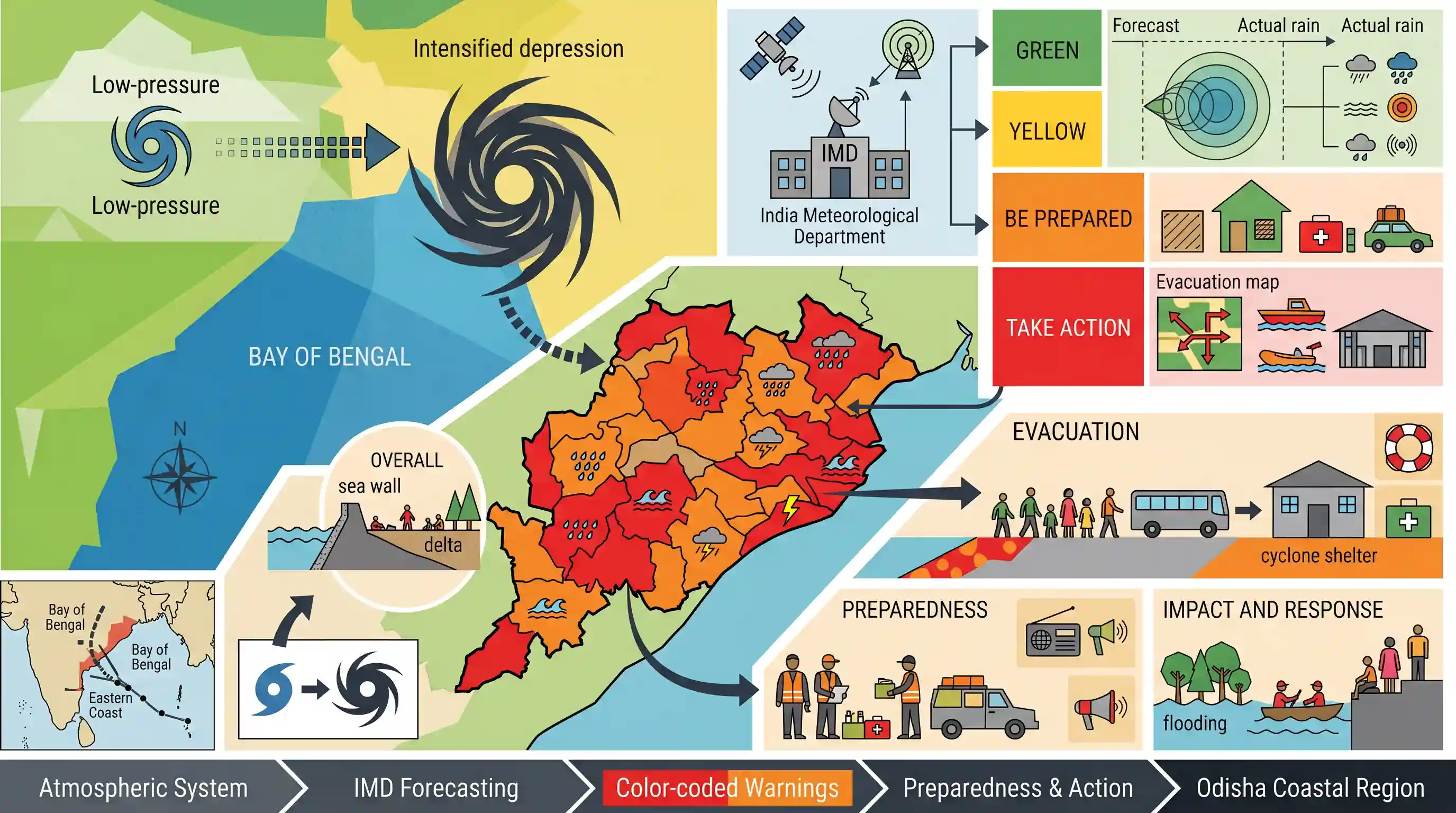
Why It Matters
Provides a real-world case study on the formation of depressions in the Bay of Bengal and the operational mechanics of the IMD's color-coded weather warning system—a topic directly relevant to both geographical phenomena and disaster preparedness in UPSC exams.
Summary
The India Meteorological Department (IMD) has forecast heavy to extremely heavy rainfall in Odisha due to a low-pressure area over the Bay of Bengal intensifying into a depression. The meteorological event has triggered critical red and orange weather warnings across multiple districts. This highlights the practical application of the IMD's color-coded early warning systems and the ongoing vulnerability of India's eastern coast to severe cyclonic and depressive weather phenomena originating in the Bay of Bengal.
Key Points
- A low-pressure system over the Bay of Bengal has intensified into a depression, threatening heavy to extremely heavy rainfall across Odisha.
- The India Meteorological Department (IMD) deployed its color-coded warning system, issuing a red warning for maximum severity in specific districts.
- Authorities have issued advisories against venturing into the rough seas of the Bay of Bengal and have taken pre-emptive administrative measures for flood management.
Important Terms
India Meteorological Department (IMD)

The national meteorological service under the Ministry of Earth Sciences, responsible for weather forecasting, seismology, and providing early warnings for natural disasters in India.
UPSC context
Relevant for GS-I (Geography) and GS-III (Disaster Management) regarding the institutional framework for early warning systems.
Depression (Meteorological)
A cyclonic disturbance in which the maximum sustained surface wind speed ranges between 17 and 27 knots (31–49 km/h), characterized by organized convection and at least two closed isobars.
UPSC context
Tests conceptual clarity in GS-I Physical Geography (Climatology) regarding the classification of tropical disturbances and monsoon phenomena.
Low-Pressure Area (LPA)
A region where atmospheric pressure is lower than its surroundings, often leading to cloud formation and precipitation; classified by IMD when wind speeds are below 17 knots.
UPSC context
Fundamental concept for GS-I Geography in understanding atmospheric circulation, cyclogenesis, and the mechanics of the Indian Monsoon.
Color-coded Weather Alerts
IMD's impact-based warning system: Red (Take Action), Orange (Be Prepared), Yellow (Be Aware), and Green (No Warning), used to communicate severity to disaster management authorities.
UPSC context
Critical for GS-III (Disaster Management) relating to community preparedness and the role of technology in mitigating weather-related risks.
Extremely Heavy Rainfall
A technical IMD classification for 24-hour cumulative rainfall exceeding 204.5 mm at a single station, indicating severe risk of flooding and landslides.
UPSC context
Important for GS-III (Disaster Management) and GS-I (Geography) to understand hazard intensity and localized environmental impacts.
Prelims Trap
A meteorological depression in the Bay of Bengal indicates sustained wind speeds exceeding 62 kmph.
A depression is merely a precursor with wind speeds of 31-50 kmph. It only escalates to a "cyclonic storm" when wind speeds cross 62 kmph.
Static Concepts Connected
Why is the Bay of Bengal highly prone to cyclonic depressions?
- High SST: The semi-enclosed basin maintains Sea Surface Temperatures (SST) above 28°C, providing ideal thermodynamic conditions.
- Freshwater stratification: Massive riverine freshwater influx creates a stratified surface layer, preventing the upwelling of cooler deep ocean waters.
- Weaker wind shear: Weaker vertical wind shear compared to the Arabian Sea aids the rapid intensification of low-pressure systems.
How does the IMD's color-coded weather warning system work?
- Yellow (Be updated): Advises authorities and the public to stay informed about potentially worsening weather conditions over several days.
- Orange (Be prepared): Warns of extremely bad weather with the potential for commuting disruptions and localized power outages.
- Red (Take action): Maximum severity alert requiring immediate preemptive administrative measures, such as coastal evacuations, to mitigate disaster.
Cross-Topic Patterns
Arabian Sea warming trend
While the Bay of Bengal historically dominates, climate change is increasing the Arabian Sea's baseline sea surface temperatures, triggering more frequent and severe west-coast cyclogenesis.
Sendai Framework preparedness
IMD early warnings form the core of the 'preparedness' phase in disaster management, triggering immediate administrative responses distinct from long-term 'mitigation' like shelter construction.

Factors driving Bay of Bengal cyclogenesis (freshwater stratification, SST) are prime candidates for a conceptual geography question in 2026.
Linked PYQs · 2
Linked PYQs · 2
- 2022MainsGS1
Discuss the meaning of colour-coded weather warnings for cyclone prone areas given by India Meteorological Department.
- 2014MainsGS1
Tropical cyclones are largely confined to South China Sea, Bay of Bengal and Gulf of Mexico. Why?
