West Bengal Tourism Observes World Mangrove Day with Eco Initiatives
Source:bottindia ↗
কেন এটি গুরুত্বপূর্ণ
Highlights critical eco-tourism policies, local mangrove conservation efforts (Blue Carbon Economy), and inland waterway development (NW-1, NW-97) in West Bengal. Essential for WBCS Geography and Environment sections.
সারসংক্ষেপ
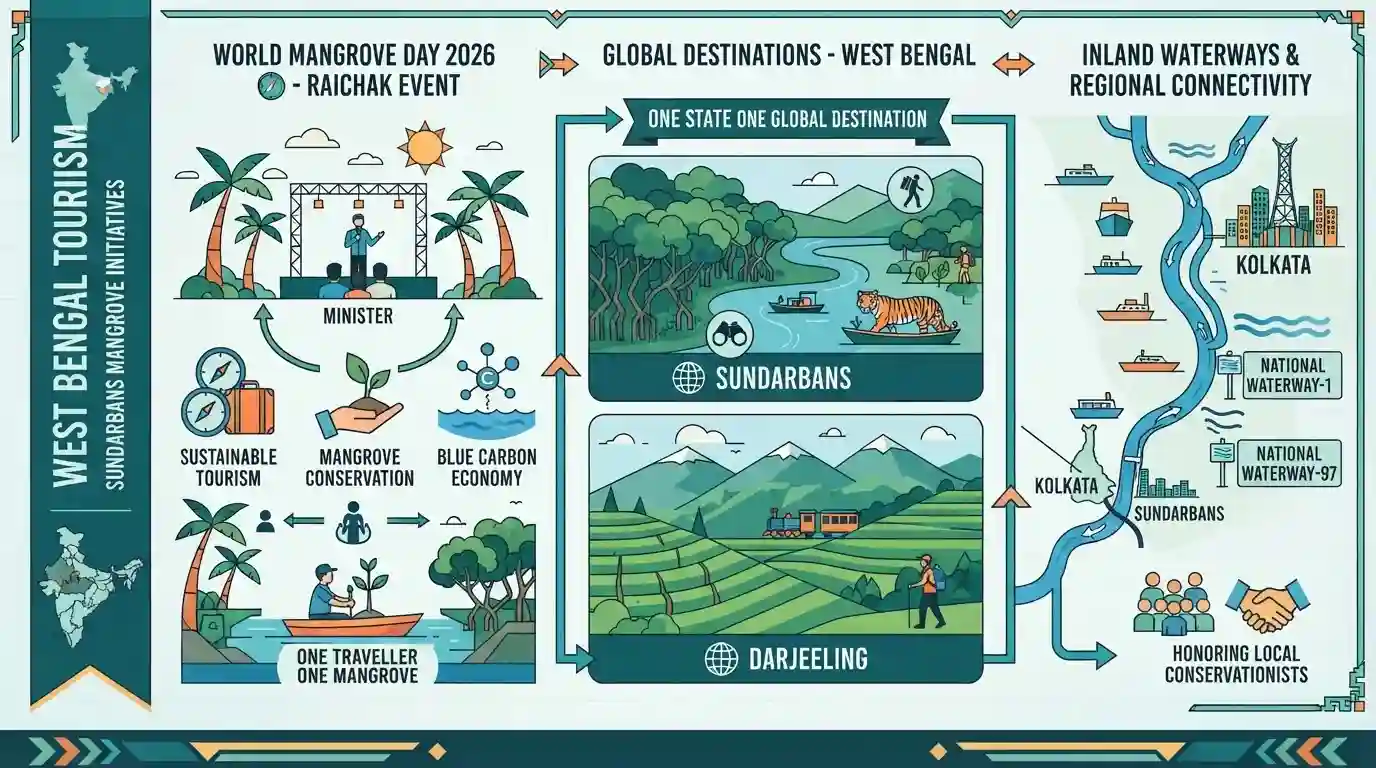
The Department of Tourism, West Bengal, observed World Mangrove Day 2026 by focusing on sustainable tourism, mangrove conservation, and the Blue Carbon Economy. Held in Raichak, the event saw Minister Shankar Ghosh announce the 'One Traveller One Mangrove' initiative to promote eco-tourism and active tourist participation in mangrove planting. The department also plans to elevate the Sundarbans and Darjeeling under the 'One State, One Global Destination' initiative. Additionally, river tourism will be expanded by connecting Kolkata to the Sundarbans through National Waterway-1 and National Waterway-97, boosting regional connectivity while honoring local conservationists.
মূল বিষয়
- West Bengal Tourism Department observed World Mangrove Day 2026 in Raichak, prioritizing the Blue Carbon Economy and eco-friendly sustainable tourism.
- Launched the 'One Traveller One Mangrove' initiative under the Blue Carbon Ambassador Programme, encouraging tourists to plant a sapling in the Sundarbans.
- Announced plans to pitch Darjeeling and the Sundarbans as flagship sites under the 'One State, One Global Destination' scheme to attract international tourism.
- Explored the development of river tourism linking Kolkata directly to the Sundarbans via National Waterway-1 and National Waterway-97.
- Felicitated Umashankar Mondal (the 'Mangrove Man') and other grassroot conservationists for their vital restoration efforts in the fragile coastal ecosystem.
গুরুত্বপূর্ণ শব্দ
One Traveller One Mangrove

An eco-tourism initiative by West Bengal's Tourism Department encouraging Sundarbans visitors to plant mangrove saplings, fostering active community-led climate action and environmental stewardship.
UPSC context
GS Paper III (Environment & Ecology); tests sustainable tourism frameworks and community-based coastal ecosystem restoration models.
Blue Carbon Ambassador Programme (BCAP)
A capacity-building campaign integrated with West Bengal's 'One Traveller One Mangrove' initiative to award conservation certificates to tourists, promoting carbon sequestration and the Blue Carbon Economy.
UPSC context
GS Paper III (Environment & Biodiversity); tests understanding of blue carbon, climate mitigation tools, and public-private conservation synergy.
One State, One Global Destination initiative
A central government scheme aiming to develop at least one globally benchmarked, sustainably managed tourist destination in every Indian State and Union Territory to boost eco-tourism.
UPSC context
GS Paper III (Economic Development); tests national tourism policies, infrastructure development, and competitive federalism strategies.
Bali Nature and Wildlife Conservation Society
A grassroots non-governmental organisation based in the Sundarbans, West Bengal, working to prevent poaching, conserve the fragile mangrove ecosystem, and support alternative ecotourism livelihoods for local communities.
UPSC context
GS Paper III (Biodiversity & Conservation); tests the role of local NGOs and community participation in managing human-wildlife conflicts.
NEWS
A prominent non-profit organisation in India dedicated to protecting wildlife habitats, promoting climate resilience, and driving ecological restoration, particularly focusing on the Sundarbans mangrove ecosystem.
UPSC context
GS Paper III (Ecology & Climate Change); tests civil society participation in environmental sustainability and disaster-resilient coastal restoration.
Department of Tourism (West Bengal)
The state government agency responsible for formulating tourism policies, developing regional transport networks, and implementing sustainable, responsible, and experience-led travel initiatives across West Bengal.
UPSC context
GS Paper III (Economic Development & Infrastructure); tests public policy frameworks, regional connectivity, and infrastructure projects.
প্রিলিমস ফাঁদ
NW-97 is exclusively a domestic route within West Bengal and does not facilitate international transit to neighboring countries.
NW-97 (Sundarbans Waterways) is actually a crucial international transit and trade route connecting Kolkata to Bangladesh as part of the Indo-Bangladesh Protocol Route.
সংযুক্ত স্থির ধারণা
What are the primary characteristics of Blue Carbon ecosystems?
- High sequestration: Coastal ecosystems like mangroves, salt marshes, and seagrasses sequester carbon at rates up to 10 times higher than terrestrial forests.
- Long-term storage: They store most of their carbon in waterlogged, anaerobic soils, preventing rapid decomposition and locking it away for millennia.
- Triple benefit: Beyond carbon storage, they provide shoreline protection against cyclones and serve as critical nursery habitats for marine biodiversity.
How do National Waterway-1 and NW-97 integrate into eastern India's transit network?
- NW-1 (Ganga system): Runs from Prayagraj to Haldia on the Ganga-Bhagirathi-Hooghly system, forming the main arterial inland waterway of northern and eastern India.
- NW-97 (Sundarbans): Comprises tidal rivers (Matla, Raimangal) in the Sundarbans delta, extending eastwards from the Hooghly river system.
- IBP Route linkage: NW-97 acts as a vital link connecting NW-1 to the Indo-Bangladesh Protocol Route, enabling continuous inland water transit to NW-2 (Brahmaputra) in Assam.
আন্তঃবিষয় প্যাটার্ন
Mangroves + India's Climate NDCs
Initiatives like 'One Traveller One Mangrove' complement the Union's MISHTI scheme, driving India's NDC target under the Paris Agreement to create an additional 2.5-3.0 billion tonne carbon sink.
Inland Waterways + Strategic Border Transit
Developing NW-97 for river tourism concurrently strengthens the navigable infrastructure required for the Indo-Bangladesh Protocol Route, offering strategic, alternative freight connectivity to Northeast India.

Mapping NW-1, NW-97 (Sundarbans), and NW-2 via the Indo-Bangladesh Protocol route is highly likely as a 2026 complex geography question.
সংযুক্ত PYQ · 2
সংযুক্ত PYQ · 2
- 2019WBCS_PRELIMSGS1
Sundarban is declared as 'World Heritage Site' for
- 2022WBCS_PRELIMSGS1
'Loringa' mangrove is located in
