Denmark Forms First Government with Female Majority Cabinet
Source:The Hindu ↗
Why It Matters
Provides a strong international case study for women's political empowerment and gender equity in high-level executive roles. It also serves as a relevant comparative example for understanding minority and coalition government dynamics in parliamentary systems.
Summary
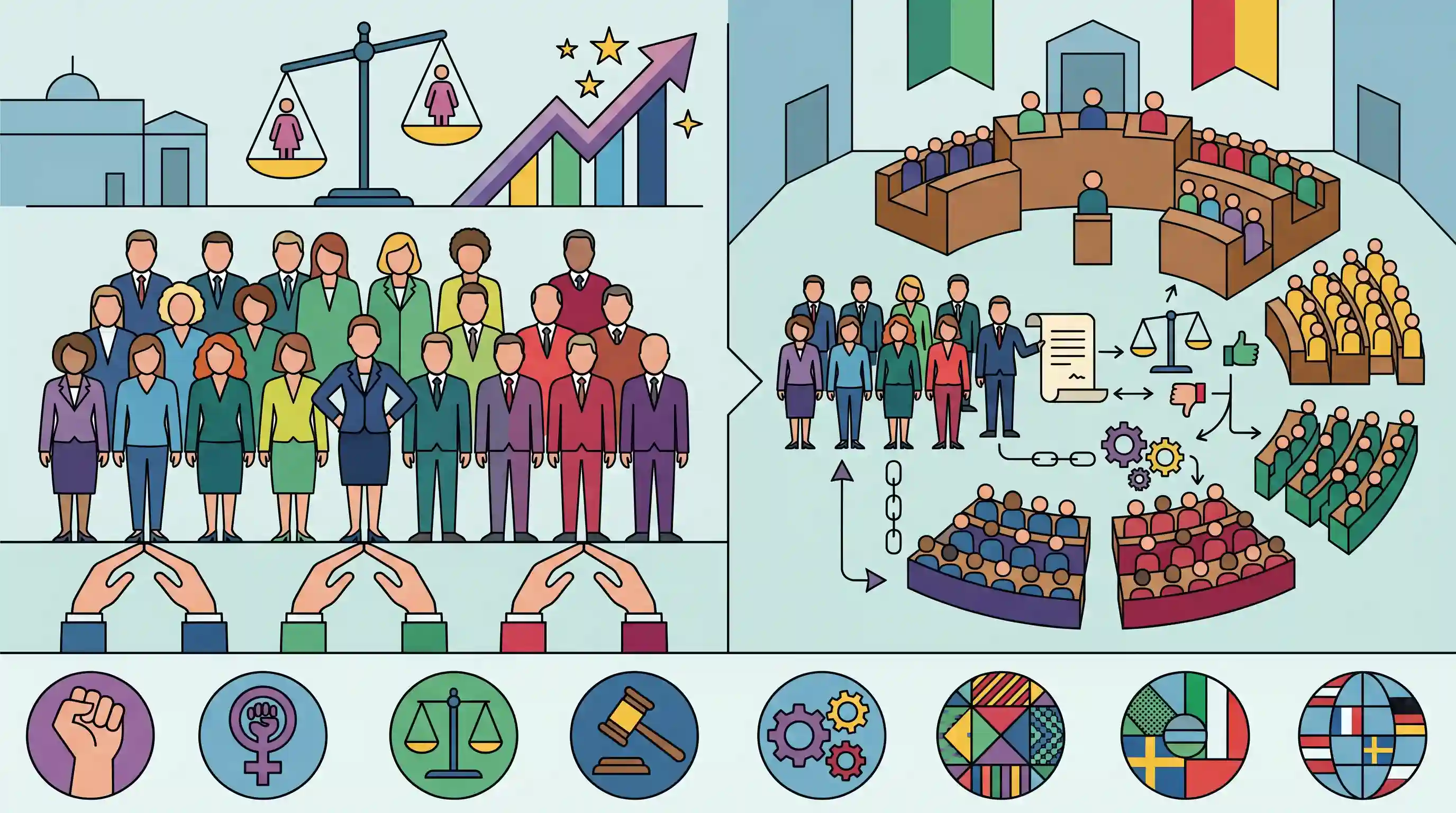
Danish Prime Minister Mette Frederiksen has presented her new minority coalition government, which features the country's first female-majority cabinet (11 of 21 ministers). The four-party coalition will need to rely on outside parliamentary support to pass legislation, illustrating both a landmark achievement in gender representation in politics and the dynamics of minority governments in parliamentary democracies.
Key Points
- Denmark has formed its first-ever government with a female-majority cabinet, with 11 out of 21 ministers being women.
- The government is a minority coalition comprising the Social Democrats, Socialist People's Party, Radikale Venstre, and Moderates.
- Because the coalition holds only 82 out of 179 seats in Parliament, it will rely on the support of other parties to pass legislation.
- The development highlights a significant global milestone in women's political empowerment and representation at the highest levels of governance.
Important Terms
Social Democrats (Denmark)

A Danish center-left political party that is the primary architect of the Nordic welfare state, emphasizing social justice, workers' rights, and government-managed social safety nets.
UPSC context
Relevant for GS Paper II (Political Ideologies) and GS Paper III (Welfare Models/Economic Governance).
Minority Government
A government formed by a party or coalition that does not hold a majority of seats in parliament, requiring external support to pass legislation and survive confidence votes.
UPSC context
Relevant for GS Paper II (Parliamentary Systems) and Comparative Politics, testing understanding of executive stability and legislative deadlock.
Moderates (Denmark)
A centrist Danish political party founded in 2022 by Lars Løkke Rasmussen, aimed at breaking traditional left-right bloc politics through pragmatic, evidence-based policy.
UPSC context
Important for GS Paper II (Comparative Politics) and understanding the evolution of multi-party systems in parliamentary democracies.
Socialist People's Party
A left-wing party in Denmark that combines democratic socialism with green politics, advocating for environmental protection, feminism, and social equality within the welfare state framework.
UPSC context
Relevant for GS Paper II (Ideologies) and Green Politics as a factor in modern governance.
Radikale Venstre
A centrist social-liberal party in Denmark known for its role as a "kingmaker," supporting both left and right governments while advocating for internationalism and social reform.
UPSC context
Tests knowledge of comparative political systems and the influence of pivotal centrist parties in coalition-building (GS Paper II).
Gender Representation
The equitable presence of women in political leadership; in this context, achieving a landmark 11 of 21 ministerial positions (over 50%) in the national cabinet.
UPSC context
Crucial for GS Paper I (Social Issues) and GS Paper II (Social Justice/Women Empowerment).
Prelims Trap
Nordic nations achieved gender parity in parliaments through strict, constitutionally mandated legislative quotas.
Nordic representation is largely organic, driven by voluntary political party quotas and high civic mobilization, unlike India's legally binding 106th Constitutional Amendment Act.
Static Concepts Connected
What distinguishes a 'minority government' in parliamentary democracies?
- Absence of majority: The ruling coalition holds less than 50% of lower house seats, governing through external legislative support.
- Parliamentary supremacy: Executive power is checked heavily, as bills require continuous cross-party negotiation rather than majoritarian steamrolling.
- Confidence and supply: Outside parties may guarantee support during budget or trust votes while negotiating individual bills case-by-case.
What are the core provisions of the 106th Constitutional Amendment Act (Nari Shakti Vandan Adhiniyam)?
- One-third quota: Mandates 33% reservation for women in the Lok Sabha, State Legislative Assemblies, and NCT of Delhi.
- SC/ST inclusion: Ensures reservation for SC/ST women within the pre-existing constitutional quotas for these communities.
- Delimitation dependency: The quotas will take effect only after a delimitation exercise based on the first post-enactment census.
Cross-Topic Patterns
Electoral systems vs Gender parity
Proportional Representation (PR) systems, common in Europe, historically facilitate higher female representation by incentivizing diverse party lists, unlike majoritarian FPTP systems utilized in India and the UK.
Global Gender Gap Index realities
Denmark's cabinet highlights India's contrasting performance in the WEF Global Gender Gap Report, where India struggles with political empowerment due to sub-7% female ministerial representation at the federal level.

Expect a GS2 Mains question contrasting organic women's political empowerment (Nordic model) with India's legislative quota (106th CAA).
Linked PYQs · 3
Linked PYQs · 3
- 2023MainsGS2
Discuss the contribution of civil society groups for women's effective and meaningful participation and representation in state legislatures in India.
- 2024MainsGS1
Distinguish between gender equality, gender equity and women's empowerment. Why is it important to take gender concerns into account in programme design and implementation?
- 2024MainsGS2
“The growth of cabinet system has practically resulted in the marginalisation of the parliamentary supremacy.” Elucidate.
