Climate Change Induced Spread of Vector Borne Diseases
Source:The Hindu ↗
Why It Matters
Demonstrates the real-world impact of global warming on the geographic spread of vector-borne diseases, a critical concept combining GS3 Environment (climate change impacts) and Health (disease management).
Summary
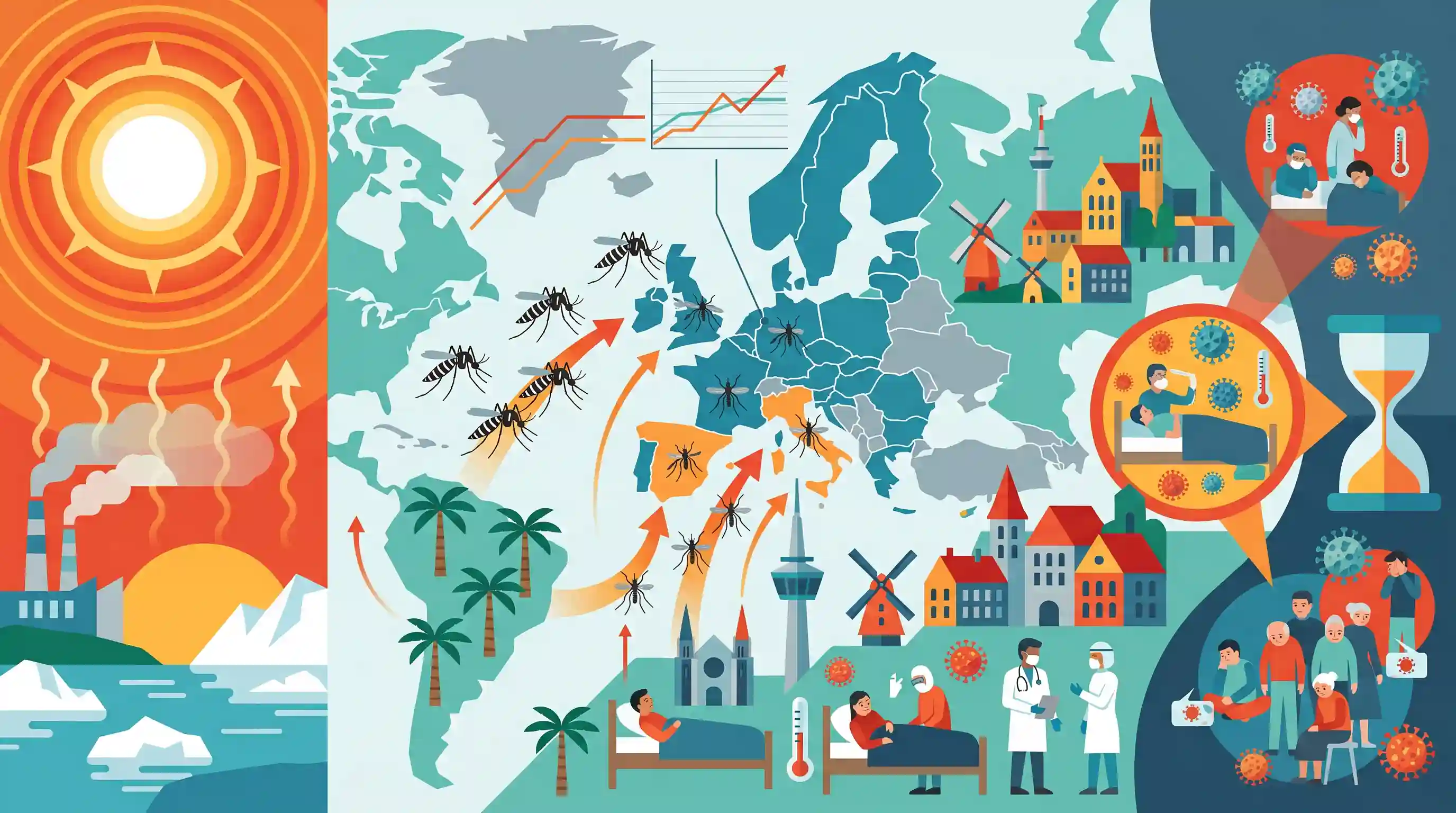
Research published in the Lancet Planetary Health warns that tropical diseases like dengue and chikungunya could soon become endemic in Europe. The 'tiger mosquitoes' (Aedes aegypti and Aedes albopictus), which transmit these viruses alongside Zika and West Nile, are moving northward due to human-driven climate change. The study predicts that under severe global warming scenarios, disease outbreaks in the region could multiply up to five times by 2060, illustrating the direct public health consequences of a warming planet.
Key Points
- Climate change and global warming are causing 'tiger mosquitoes' (Aedes aegypti and Aedes albopictus) to expand their range northward into Europe.
- These mosquitoes are primary vectors for tropical diseases such as dengue, chikungunya, Zika, and West Nile virus.
- A study in the Lancet Planetary Health journal predicts that under worst-case climate scenarios, dengue and chikungunya outbreaks in Europe could be up to five times more frequent by 2060.
- The findings highlight a major intersection between climate change and public health, showing that historically tropical diseases could become endemic in temperate regions.
Important Terms
Lancet Planetary Health

A leading peer-reviewed journal focused on how human-driven environmental changes, like climate change, impact human health and the planet's ecosystems.
UPSC context
GS III (Environment/S&T); vital for scientific evidence regarding climate change's direct impact on public health.
Planetary Health
An interdisciplinary field focusing on the human health impacts of human-caused disruptions of Earth's natural systems, emphasizing the interdependence of ecosystems and wellbeing.
UPSC context
GS III (S&T); essential for 'One Health' concepts and understanding environmental determinants of health in policy.
Endemic Disease
A disease that is constantly present in a specific region or population at a predictable rate, unlike an epidemic which is a sudden spike.
UPSC context
GS II (Health); crucial for distinguishing disease stages (endemic vs. epidemic) in public health governance.
Vector-borne Diseases
Human illnesses caused by parasites, viruses, and bacteria transmitted by vectors like mosquitoes, ticks, and fleas, often influenced by environmental changes.
UPSC context
GS III (S&T); vital for discussing India's National Vector Borne Disease Control Programme and epidemic preparedness.
Aedes aegypti and Aedes albopictus
Mosquito species (often called 'tiger mosquitoes') that serve as primary vectors for transmitting Dengue, Chikungunya, and Zika; their range expands with global warming.
UPSC context
GS III (S&T); relevant for biotechnology (GM mosquitoes) and ecological shifts impacting health infrastructure.
West Nile Virus
A mosquito-borne virus that can cause neurological disease; it circulates between mosquitoes and birds, occasionally infecting humans through bites.
UPSC context
GS III (Science); an emerging threat linked to climate change, testing disease surveillance capabilities.
Prelims Trap
Dengue and Chikungunya are strictly tropical diseases restricted to the equatorial belt.
Climate change has expanded the habitat of Aedes mosquitoes to temperate zones like Europe, making the 'exclusively tropical' label scientifically obsolete.
Static Concepts Connected
Which specific mosquito vectors transmit major viral and parasitic diseases?
- Aedes species: Transmits Dengue, Chikungunya, Zika, and Yellow Fever. Breeds in clean, stagnant water and primarily bites during the day.
- Anopheles species: Female Anopheles transmits Malaria parasites. Typically breeds in fresh water and bites at night.
- Culex species: Primary vector for West Nile Virus and Japanese Encephalitis. Breeds in stagnant, dirty water and is highly active at dawn and dusk.
How does the Wolbachia method control mosquito-borne diseases?
- Biological control: Introduces naturally occurring Wolbachia bacteria into Aedes aegypti mosquitoes, which do not normally carry it.
- Viral blockage: The bacteria compete with viruses like dengue for resources inside the mosquito, drastically reducing the vector's ability to transmit the disease.
- Non-genetic: It uses natural bacteria and does not alter the mosquito's DNA, differentiating it from genetically modified organism (GMO) approaches.
Cross-Topic Patterns
Climate change and vector geography
Global warming shifts the geographical range of disease vectors to higher latitudes and altitudes, a recurring UPSC mains theme bridging Environment and Public Health.
Biotech bio-control vs GMO interventions
UPSC frequently tests the distinction between biological interventions (like the Wolbachia method) and genetic engineering (like CRISPR/sterile insect technique) in controlling mosquito populations.

Expect a 2026 multi-statement question linking climate-induced mosquito habitat shifts with bio-controls like the Wolbachia method.
Linked PYQs · 4
Linked PYQs · 4
- 2017PrelimsGS1
Consider the following statements: 1. In tropical regions, Zika virus disease is transmitted by the same mosquito that transmits dengue. 2. Sexual transmission of Zika virus disease is possible. Which of the statements given above is/are correct?
- 2023PrelimsGS1
'Wolbachia method' is sometimes talked about with reference to which one of the following?
- 2017MainsGS3
'Climate change' is a global problem. How India will be affected by climate change? How Himalayan and coastal states of India will be affected by climate change?
- 2022MainsGS3
Discuss global warming and mention its effects on the global climate. Explain the control measures to bring down the level of greenhouse gases which cause global warming, in the light of the Kyoto Protocol, 1997.
