West Bengal Vector Borne Disease Control and Dengue Situation
Source:The Hindu ↗
Why It Matters
Important for understanding regional public health challenges, vector-borne disease control, and governance measures in West Bengal.
Summary
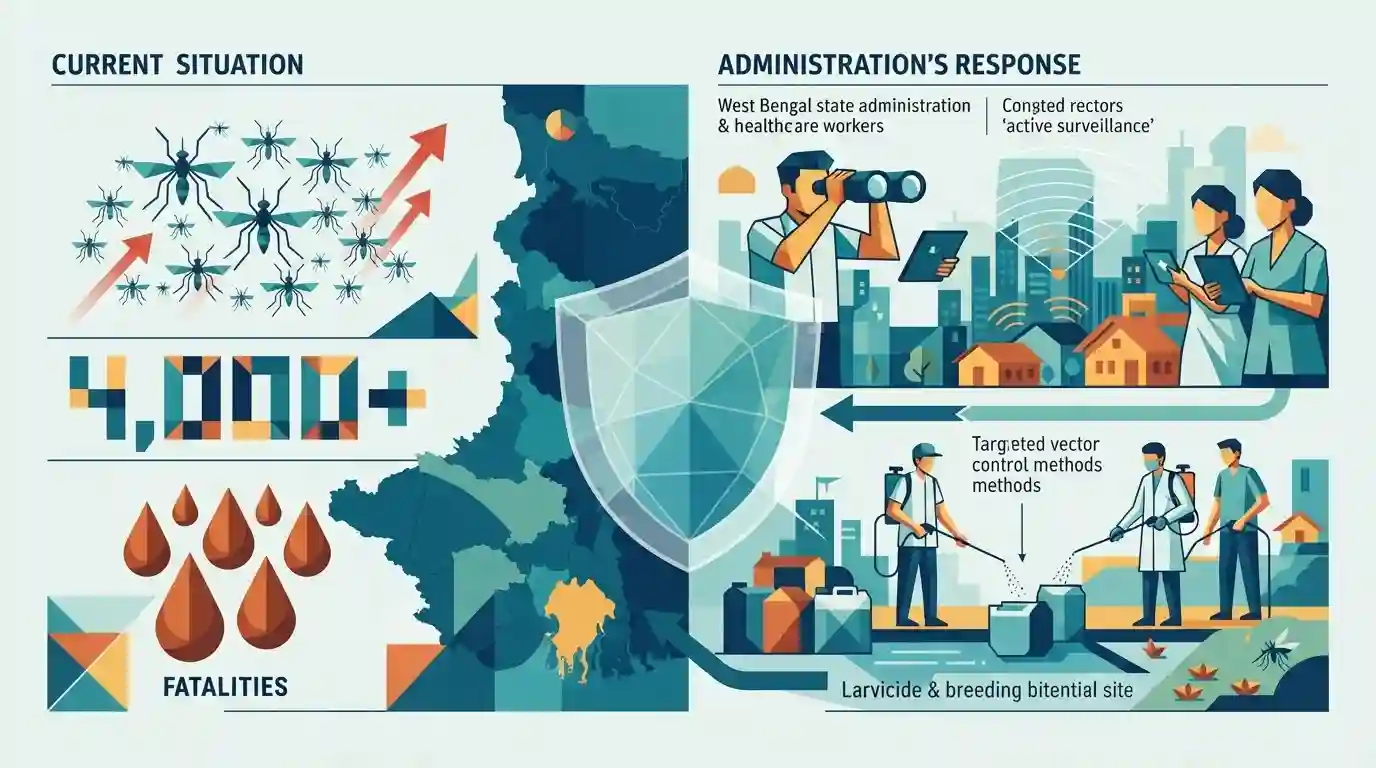
Dengue cases in West Bengal have surpassed 4,000 alongside seven fatalities, prompting the State administration to declare that the public health situation remains under control through active surveillance and vector management.
Key Points
- Dengue cases in West Bengal crossed 4,000 with 7 reported deaths.
- The State Chief Minister stated that the situation is under control and various public health measures are being scaled up.
- Vector-borne disease management remains a recurring public health challenge in West Bengal during and after the monsoon season.
Important Terms
Vector-Borne Diseases

Illnesses caused by pathogens and parasites transmitted by vectors like mosquitoes, including dengue, malaria, and Japanese encephalitis, heavily impacting state public health administration and local governance.
UPSC context
WBCS Paper IV (Public Health & General Science): Tests knowledge of tropical diseases, epidemic management, and state health welfare schemes.
West Bengal State Government
The elected regional government responsible for executive administration, public health policy, vector management, and municipal sanitation across West Bengal districts.
UPSC context
WBCS Paper III (Polity & Administration): Important for understanding state-level governance, disaster response, and health administration structures.
Prelims Trap
vector-borne disease management is primarily an agricultural and rural health challenge in West Bengal
Aspirants often assume vector-borne disease outbreaks are exclusively rural or agricultural problems, missing that urban and peri-urban centers like Kolkata and North 24 Parganas are the primary high-incidence zones for dengue.
Static Concepts Connected
What are the primary vectors and transmission cycles of major vector-borne diseases in West Bengal?
- Primary Vector: Aedes aegypti mosquito thrives in clean, stagnant water collections around urban and semi-urban households.
- Seasonal Peak: Peak transmission occurs during and immediately after the monsoon season due to high humidity and stagnant pools.
- Endemic Zones: Key districts historically vulnerable include Kolkata, North 24 Parganas, Howrah, and Murshidabad.
Cross-Topic Patterns
Vector-Borne Diseases & Municipal Governance
Dengue and malaria outbreaks in districts like Murshidabad and North 24 Parganas directly link public health challenges with local self-government (Panchayati Raj and municipal) sanitation responsibilities.

Expect a direct prelims match on high-incidence dengue districts in WB or vector-borne disease transmission cycles.
Linked PYQs · 1
Linked PYQs · 1
- 2021WBCS_PRELIMSGS1
How many new Government Medical Colleges have become functional in West Bengal during the last ten years?
