West Bengal Reports Rise in Dengue Cases and Fatalities
Source:The Hindu ↗
Why It Matters
Important for tracking public health indicators, administrative responses, and disease surveillance frameworks within West Bengal for state-level examinations.
Summary
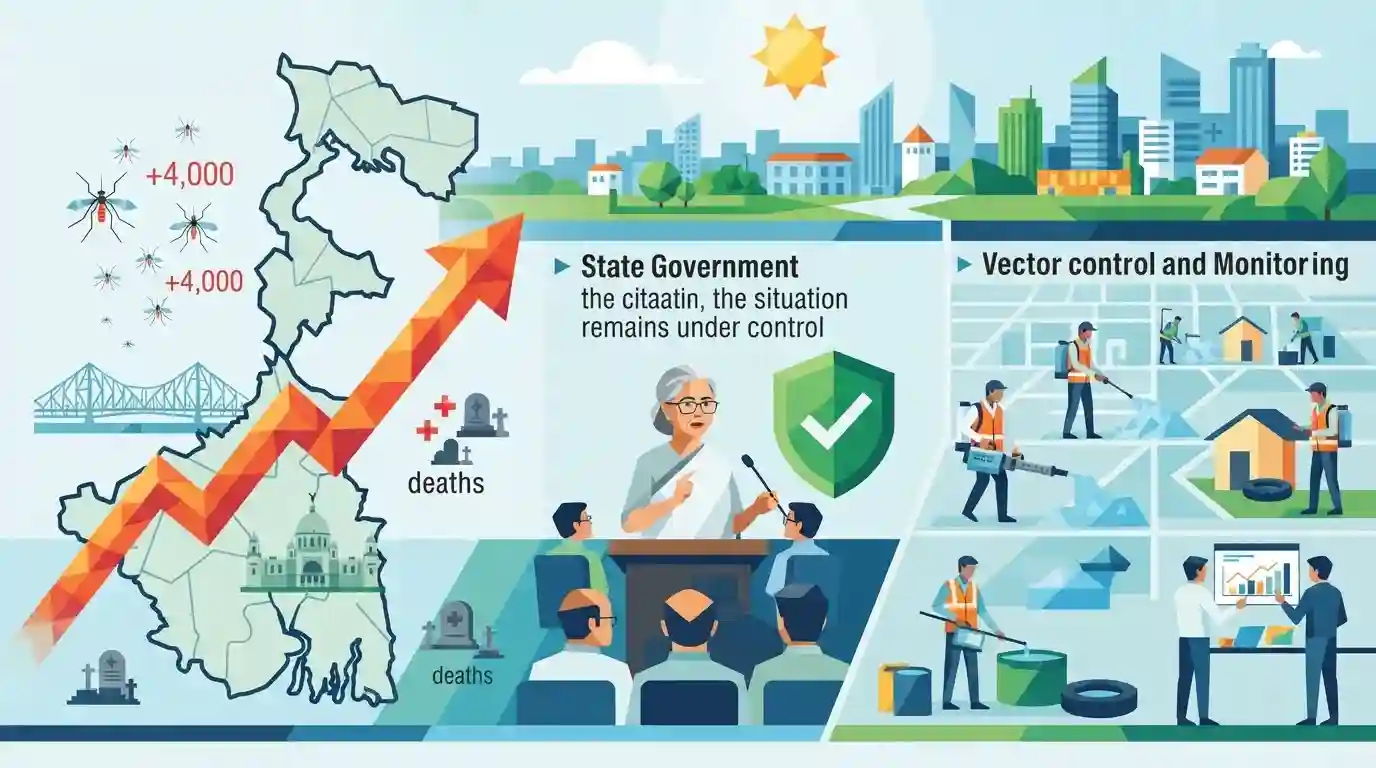
With dengue cases in West Bengal surpassing 4,000 alongside seven deaths, the State government has stepped up monitoring and vector control measures, while the Chief Minister emphasized that the situation remains under control.
Key Points
- Dengue cases in West Bengal crossed 4,000 with seven reported fatalities, prompting administrative review.
- The Chief Minister of West Bengal assured the public that the situation is currently under control and healthcare systems are prepared.
- Vector-borne disease outbreaks, particularly dengue and malaria, remain a recurrent public health challenge in monsoon and post-monsoon seasons across various districts of West Bengal.
Important Terms
West Bengal State Government

The administrative and executive apparatus of the State of West Bengal, responsible for policy formulation, governance, and public health delivery.
UPSC context
WBCS Paper IV (Governance and Administration): Tests understanding of state-level policy execution, disaster management, and public health administration.
Health Department West Bengal
The state government department tasked with formulating health policies, monitoring vector-borne diseases, and overseeing public healthcare delivery across districts.
UPSC context
WBCS Paper IV (Social Welfare and Public Health): Evaluates administrative handling of epidemics, public health infrastructure, and preventive healthcare initiatives.
Prelims Trap
Dengue outbreaks in West Bengal are strictly restricted to municipal corporation areas like Kolkata and Howrah.
Aspirants often assume dengue is exclusively an urban phenomenon in WB, overlooking its significant spread across semi-urban and rural blocks in districts like North and South 24 Parganas.
Static Concepts Connected
What are the key vector-borne diseases endemic to West Bengal and their vectors?
- Dengue Vector: Dengue is transmitted primarily by the Aedes aegypti mosquito, peaking during and post-monsoon.
- Malaria Vector: Malaria is transmitted by female Anopheles mosquitoes, prevalent across rural and forested districts of the state.
- JE Vector: Japanese Encephalitis is transmitted by Culex mosquitoes, linked to paddy cultivation and pig-farming areas in North Bengal.
- Filariasis Vector: Lymphatic Filariasis is transmitted by Culex quinquefasciatus, targeted under national elimination campaigns.
Cross-Topic Patterns
Dengue Outbreaks and Local Governance (Panchayati Raj)
Dengue and vector-borne outbreaks test rural local bodies (Panchayats) and urban civic bodies (Municipal Corporations) in resource mobilization and sanitation enforcement during monsoons.
District Administration and Public Health Management
Public health crises test the administrative machinery of the District Magistrate and Chief Medical Officer of Health (CMOH) in West Bengal.

WBCS Prelims often tests vulnerable districts for dengue in WB or vectors; expect questions on endemic vector-borne diseases in the state.
