Telangana Promotes Grassroots Plastic Alternatives Through Steel Banks
Source:The Hindu ↗
Why It Matters
The 'Steel Bank' initiative serves as an excellent case study for GS-3 (Environment/Solid Waste Management) and GS-2 (Governance/SHGs). It demonstrates how local administrations can effectively involve women's groups in grass-roots environmental conservation and phase out single-use plastics.
Summary
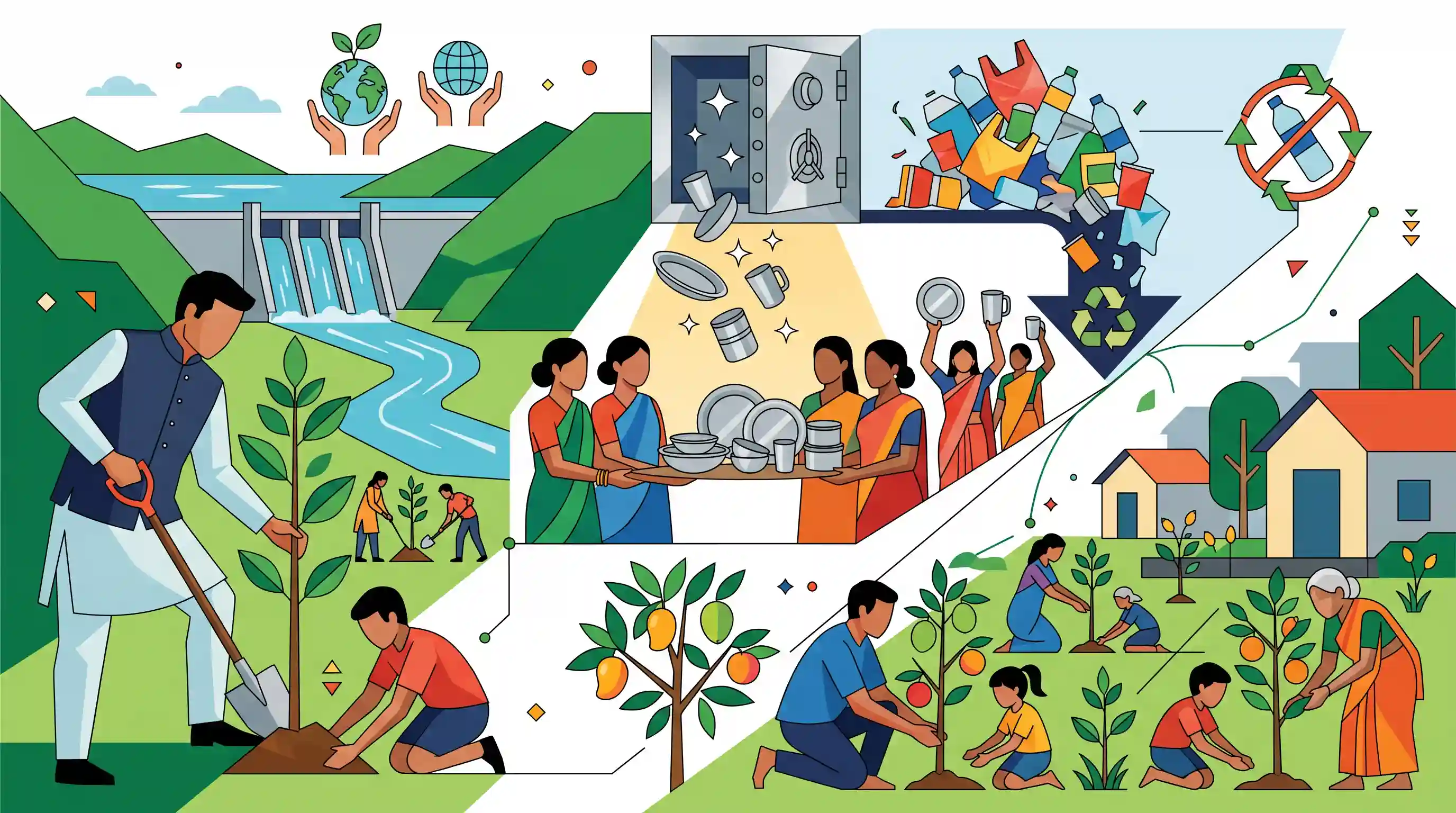
On World Environment Day, Telangana Transport and Backward Classes Welfare Minister Ponnam Prabhakar emphasized the need for collective action toward environmental protection. Speaking in Karimnagar after planting saplings near the Lower Manair Dam, he highlighted the 'Steel Bank' initiative in the Husnabad constituency. This eco-friendly scheme combats plastic pollution by distributing steel utensil kits to 280 women Self-Help Groups (SHGs). He further urged citizens to make sapling plantation a social movement, suggesting the widespread planting of fruit-bearing trees in residential areas.
Key Points
- Transport and Backward Classes Welfare Minister Ponnam Prabhakar planted saplings near Lower Manair Dam on World Environment Day to promote environmental protection.
- He highlighted the successful 'Steel Bank' initiative in the Husnabad Assembly constituency, aimed at combating plastic pollution.
- Under the initiative, kits containing around 70,000 steel plates were distributed to 280 women Self-Help Groups (SHGs) to replace single-use plastics.
- The Minister advocated turning sapling plantation into a social movement, emphasizing avenue plantation and the mass planting of fruit-bearing trees like guava and drumstick in residential areas.
Important Terms
Steel Bank initiative

A sustainable waste management model providing reusable steel utensils to replace single-use plastics at community events. Managed by local bodies or SHGs, it reduces plastic waste and promotes environmental stewardship.
UPSC context
GS Paper 3: Waste Management and Environmental Conservation; GS Paper 2: Grassroots Governance.
Self-Help Groups (SHGs)
Informal, community-based associations of individuals who pool resources for socio-economic empowerment. They serve as primary vehicles for microfinance, social change, and the implementation of grassroots development schemes.
UPSC context
GS Paper 2: Development Processes and Industry; GS Paper 3: Inclusive Growth.
4R Principle
An environmental strategy encompassing Refuse, Reduce, Reuse, and Recycle. It focuses on waste minimization at the source and is a cornerstone of the circular economy and sustainable resource management.
UPSC context
GS Paper 3: Environmental Pollution and Degradation; essential for urban and rural waste strategies.
Solid Waste Management (SWM)
The systematic process of collecting, treating, and disposing of solid waste. Effective SWM emphasizes source segregation and community participation to mitigate environmental hazards and plastic pollution.
UPSC context
GS Paper 3: Environmental Pollution; GS Paper 2: Role of Urban/Rural Local Bodies.
Prelims Trap
"The 'Steel Bank' initiative is a financial credit scheme by the Ministry of Steel to support MSMEs."
It is a decentralized solid waste management model lauded in the Economic Survey, where SHGs rent out reusable steel utensils to eliminate single-use plastics.
Static Concepts Connected
What are the key provisions for single-use plastics under the PWM Rules?
- Nationwide ban: Prohibits the manufacture, import, stocking, sale, and use of identified single-use plastics (SUPs) like cutlery and plates since July 2022.
- Thickness mandate: Increased the minimum thickness of plastic carry bags to 120 microns to facilitate easier collection and reuse.
- EPR framework: Mandates Extended Producer Responsibility (EPR) for producers and brand owners to legally ensure plastic waste recycling.
What is the geographical context of the Manair River?
- Right-bank tributary: The Manair is a crucial right-bank tributary of the Godavari River, flowing primarily through the state of Telangana.
- Associated infrastructure: It hosts the Lower Manair Dam, a major earth-cum-masonry dam vital for local irrigation and drinking water.
Cross-Topic Patterns
SHGs beyond microfinance
UPSC increasingly frames SHGs not just as credit groups, but as vital delivery mechanisms for decentralized environmental governance and solid waste management.
Economic Survey case studies
Local initiatives lauded in the Economic Survey, like the Steel Bank, serve as high-yield fodder for GS2 Governance and GS3 Environment mains answers.

Expect a 2026 GS-2/GS-3 question linking SHG empowerment directly to decentralized environmental governance and local solid waste management.
Linked PYQs · 4
Linked PYQs · 4
- 2018MainsGS3
What are the impediments in disposing the huge quantities of discarded solid wastes which are continuously being generated? How do we remove safely the toxic wastes that have been accumulating in our habitable environment?
- 2017MainsGS2
The emergence of the Self-Help Groups (SHGs) in contemporary times points to the slow but steady withdrawal of the State from developmental activities." Examine the role of the SHGs in developmental activities and the measures taken by the Government of India to promote the SHGs.
- 2019PrelimsGS1
As per the Solid Waste Management Rules, 2016 in India, which one of the following statements is correct?
- 2024PrelimsGS1
Consider the following statements : Statement-I: Many chewing gums found in the market are considered a source of environmental pollution. Statement-II : Many chewing gums contain plastic as gum base. Which one of the following is correct in respect of the above statements?
