Urban Land Reclamation and Anti-Encroachment Drives in Chandigarh
Source:Indian Express ↗
Why It Matters
Illegal encroachments and urban sprawl are critical challenges for modern city planning in India. Understanding how administrations reclaim and manage urban land sheds light on the practical difficulties of urbanization, infrastructure development, and the socio-economic implications of displacement and rehabilitation in urban areas.
Summary
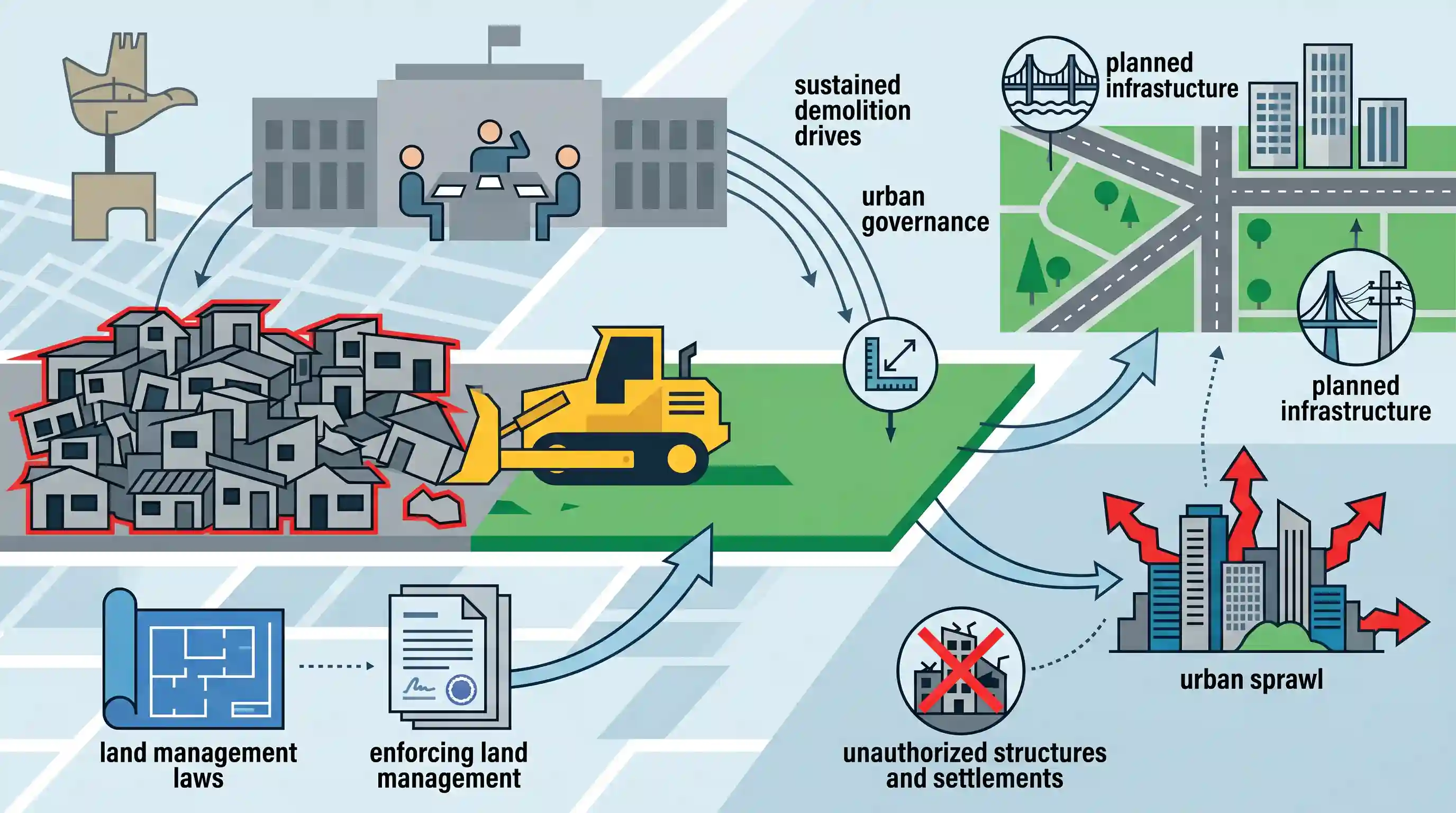
The Chandigarh Union Territory administration has reclaimed nearly 500 acres of government land from illegal encroachments through sustained demolition drives conducted since 2007. The ongoing operations target unauthorized structures and settlements, reflecting the complex urban governance challenges of mitigating urban sprawl, enforcing land management laws, and maintaining planned infrastructure development in rapidly growing cities.
Key Points
- The Chandigarh UT administration has successfully reclaimed approximately 500 acres of government land since 2007.
- The land was recovered through systematic demolition drives targeting illegal encroachments and unauthorized structures.
- These anti-encroachment measures underscore significant challenges in urban planning, land governance, and managing urban sprawl.
- The reclamation efforts emphasize the administration's strict stance on protecting public land, alongside the broader governance issue of managing rehabilitation for displaced vulnerable urban populations.
Important Terms
Chandigarh Union Territory Administration

The administrative body governing Chandigarh, headed by an Administrator appointed by the President. It manages the city’s unique status as a shared capital and ensures adherence to its specialized planned urban framework.
UPSC context
GS Paper 2: Federal structure and UT administration; GS Paper 1: Case study of planned urbanization in post-independence India.
Urban Governance
The institutional system for managing cities, involving Urban Local Bodies and parastatal agencies. It encompasses decision-making for land-use planning, infrastructure delivery, and maintaining the socio-economic well-being of urban populations.
UPSC context
GS Paper 2: 74th Constitutional Amendment, municipal autonomy, and challenges like fragmented accountability in metropolitan management.
Urban Sprawl
The rapid, unplanned outward expansion of cities into peripheral rural areas, characterized by low-density development. It leads to inefficient land use, increased travel distances, and strain on public infrastructure and environmental resources.
UPSC context
GS Paper 1: Urbanization problems; GS Paper 3: Environmental sustainability and the high economic cost of uncoordinated urban expansion.
Encroachment
The unauthorized occupation or illegal construction on public or private land. Under the Indian Penal Code, it is treated as criminal trespass, requiring administrative demolition drives or judicial intervention to reclaim property.
UPSC context
GS Paper 2: Governance and rule of law; GS Paper 3: Land management challenges and the socio-legal complexities of slum-clearance.
Land Management
The strategic process of regulating land use and development to balance economic growth with environmental protection. It includes zoning, reclamation, and maintaining land records to prevent illegal occupation and sprawl.
UPSC context
GS Paper 3: Land reforms and resource mobilization; essential for ensuring inclusive growth and infrastructure efficiency in rapidly growing cities.
Master Plan
A statutory long-term planning document that provides a conceptual layout for a city’s growth. It designates specific zones for residential, industrial, and recreational use to ensure orderly and sustainable development.
UPSC context
GS Paper 1/3: Urban planning and developmental models; tests understanding of how statutory frameworks prevent unplanned urbanization.
Prelims Trap
"The Right to Shelter under Article 21 provides absolute immunity against eviction from public lands."
Article 21 requires due process and notice prior to eviction (Olga Tellis case), but it does not grant absolute immunity to illegal encroachers occupying public property.
Static Concepts Connected
How has the Supreme Court balanced anti-encroachment drives with Article 21?
- Olga Tellis (1985): Expanded Article 21 to include Right to Livelihood, declaring arbitrary, unannounced evictions unconstitutional.
- Due Process: Authorities must strictly follow statutory procedures, including issuing prior show-cause notices and granting a hearing to occupants.
- Rehabilitation: While evicting encroachers from public land is legally permissible, the state is directed to formulate rehabilitation schemes for vulnerable populations.
What are the constitutional mechanisms for urban land use and planning?
- 12th Schedule: Under Article 243W (74th Amendment), urban planning, town planning, and the regulation of land use are core municipal responsibilities.
- DPCs and MPCs: Articles 243ZD and 243ZE mandate District and Metropolitan Planning Committees to consolidate spatial planning and infrastructure development.
Cross-Topic Patterns
Demolitions + PMAY-U
Clearing encroachments is deeply tied to the deficit of affordable housing; schemes like PM Awas Yojana (Urban) aim to formally absorb these vulnerable populations to prevent re-encroachment.
Urban Sprawl + Disaster Resilience
Illegal encroachments frequently choke natural drainage systems and floodplains, directly exacerbating urban flooding crises recently witnessed in major Indian metropolises.

Expect a GS-2 mains question linking municipal anti-encroachment drives, due process, and the Olga Tellis mandate on Article 21.
Linked PYQs · 3
Linked PYQs · 3
- 2013MainsGS1
Discuss the various social problems which originated out of the speedy process of urbanization in India.
- 2025MainsGS1
How does smart city in India, address the issues of urban poverty and distributive justice?
- 2021MainsGS1
What are the environmental implications of the reclamation of water bodies into urban land use ? Explain with examples.
