Demographic Shifts in Border Regions and National Security Risks
Source:The Hindu ↗
Why It Matters
This article illustrates the crucial intersection of border security and local socio-economic development. The focus on curbing demographic shifts and boosting infrastructure via the Vibrant Villages Programme reflects the government's comprehensive approach to border management, shifting from purely militaristic controls to community-driven resilience against external threats.
Summary
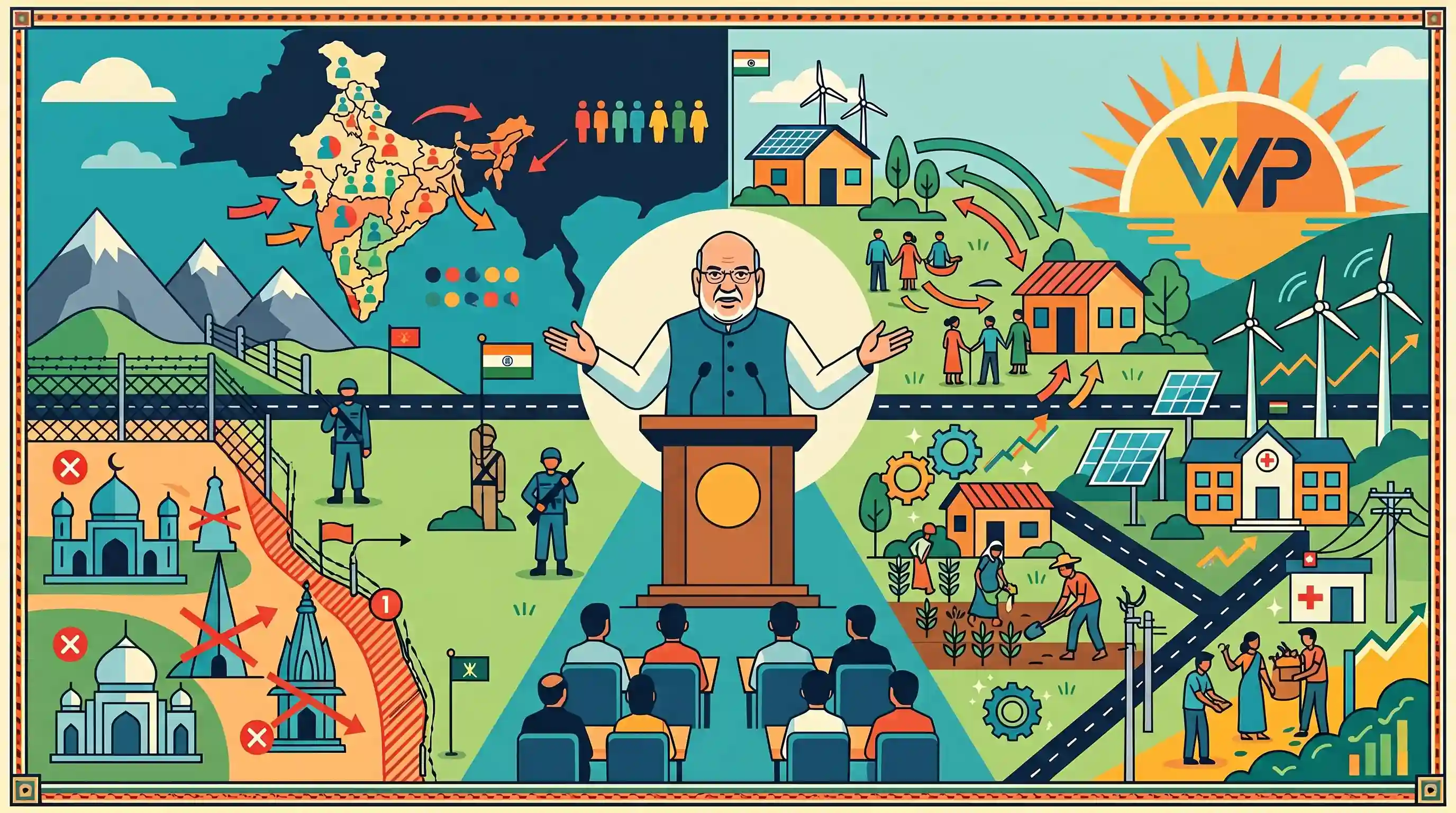
Union Home Minister Amit Shah, speaking at a national workshop for District Collectors under the Vibrant Villages Programme (VVP), asserted that demographic changes in border areas are a deliberate design threatening national security. He urged the removal of illegal religious encroachments within 30 km of the borders, referencing successful clearance efforts in Gujarat. Shah also emphasized the critical role of the VVP in preventing out-migration from border villages by providing robust infrastructure, effectively turning these areas into 'the first villages of India'.
Key Points
- Union Home Minister Amit Shah labeled demographic changes in border areas as a 'deliberate design' detrimental to national security.
- He instructed District Collectors to clear illegal religious encroachments within a 30-km radius of the border, citing past actions in Gujarat.
- The Vibrant Villages Programme (VVP) aims to halt migration from border areas by enhancing socio-economic infrastructure and basic amenities.
- Border villages are being prioritized as 'the first villages of India', shifting away from the narrative of them being remote outposts.
Important Terms
Vibrant Villages Programme (VVP)

A centrally sponsored scheme targeting the development of infrastructure and livelihoods in India's northern border villages to improve quality of life and curb out-migration.
UPSC context
GS II (Welfare Schemes) and GS III (Border Management); crucial for strengthening India's frontier security.
Border Management
The strategy and infrastructure used by the state to regulate boundaries, prevent infiltration, and manage the movement of people and goods across international borders.
UPSC context
GS III (Internal Security); tests understanding of border security challenges and "one border, one force" implementation.
Demographic Change
Shifts in the ethnic or religious composition of border populations, often attributed to illegal migration or encroachment, which are viewed as deliberate security vulnerabilities.
UPSC context
GS III (Security); analyzed under internal security challenges and the impact of migration on national integrity.
District Collector
The district's chief administrative head. In border areas, they are responsible for implementing VVP action plans and achieving "100% saturation" of government welfare schemes.
UPSC context
GS II (Governance); examines the role of administrative officers in development and security-related policy execution.
Reverse Migration
The process of encouraging residents to return to border villages. This creates a "human shield" of populated settlements that aids surveillance and territorial integrity.
UPSC context
GS I (Population) and GS III (Security); focuses on socio-economic stability as a tool for border defense.
Prelims Trap
"Vibrant Villages Programme (VVP) exclusively covers villages along the Northern land borders facing China."
Phase I of VVP was restricted to the China border, but VVP-II has expanded the coverage to all International Land Borders across 17 States and UTs.
Static Concepts Connected
What are the core features of the Vibrant Villages Programme (VVP)?
- Scheme Type: A Centrally Sponsored Scheme designed for the comprehensive development of remote frontier settlements.
- Primary Objective: To halt and reverse out-migration by providing robust socio-economic infrastructure, officially rebranding them as India's 'first villages'.
- Evolution: Phase I targeted only the northern borders (China), while VVP-II expands comprehensive coverage to all international land borders.
How do border demographics affect internal security?
- Intelligence Deficit: A stable civilian population functions as the essential 'eyes and ears' of border guarding forces like BSF and ITBP.
- Safe Havens: Illegal encroachments and unchecked shifting populations can provide cover and logistical support for infiltrators and sleeper cells.
- Crime Facilitation: Out-migration and changing local dynamics create fertile ground for radicalization, human trafficking, and transborder smuggling networks.
Cross-Topic Patterns
Border Demography & NRC Debates
The framing of border demographic changes as a 'deliberate design' connects deeply to historical internal security debates regarding illegal migration, NRC, and ethnic dynamics in Assam and the Northeast.
Border Infrastructure vs Xiaokang Villages
VVP complements massive strategic infrastructure pushes by the Border Roads Organisation (BRO), such as the Sela Tunnel and frontier highways, to counter China's Xiaokang (border defence villages).

VVP-II expansion to all land borders, coupled with the 'demographic design' security threat, is prime for a GS-III 2026 Mains question.
Linked PYQs · 3
Linked PYQs · 3
- 2024MainsGS3
India has a long and troubled border with China and Pakistan fraught with contentious issues. Examine the conflicting issues and security challenges along the border. Also give out the development being undertaken in these areas under the Border Area Development Programme (BADP) and Border Infrastructure and Management (BIM) Scheme.
- 2020MainsGS3
Analyze internal security threats and transborder crimes along Myanmar, Bangladesh and Pakistan borders including Line of Control (LoC). Also discuss the role played by various security forces in this regard.
- 2020MainsGS3
For effective border area management, discuss the steps required to be taken to deny local support to militants and also suggest ways to manage favourable perception among locals.
