Supply chain disruptions and macroeconomic growth assessment by RBI
Source:The Hindu ↗
Why It Matters
The RBI's periodic assessments are critical for UPSC aspirants to understand the current macroeconomic headwinds, the interplay between growth and inflation, and how external geopolitical shocks impact domestic supply chains and monetary policy decisions.
Summary
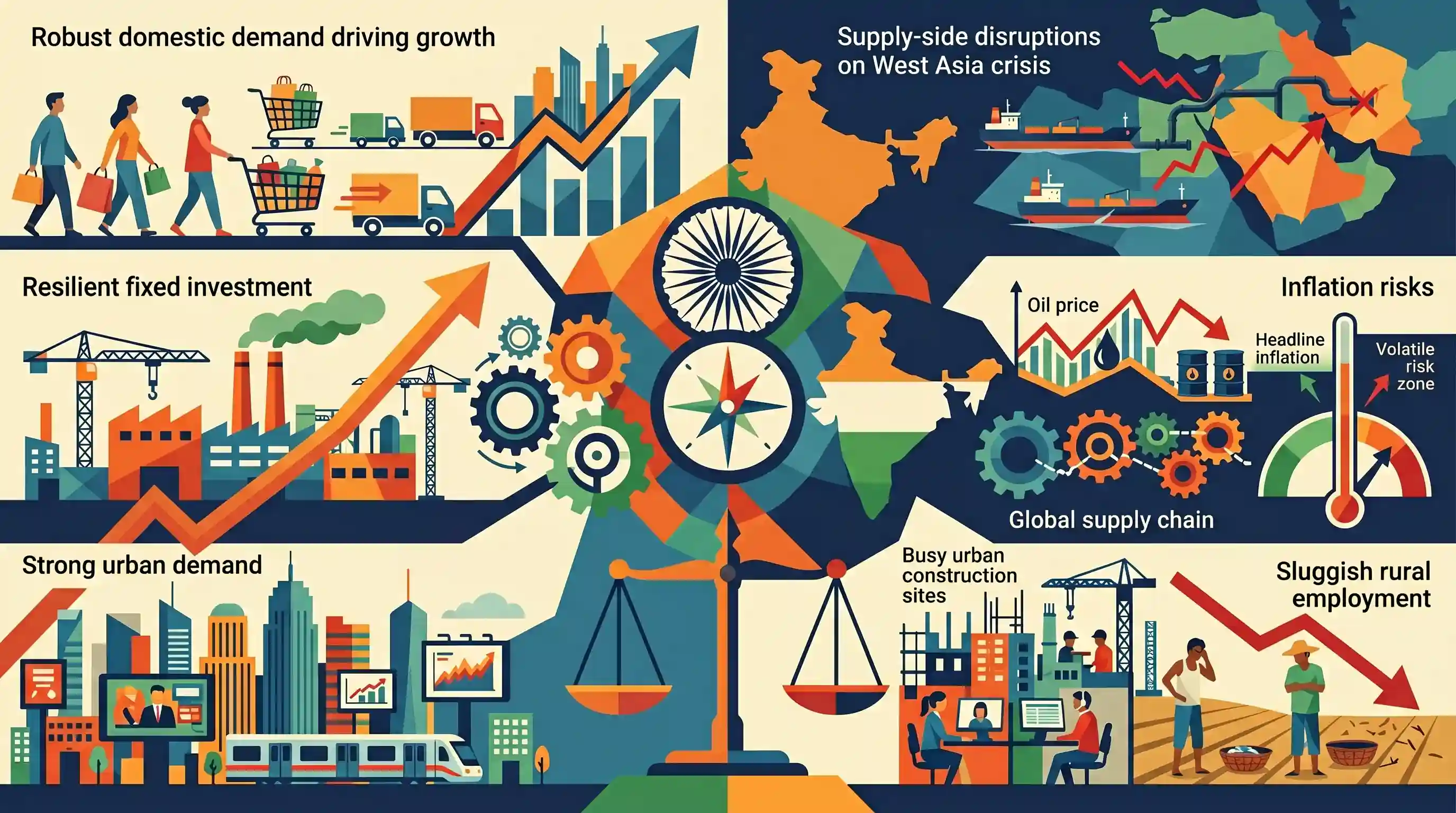
The Reserve Bank of India's 'State of the Economy' report for April highlights that while robust domestic demand continues to drive India's economic growth, the near-term outlook faces headwinds from supply-side disruptions linked to the West Asia crisis. Although headline inflation has moderated into the RBI's tolerance band, upside risks persist due to volatile crude oil prices and global supply chain bottlenecks. The report also notes a mixed macroeconomic picture, with resilient fixed investment and urban demand contrasted by sluggish rural employment growth and uneven high-frequency indicators.
Key Points
- The RBI's April 'State of the Economy' report identifies domestic demand as the primary driver of India's economic growth, supported by robust fixed investment.
- Near-term growth and inflation outlooks are clouded by supply-side pressures, specifically geopolitical tensions in West Asia leading to supply chain disruptions and volatile crude oil prices.
- Headline inflation has entered the RBI's tolerance band (2-6%), but potential pass-through of global commodity price shocks to domestic prices remains a concern.
- High-frequency indicators reveal a mixed picture: E-way bills point to resilient trade, but fuel consumption growth is sluggish, and rural employment conditions worsened in early 2026.
- Despite rural labor market stress, there was a sequential increase in the share of regular salaried employment and the labor force participation rate.
Important Terms
Reserve Bank of India (RBI)

India's central bank and regulatory body, established in 1935, responsible for monetary policy, currency issuance, and overseeing the country's financial system and banking sector.
UPSC context
GS Paper 3: Monetary policy, price stability, and economic growth; tests understanding of the central bank's functions and mandate.
Headline Inflation
The total inflation in an economy, including volatile components like food and fuel, usually reported via the Consumer Price Index (CPI) in India.
UPSC context
GS Paper 3: Inflation targeting and its impact on the economy; crucial for understanding the RBI's policy stance.
Tolerance Band
The range (currently 2% to 6%) within which the RBI is mandated to keep CPI inflation, centered around a 4% target.
UPSC context
GS Paper 3: Monetary Policy Framework; tests knowledge of statutory targets and the Monetary Policy Committee's accountability.
High-frequency indicators
Real-time or monthly data points (e.g., GST collections, auto sales, power consumption) used to track economic momentum before quarterly GDP figures are released.
UPSC context
GS Paper 3: Economic growth and development; used to assess the current health and trends of the economy.
Supply-side disruptions
External or internal shocks (e.g., wars, pandemics) that interrupt the production or flow of goods, often leading to cost-push inflation.
UPSC context
GS Paper 3: Effects of global geopolitics on India's economy and price stability.
Ministry of Statistics and Programme Implementation (MoSPI)
The nodal agency for official statistics in India, responsible for compiling national accounts (GDP), industrial production (IIP), and monitoring major government programmes.
UPSC context
GS Paper 3: Issues relating to planning, mobilization of resources, and economic data management.
Prelims Trap
An increase in the Labour Force Participation Rate (LFPR) always indicates a corresponding drop in unemployment.
LFPR measures those employed PLUS those actively seeking work. A rising LFPR alongside rural stress often indicates distress-driven job seeking, not actual employment generation.
Static Concepts Connected
What distinguishes Headline from Core Inflation in RBI's framework?
- Headline Inflation: Measures total price rise across a standard basket of goods, including highly volatile components like food and energy (imported crude oil).
- Core Inflation: Excludes volatile food and fuel prices to reveal the underlying, structural macroeconomic price trends, making it less susceptible to immediate supply shocks.
- RBI Mandate: The RBI's statutory monetary policy target (4% +/- 2% tolerance band) is strictly based on Headline CPI, not Core CPI.
What role do E-way bills play as High-Frequency Indicators (HFIs)?
- Tracking Real-Time Growth: HFIs are daily, weekly, or monthly data points used to gauge real-time economic momentum before official quarterly GDP estimates are released.
- E-way Bills: Mandatory digital permits under GST for moving goods over ₹50,000. Their generation volume acts as a highly accurate proxy for domestic trade resilience.
- Policy Agility: HFIs like E-way bills and fuel consumption allow the RBI to dynamically adjust interest rates against rapid external shocks, rather than relying on lagging data.
Cross-Topic Patterns
Imported Inflation via West Asia
Geopolitical bottlenecks in the Middle East directly translate into domestic inflation via higher freight costs and crude price volatility, demonstrating the limits of domestic monetary policy against global supply shocks.
Rural distress vs Urban salaried growth
The divergence between sluggish rural employment and resilient urban fixed investment highlights the persistent dual-economy challenge, frequently tested in Mains under the K-shaped economic recovery theme.

Expect a 2026 Prelims question testing the precise definitions of LFPR alongside the mechanics of imported inflation and core vs headline.
Linked PYQs · 4
Linked PYQs · 4
- 2024MainsGS3
What are the causes of persistent high food inflation in India? Comment on the effectiveness of the monetary policy of the RBI to control this type of inflation.
- 2022MainsGS3
Economic growth in the recent past has been led by increase in labour productivity." Explain this statement. Suggest the growth pattern that will lead to creation of more jobs without compromising labour productivity.
- 2022PrelimsGS1
With reference to the Indian economy, consider the following statements: 1. If the inflation is too high, Reserve Bank of India (RBI) is likely to buy government securities. 2. If the rupee is rapidly depreciating, RBI is likely to sell dollars in the market. 3. If interest rates in the USA or European Union were to fall, that is likely to induce RBI to buy dollars. Which of the statements given above are correct?
- 2022PrelimsGS1
In India, which one of the following compiles information on industrial disputes, closures, retrenchments and lay-offs in factories employing workers ?
