US State of the Union Highlights Trade and Tariffs
Source:The Hindu ↗
Why It Matters
The U.S. President's State of the Union address provides crucial insights into the superpower's policy trajectory. For UPSC aspirants, understanding U.S. protectionism (such as the imposition of tariffs) and its approach to West Asia (especially Iran) is vital, as these factors directly influence global macroeconomic stability and India's economic and strategic interests.
Summary
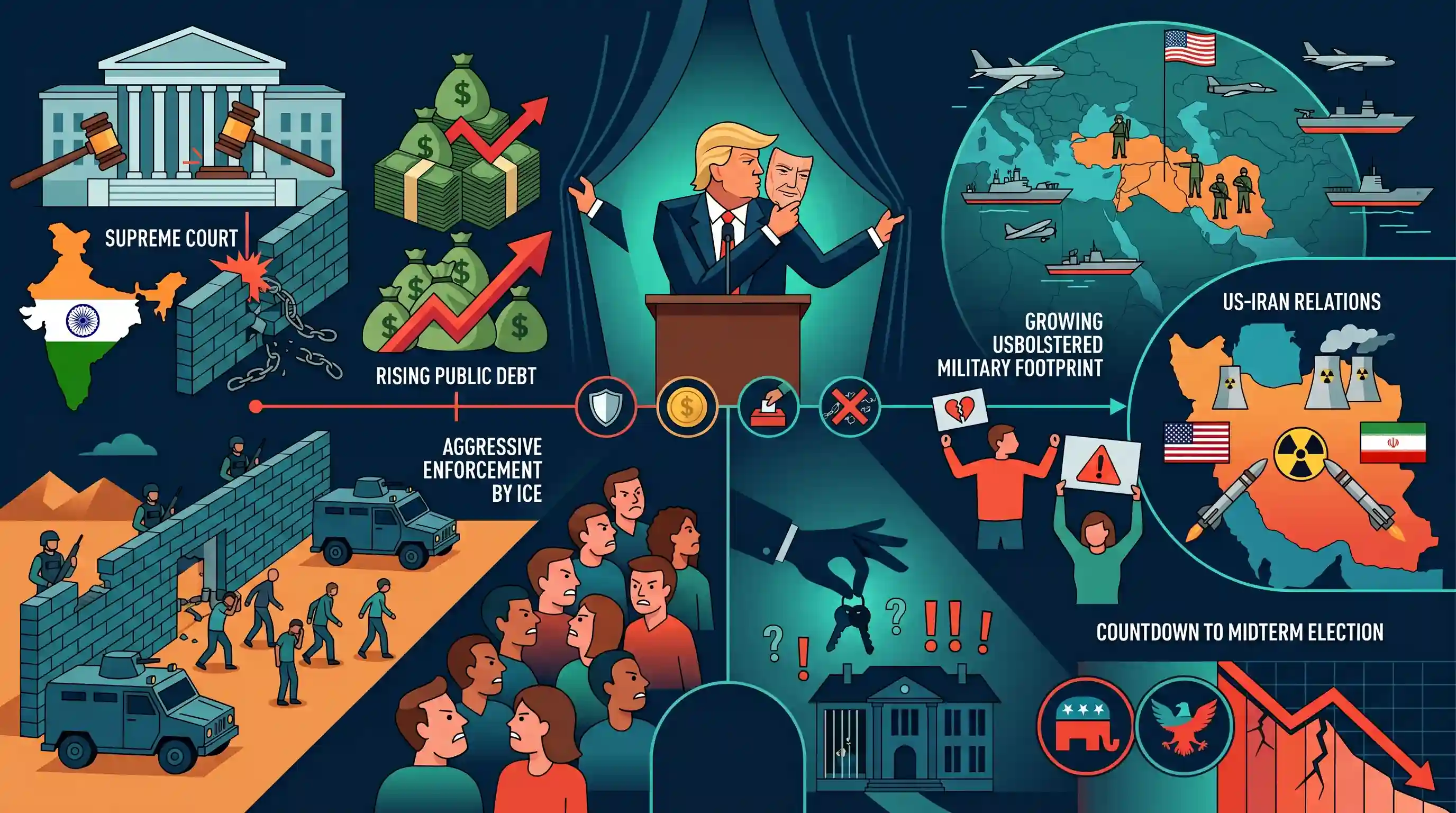
The editorial analyzes U.S. President Donald Trump's 2026 State of the Union address, characterizing him as a 'demagogue salesman' attempting to obscure the realities of his administration's policies. Key issues include the U.S. Supreme Court striking down his use of the International Emergency Economic Powers Act to impose sweeping tariffs on countries like India. Despite this setback and rising public debt, Trump doubled down on protectionism and aggressive immigration enforcement via ICE raids. On the international front, the U.S. is bolstering its military footprint in West Asia amid tensions with Iran over its nuclear program. The article notes that public dissatisfaction with these policies, coupled with controversies like the Epstein scandal, could spell trouble for the Republican Party in the approaching midterm elections.
Key Points
- U.S. President Donald Trump's 2026 State of the Union address highlighted his administration's hardline stances on immigration, trade, and foreign policy.
- The U.S. Supreme Court struck down the administration's use of the International Emergency Economic Powers Act to impose punitive tariffs on trading partners, including India.
- Despite the Supreme Court ruling, Trump continues to champion tariffs as a means to replace income taxes and 'save' the U.S. economy, even as public debt grows.
- On foreign policy, the U.S. is increasing its military presence in West Asia while Trump warns Iran against acquiring nuclear weapons, though he stated a preference for diplomacy.
- Trump took credit for plummeting inflation, although the downward trend had already begun during the Biden administration.
- Mounting dissatisfaction over tariffs, aggressive ICE raids, and Trump's association with the Epstein scandal could negatively impact the GOP in the upcoming midterm elections.
Important Terms
International Emergency Economic Powers Act (IEEPA)

A 1977 U.S. law authorizing the President to regulate international commerce and impose sanctions during a declared national emergency involving extraordinary external threats.
UPSC context
GS Paper II/III; explores executive overreach, trade legalities, and the specific impact of U.S. tariffs on India’s export sectors.
Protectionism
An economic policy that restricts imports via tariffs or quotas to shield domestic industries and workers from foreign competition.
UPSC context
GS Paper III (Economy); tests understanding of global trade shifts, macroeconomic stability, and challenges to India’s multilateral trade interests.
Immigration and Customs Enforcement (ICE)
A U.S. Department of Homeland Security agency that enforces federal laws governing border control, customs, trade, and immigration through detention and removal.
UPSC context
GS Paper II (IR); critical for analyzing the Indian diaspora's welfare, deportation trends, and strategic remittance flows.
State of the Union Address
The annual message delivered by the U.S. President to a joint session of Congress regarding the nation's condition and legislative agenda.
UPSC context
GS Paper II (Polity); tests comparative constitutional frameworks, specifically executive-legislative relations between Indian and U.S. political systems.
West Asia Geopolitics
The strategic interaction of regional powers (e.g., Iran) and external actors (e.g., U.S.) over energy, nuclear security, and maritime stability.
UPSC context
GS Paper II (IR); focuses on India’s strategic autonomy, energy security (Strait of Hormuz), and regional stability.
Judicial Review
The power of the judiciary to examine and invalidate government actions that are inconsistent with the higher law of the constitution.
UPSC context
GS Paper II (Polity); compares the U.S. Supreme Court’s powers with India’s "Basic Structure" doctrine and checks on executive power.
Prelims Trap
The US Executive has unilateral constitutional authority to levy tariffs under national emergencies.
Like India's Article 265, the US Constitution reserves the power to tax/levy tariffs to the legislature. Executive emergency powers cannot bypass this.
Static Concepts Connected
What are the primary instruments of trade protectionism?
- Tariff Barriers: Taxes imposed on imported goods to make them more expensive than domestic alternatives, often unilaterally applied by the executive.
- Non-Tariff Barriers: Includes quotas, licensing requirements, sanitary and phytosanitary (SPS) measures, and strict immigration/visa rules that block service mobility.
- Security Exceptions: Under GATT Article XXI, nations can restrict trade for national security reasons, a clause frequently invoked in modern trade wars.
Which maritime chokepoints are critical to West Asian geopolitics and India's energy?
- Strait of Hormuz: Connects the Persian Gulf to the Gulf of Oman. Highly vulnerable to US-Iran military escalation; crucial for India's oil imports.
- Bab-el-Mandeb: Connects the Red Sea to the Gulf of Aden. Vital for India's trade with Europe and the US via the Suez Canal.
- Chabahar Port: Strategic Iranian port allowing India to bypass Pakistan to access Afghanistan, Central Asia, and the INSTC route.
Cross-Topic Patterns
Protectionism + Indian IT Services
Aggressive US immigration enforcement and H-1B visa curbs directly impact India's service exports, which must be analyzed alongside goods protectionism as a dual shock to India's current account.
US-Iran Tensions + India's Energy Security
Increased US military posture against Iran complicates India's strategic balancing, directly threatening energy flows through the Strait of Hormuz and the viability of the Chabahar-INSTC transit corridor.

US protectionism and West Asia volatility could feature in a GS-2 Mains question on balancing India's export and energy security.
Linked PYQs · 4
Linked PYQs · 4
- 2018MainsGS3
How would the recent phenomena of protectionism and currency manipulations in world trade affect macroeconomic stability of India?
- 2025MainsGS3
What are the challenges before the Indian economy when the world is moving away from free trade and multilateralism to protectionism and bilateralism? How can these challenges be met?
- 2012MainsGS2
Discuss the likely negative impact of the protectionist measures proposed by the US on India's software industry.
- 2018MainsGS2
In what ways would the ongoing US-Iran Nuclear Pact Controversy affect the national interest of India? How should India respond to this situation?
