Genetically Modified Crops Regulation and Farmers Concerns
Source:The Hindu ↗
Why It Matters
The introduction of GM crops is a recurring and highly debated topic in Indian agriculture. It sits at the intersection of science and technology, food security, environmental conservation, and farmers' livelihoods. Understanding the regulatory mechanisms (such as GEAC), judicial oversight, and the socio-economic concerns of traditional farmers is crucial for evaluating biotechnology policies.
Summary
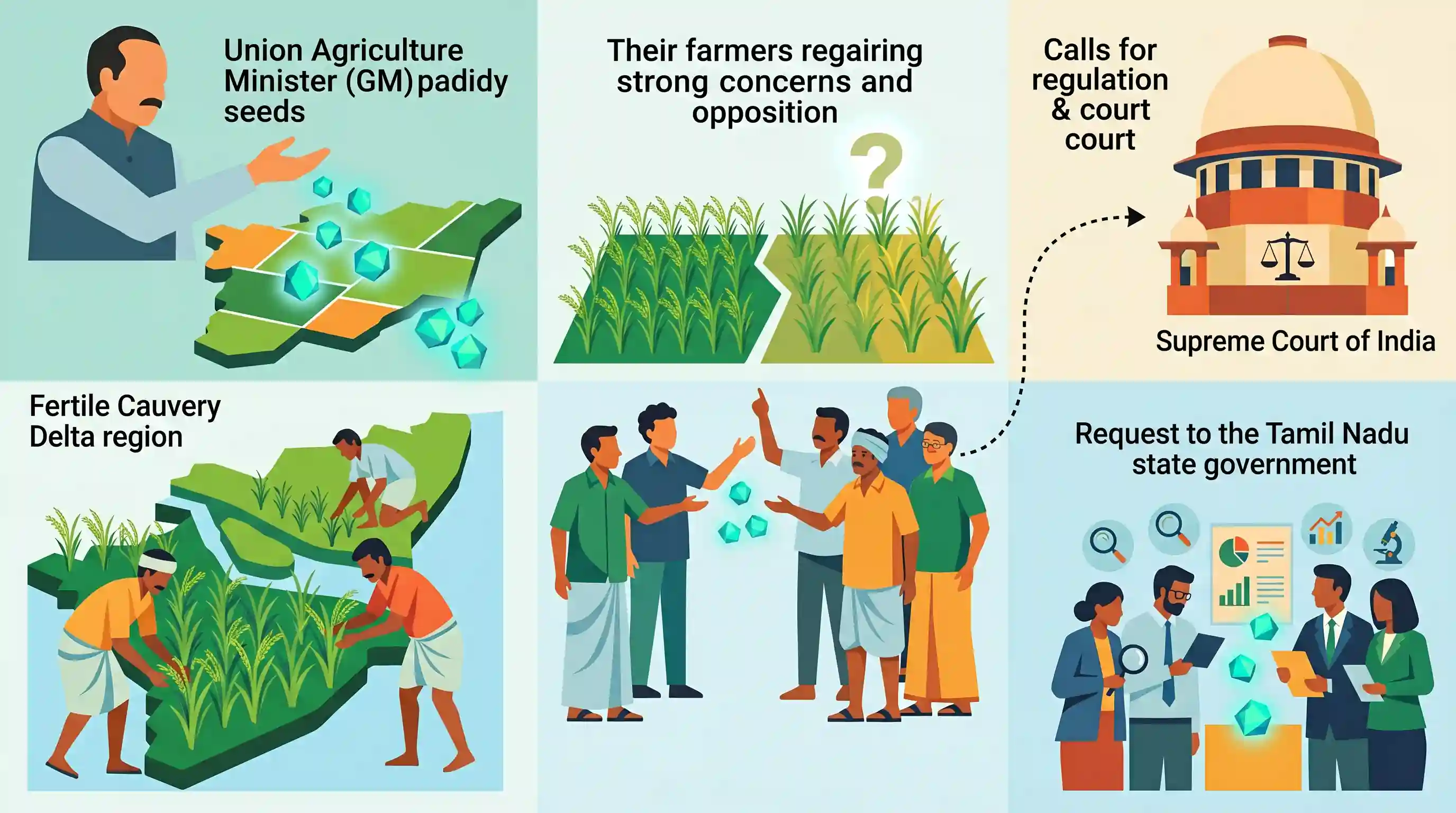
Delta farmers in Tamil Nadu have expressed strong concerns and sought clarification from the state government regarding reports of impending trials for genetically modified (GM) paddy seeds in the Cauvery delta region. Following the Union Agriculture Minister's release of new modified seeds, the Federation of All Farmers' Associations emphasized that farmers have historically opposed GM seeds due to fears of adverse ecological effects on traditional agricultural operations. Citing a pending Supreme Court case on the matter, the farmers urged the Tamil Nadu government to form an expert committee to analyze the environmental and agricultural impacts before allowing any GM seed testing in their time-tested farmlands.
Key Points
- Delta farmers in Tamil Nadu are seeking clarification from the State government over reports that genetically modified (GM) paddy seeds will be tested in their region.
- The concerns were sparked by the recent release of a new set of modified seeds by Union Agriculture Minister Shivraj Singh Chouhan.
- Farmers reiterated their longstanding opposition to GM seeds and noted that a relevant legal challenge remains pending before the Supreme Court.
- They have urged the State government to form an expert committee to thoroughly analyze the potential impacts of GM seeds on time-tested, traditional agricultural practices.
Important Terms
Federation of All Farmers’ Associations in Tamil Nadu

A coalition of regional farmers' groups advocating for seed sovereignty, ecological protection, and fair pricing; it acts as a key pressure group in Tamil Nadu's agricultural politics.
UPSC context
GS Paper II (Pressure Groups) and GS Paper III (Farmers' movements and agricultural policy).
Genetic Engineering Appraisal Committee (GEAC)
The apex technical body under the MoEFCC responsible for the appraisal of proposals relating to the release of genetically engineered organisms into the environment.
UPSC context
GS Paper III (Biotechnology and Statutory Bodies); tests knowledge of environmental regulation.
Genome Editing
A precise genetic modification technique (like CRISPR) that alters an organism's own DNA without foreign gene insertion. India regulates it more leniently than transgenic GMOs.
UPSC context
GS Paper III (Science & Tech); essential for distinguishing between GM and genome-edited crops.
DMH-11 (Dhara Mustard Hybrid-11)
A transgenic mustard hybrid developed in India, currently the subject of a Supreme Court battle regarding the environmental safety of GM food crops.
UPSC context
GS Paper III (Major crops and Biotechnology); a primary case study for agricultural innovation vs. safety.
National Policy on GM Crops
A court-mandated framework intended to provide a transparent, long-term roadmap for the research, cultivation, and trade of genetically modified organisms in India.
UPSC context
GS Paper II (Governance and Judiciary); tests understanding of judicial activism and executive policy-making.
Prelims Trap
The Union Government has exclusive authority to authorize and conduct open-field trials of GM crops anywhere in India.
While the central GEAC gives environmental clearance, agriculture is a State subject. Open-field trials strictly require a No Objection Certificate (NOC) from the respective State government.
Static Concepts Connected
What is the statutory basis and function of the GEAC?
- Statutory Backing: It derives its powers from the Rules notified under the Environment (Protection) Act, 1986, not an agriculture-specific act.
- Nodal Ministry: It functions under the Ministry of Environment, Forest and Climate Change (MoEFCC), not the Ministry of Agriculture.
- Core Mandate: It is the apex body appraising proposals for environmental release and experimental field trials of genetically engineered crops.
What is the current status of GM crop approvals in India?
- Commercial Cultivation: Bt Cotton remains the only GM crop formally approved for commercial cultivation in India (since 2002).
- Pending / Stalled: GM Mustard (DMH-11) received GEAC clearance in 2022 but remains stalled due to a July 2024 Supreme Court split verdict.
Cross-Topic Patterns
Biotechnology testing vs. State Autonomy
Agriculture is a State List subject, but GM environmental clearance falls under the Centre (EPA 1986). This necessitates State NOCs for field trials, making biotechnology a frequent flashpoint for federal friction.
GM Seeds and Traditional Varieties
The introduction of GM paddy directly clashes with traditional farming practices, highlighting the tension between patent-heavy agricultural biotechnology and indigenous seed sovereignty protected under the PPVFR Act.

Expect a multi-statement question in 2026 linking GEAC's EPA 1986 mandate, the state NOC requirement for field trials, and DMH-11 status.
Linked PYQs · 4
Linked PYQs · 4
- 2021PrelimsGS1
Bollgard I and Bollgard II technologies are mentioned in the context of
- 2019MainsGS3
How can biotechnology help to improve the living standards of farmers?
- 2020MainsGS3
How is science interwoven deeply with our lives? What are the striking changes in agriculture triggered off by the science-based technologies?
- 2021MainsGS3
What are the present challenges before crop diversification? How do emerging technologies provide an opportunity for crop diversification?
