Delimitation and Women Reservation Dynamics
Source:The Hindu ↗
Why It Matters
This intersection is a highly probable UPSC Mains topic because it combines two major recent constitutional debates: the North-South demographic divide affecting federal representation via delimitation, and the historic 106th Amendment Act aimed at women's political empowerment.
Summary
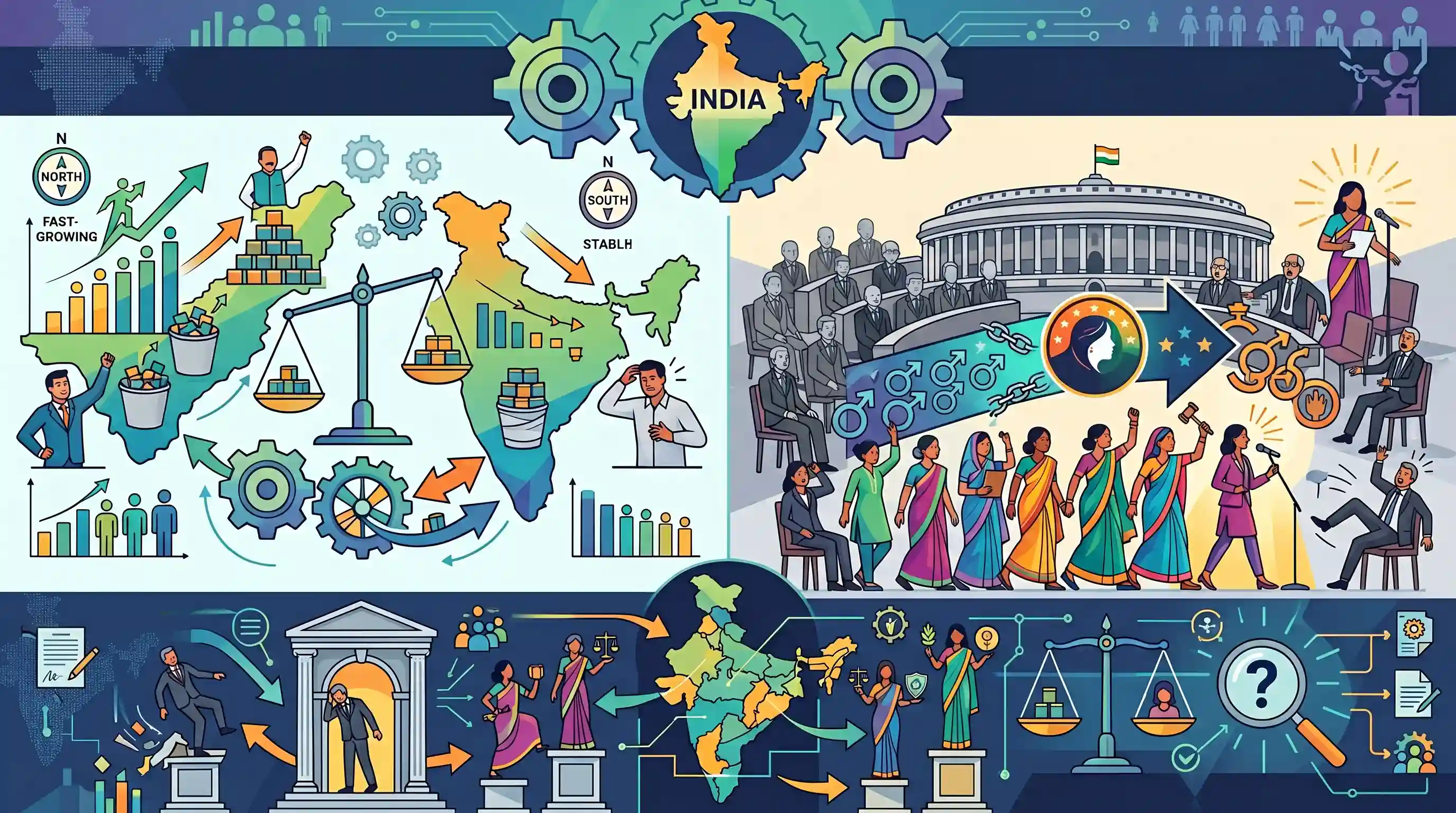
The article analyzes the complex political dynamics at the intersection of the impending delimitation exercise and the implementation of the women's reservation law (Nari Shakti Vandan Adhiniyam). While delimitation threatens to exacerbate the North-South federal divide by penalizing states that have successfully controlled their populations, the simultaneous reservation of 33% of seats for women introduces a massive structural disruption to the existing patriarchal political establishment. Together, these two mechanisms will fundamentally redraw India's electoral map, displace entrenched incumbents, and test the resilience of federalism and genuine female political empowerment.
Key Points
- The implementation of the Nari Shakti Vandan Adhiniyam, which mandates a 33% quota for women in the Lok Sabha and State Assemblies, is legally contingent upon the completion of the next delimitation exercise post-2026.
- The upcoming delimitation poses a significant federal challenge: southern states fear a proportionate loss of parliamentary representation due to their success in population control, while northern states stand to gain seats.
- The simultaneous rollout of delimitation and women's reservation will drastically restructure political power, displacing incumbent male politicians and redrawing the electoral calculus across constituencies.
- This intersection of representational shifts offers a historic opportunity to reshape the deeply entrenched patriarchal nature of Indian politics, though lessons from local bodies show the need to guard against tokenism (e.g., 'Sarpanch Pati' syndrome).
Important Terms
Nari Shakti Vandan Adhiniyam (106th Amendment Act)

Act mandating 33% reservation for women in Lok Sabha and state assemblies; implementation is linked to post-2023 census and subsequent delimitation.
UPSC context
GS II: Governance/Women's Empowerment. Tests constitutional amendments and socio-political participation hurdles.
84th Constitutional Amendment Act
2001 amendment that froze Lok Sabha seat allocation among states until the first census after 2026 to encourage population control efforts.
UPSC context
GS II: Federal Structure. Tests demographic impacts on political representation and the North-South federal divide.
Delimitation Commission
Statutory body appointed by the President to redraw constituency boundaries based on census data; its final orders cannot be challenged in court.
UPSC context
GS II: Statutory Bodies. Tests understanding of independent electoral mechanisms and proportional representation principles.
Delimitation Act
Parliamentary legislation enacted under Article 82 providing the legal authority to constitute a Commission for periodic readjustment of electoral boundaries.
UPSC context
GS II: Parliament/Elections. Tests knowledge of the legislative framework for periodic electoral boundary adjustments.
Article 82
Constitutional provision mandating Parliament to enact a law for the readjustment of constituency boundaries and seat allocation after every decennial census.
UPSC context
GS II: Constitution. Tests specific constitutional mandates for maintaining equitable political representation across India.
Prelims Trap
The 106th Constitutional Amendment mandates 33% reservation for women in both Houses of Parliament and State Legislatures.
The quota applies strictly to the Lok Sabha, State Legislative Assemblies, and the Delhi Assembly. It does NOT extend to the Rajya Sabha or State Legislative Councils.
Static Concepts Connected
How is the Delimitation Commission empowered under the Constitution?
- Binding nature: The Commission's orders have the force of law and cannot be challenged in any court.
- No legislative modification: Neither the Parliament nor State Legislative Assemblies can modify the orders issued by the Delimitation Commission.
- Constitution: Appointed by the President, the Commission functions in direct collaboration with the Election Commission of India.
Which Constitutional Amendments froze the inter-state allocation of Lok Sabha seats?
- 42nd Amendment (1976): Froze the allocation of seats to states based on the 1971 census until the year 2000 to encourage population stabilization measures.
- 84th Amendment (2001): Extended the freeze on the inter-state reallocation of Lok Sabha seats until the figures of the first census published after 2026.
- 87th Amendment (2003): Allowed territorial readjustment of constituencies within a state based on the 2001 census without altering the total seat count for that state.
Cross-Topic Patterns
Demographic Dividend vs. Federal Penalty
Southern states face a dual challenge: potential loss of Lok Sabha representation via delimitation, and reduced tax devolution from the Finance Commission, which heavily weighs current population metrics.
PRI parallels in National Women's Quota
The 106th CAA extends the 73rd/74th Amendment logic to Parliament. Mains answers must connect the 'Sarpanch Pati' syndrome in PRIs to the risks of proxy representation at the national level.

Expect a multi-statement question on the 106th CAA testing Articles 330A/332A, delimitation prerequisites, and exclusion of Rajya Sabha.
Linked PYQs · 4
Linked PYQs · 4
- 2019MainsGS2
“The reservation of seats for women in the institutions of local self-government has had a limited impact on the patriarchal character of the Indian Political Process.” Comment.
- 2023MainsGS2
Discuss the contribution of civil society groups for women's effective and meaningful participation and representation in state legislatures in India.
- 2019MainsGS1
“Empowering women is the key to control population growth.” Discuss.
- 2022MainsGS2
“While the national political parties in India favour centralisation, the regional parties are in favour of State autonomy.” Comment.
