Delimitation Debate and Federal Representation in Indian Democracy
Source:Indian Express ↗
Why It Matters
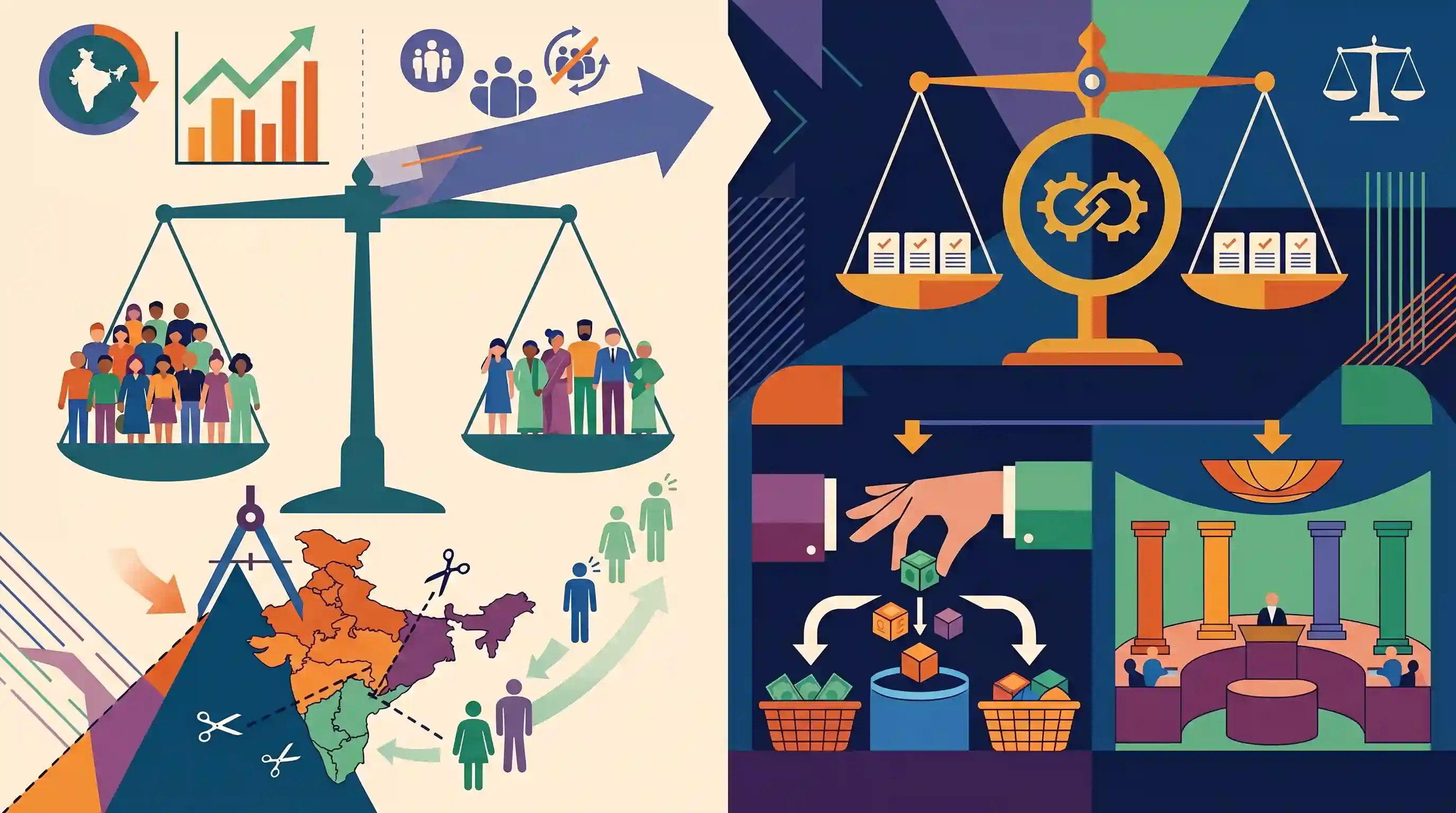
The freezing of Lok Sabha seats ends in 2026, making delimitation a critical and highly contentious upcoming issue. It directly touches upon the core UPSC syllabus areas of Indian federalism, democratic representation, and Centre-State fiscal/political relations.
Summary
The article examines the complex debate surrounding the upcoming delimitation of Lok Sabha constituencies, which threatens to reduce the political weight of southern states that have successfully curbed population growth. While acknowledging these states' legitimate anxieties about being penalized for effective governance, the author emphasizes that the democratic tenet of 'one person, one vote' is non-negotiable and requires equal representation for all citizens regardless of their state. The core argument is that population policy should not be used as a tool to block delimitation. Instead, concerns about regional marginalization should be addressed through stronger federal safeguards, such as the Finance Commission's tax devolution criteria and a more empowered Rajya Sabha, ensuring that individual democratic equality is not sacrificed for federal balance.
Key Points
- The upcoming unfreezing of parliamentary seats (delimitation) has sparked anxiety among southern states regarding a potential loss of political representation compared to more populous northern states.
- The author argues that the democratic ideal of 'one person, one vote' requires all citizens' votes to have equal weight, necessitating seat reallocation based on current population data.
- Relying on state-level population control policies as an argument to halt delimitation fundamentally conflicts with individual democratic rights.
- To resolve this tension, India must address federal imbalances through other constitutional mechanisms, such as Finance Commission tax devolution (rewarding demographic performance) or reforming the Rajya Sabha, rather than distorting democratic representation in the Lok Sabha.
Important Terms
Delimitation Commission

An independent body appointed by the President (under Article 82) to redraw electoral constituency boundaries based on census data to ensure uniform population representation.
UPSC context
GS Paper 2 (Polity); central to discussions on electoral reforms, democratic representation, and the 'one person, one vote' principle.
84th Constitutional Amendment Act
A 2001 law that froze the total number of seats in the Lok Sabha and State Assemblies until 2026 to encourage population stabilization without loss of representation.
UPSC context
GS Paper 2 (Federalism); explains the current freeze on delimitation and the impending 2026 deadline for seat reallocation.
Finance Commission
A constitutional body (Article 280) that recommends the distribution of tax revenues between the Union and States, often using population as a key horizontal devolution criterion.
UPSC context
GS Paper 2 & 3 (Fiscal Federalism); examines how fiscal transfers address regional disparities and reward demographic management.
Rajya Sabha
The 'Council of States' or Upper House of Parliament, designed to protect federal interests and provide regional representation regardless of a state's population size.
UPSC context
GS Paper 2 (Parliament); tests the role of the second chamber in balancing majoritarianism and protecting state rights.
One person, one vote
A fundamental democratic tenet where every citizen's vote carries equal weight, requiring that the ratio of seats to population remains consistent across all electoral districts.
UPSC context
GS Paper 2 (Governance/Ethics); tests the tension between individual political equality and the collective federal rights of states.
Prelims Trap
"The Delimitation Commission's orders are laid before Parliament, which can make modifications before final implementation."
Delimitation Commission orders have the force of law. They cannot be modified by Parliament or State Legislatures, and they enjoy absolute immunity from judicial review.
Static Concepts Connected
How did the 42nd and 84th Amendments freeze delimitation?
- 42nd Amendment (1976): Froze the allocation of Lok Sabha seats to states at 1971 Census levels until the year 2000 to encourage population control measures.
- 84th Amendment (2001): Extended the freeze on the total number of Lok Sabha seats until the publication of the first census figures post-2026.
- 87th Amendment (2003): Allowed the readjustment of territorial constituency boundaries within a state (without altering total seats) based on the 2001 Census.
What are the unique powers of the Delimitation Commission?
- Judicial Immunity: Its orders carry the force of law and cannot be questioned or challenged in any court.
- No Legislative Modification: Copies of orders are laid before Parliament and State legislatures, but these bodies cannot effect any modifications to them.
- Composition: Typically comprises a retired Supreme Court judge, the Chief Election Commissioner, and the respective State Election Commissioner.
Cross-Topic Patterns
Demographic performance vs. Fiscal Devolution
The 15th FC used the 2011 census but added a 'Demographic Performance' weight to reward states for population control. The delimitation debate mirrors this exact fiscal federalism tension.
Rajya Sabha reform and Asymmetric Federalism
Unlike the US Senate's equal state representation, Rajya Sabha seats are population-based. Delimitation fears in southern states are renewing debates on adopting symmetric federalism in India's Upper House.

Expect a 2026 Mains question linking Article 81 ('one person, one vote') with North-South federal friction and FC devolution.
Linked PYQs · 4
Linked PYQs · 4
- 2024PrelimsGS1
How many Delimitation Commissions have been constituted by the Government of India till December 2023?
- 2023PrelimsGS1
Consider the following: 1. Demographic performance 2. Forest and ecology 3. Governance reforms 4. Stable government 5. Tax and fiscal efforts For the horizontal tax devolution, the Fifteenth Finance Commission used how many of the above as criteria other than population area and income distance?
- 2025MainsGS2
Examine the evolving pattern of Centre-State financial relations in the context of planned development in India. How far have the recent reforms impacted the fiscal federalism in India?
- 2015MainsGS2
The concept of cooperative federalism has been increasingly emphasized in recent years. Highlight the drawbacks in the existing structure and the extent to which cooperative federalism would answer the shortcomings.
