Delimitation Exercise Threatens Constitutional Federalism Balance
Source:The Hindu ↗
Why It Matters
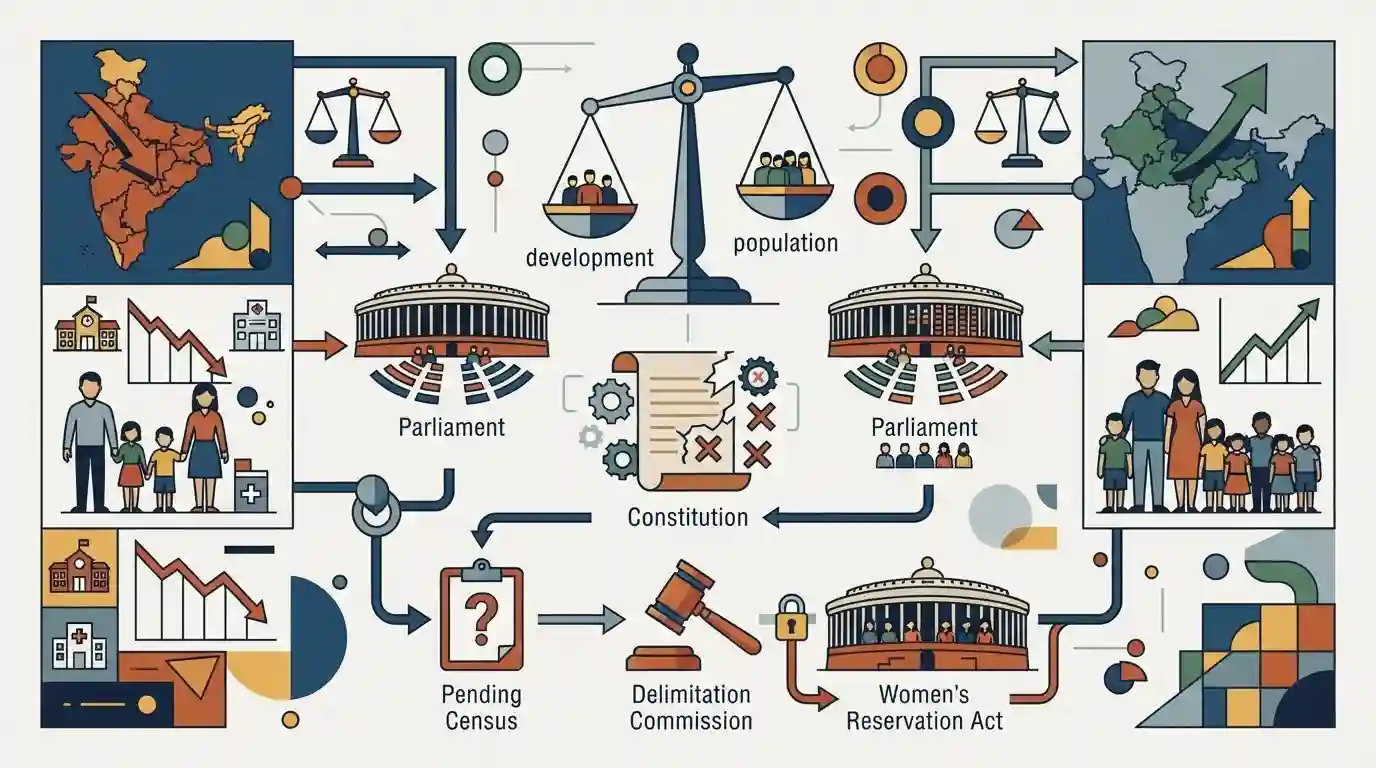
The upcoming delimitation exercise presents a critical test for Indian federalism. It highlights the tension between the democratic principle of 'one person, one vote' and the federal necessity of ensuring that states are not penalized politically for achieving national goals like population control.
Summary
Congress leader K.C. Venugopal has stated that the impending delimitation exercise is a fundamental challenge to India's Constitutional framework rather than just a political issue for the opposition INDIA bloc. The central conflict arises from the fact that Southern states, having successfully implemented family planning and population control measures, face the prospect of a reduced share of Lok Sabha seats if representation is strictly reapportioned based on current population figures. This scenario creates a federal imbalance, penalizing states for good governance while rewarding those with higher population growth. Furthermore, the issue is complicated by its direct link to the 106th Constitutional Amendment Act (Nari Shakti Vandan Adhiniyam), which makes the implementation of women's reservation contingent upon the completion of the census and the ensuing delimitation process.
Key Points
- The freeze on the number of Lok Sabha seats, established by the 42nd Amendment (1976) and extended by the 84th Amendment (2001) up to 2026, will be lifted after the publication of the first census conducted post-2026.
- Southern Indian states have effectively managed population growth, and fear that a purely population-based delimitation will drastically reduce their proportional political representation in Parliament compared to populous Northern states.
- Congress leader K.C. Venugopal emphasized that delimitation is a core Constitutional and federalism issue, not merely a political concern for the opposition INDIA bloc, as it risks penalizing states for good governance and effective demographic transition.
- The implementation of the 106th Constitutional Amendment Act (Nari Shakti Vandan Adhiniyam), which provides 33% reservation for women in legislative bodies, is intrinsically tied to the completion of the upcoming census and subsequent delimitation.
Important Terms
Delimitation Commission

A high-powered statutory body constituted by the President to redraw the boundaries of parliamentary and assembly constituencies using Census data. Its legally binding orders cannot be challenged in court, ensuring fair population representation.
UPSC context
GS Paper 2 (Indian Polity). Tests knowledge of constitutional bodies (Article 82), election mechanisms, and federal representation disputes.
106th Constitutional Amendment Act
Also known as the Nari Shakti Vandan Adhiniyam, this landmark 2023 amendment reserves 33% of Lok Sabha and State Assembly seats for women, though implementation is delayed until the post-2026 delimitation exercise.
UPSC context
GS Paper 2 (Polity/Social Justice). Evaluates constitutional amendments, women's political empowerment, and the procedural linkage to the census.
84th Constitutional Amendment Act
Enacted in 2001, this amendment extended the freeze on the inter-state allocation of Lok Sabha and Assembly seats until the first census after 2026, protecting states that successfully curbed population growth.
UPSC context
GS Paper 2 (Federalism). Tests understanding of center-state relations, electoral boundaries, and the North-South demographic divide.
42nd Constitutional Amendment Act
Passed in 1976, this act initially froze the number of Lok Sabha seats per state based on the 1971 Census to encourage population control, establishing the framework for today's delimitation controversies.
UPSC context
GS Paper 2 (Polity). Tests the historical rationale for freezing parliamentary seats and its long-term impact on political representation.
Prelims Trap
The total seats and internal constituency boundaries in the Lok Sabha are both currently frozen based on the 1971 Census.
The total number of seats per state is frozen based on the 1971 Census, but internal constituency boundaries were updated based on the 2001 Census (87th Amendment).
Static Concepts Connected
What constitutional provisions govern electoral delimitation and the status of its commission's orders?
- Constitutional Mandate: Article 82 and Article 170 empower Parliament to enact Delimitation Acts and readjust seats after each census.
- Commission Orders: Under Article 329, orders laid before Parliament/Assemblies cannot be modified and traditionally carry the force of law, barring routine judicial challenges.
- Recent Jurisprudence: In 2024, the Supreme Court clarified that judicial review is permissible if commission orders are "manifestly arbitrary" or violate core constitutional values.
How have constitutional amendments structured the freeze on seat allocation?
- 42nd Amendment (1976): Froze seat allocation for Lok Sabha and Assemblies based on the 1971 census to support population stabilization policies.
- 84th Amendment (2001): Extended this freeze on the total number of seats to the first census after 2026.
- 87th Amendment (2003): Allowed redistribution of boundaries within states using the 2001 census data, without altering the total seat count of any state.
Cross-Topic Patterns
Demographic divergence and cooperative federalism
Southern states face a political representation penalty for successful demographic transition, showcasing a direct clash between demographic performance and federal equity in parliamentary representation.
Gender justice linked to electoral mechanics
The 106th Amendment ties women's reservation to the post-2026 census and delimitation, making gender justice contingent on resolving complex federal disputes over regional seat reallocation.

The constitutional clash between demographic performance and federal representation equity is likely to be a high-yield GS-II Mains theme.
Linked PYQs · 4
Linked PYQs · 4
- 2024PrelimsGS1
How many Delimitation Commissions have been constituted by the Government of India till December 2023?
- 2012PrelimsGS1
With reference to the Delimitation Commission, consider the following statements: 1. The orders of the Delimitation Commission cannot be challenged in a Court of Law. 2. When the orders of the Delimitation Commission are laid before the Lok Sabha or State Legislative Assembly, they cannot effect any modifications in the orders. Which of the statements given above is/are correct?
- 2015MainsGS2
The concept of cooperative federalism has been increasingly emphasized in recent years. Highlight the drawbacks in the existing structure and the extent to which cooperative federalism would answer the shortcomings.
- 2025MainsGS2
Indian Constitution has conferred the amending power on the ordinary legislative institutions with a few procedural hurdles. In view of this statement, examine the procedural and substantive limitations on the amending power of the Parliament to change the Constitution.
