Delimitation and Equitable Political Representation Framework
Source:Indian Express ↗
Why It Matters
Delimitation is a critical polity topic that intersects federalism, representation, and demographic distribution, making it vital for understanding future power dynamics in Indian governance.
Summary
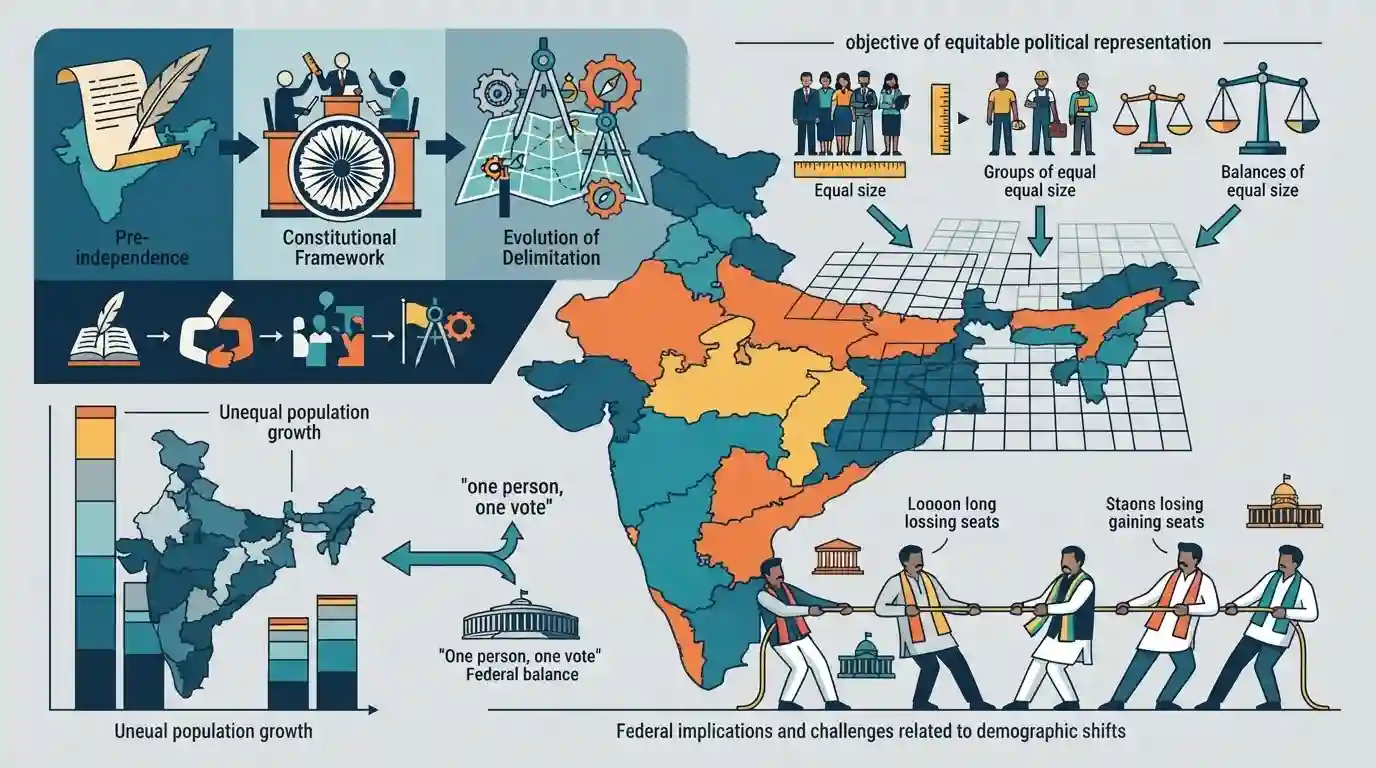
The article explores the constitutional framework, historical context, and federal implications of the delimitation process in India, emphasizing its objective of equitable political representation while highlighting challenges related to demographic shifts.
Key Points
- Delimitation involves redrawing boundaries of Lok Sabha and Assembly constituencies to ensure equitable political representation based on population.
- Article 82 of the Constitution provides for readjustment after each census, while Article 81 ensures territorial constituency allocation.
- Past freezes on delimitation (such as the 42nd and 84th Constitutional Amendments) were intended to prevent penalising southern states for population control success.
- Upcoming delimitation exercises pose federal challenges regarding potential shifts in political power across states based on demographic changes.
Important Terms
Delimitation Act

A statute enacted by the Parliament of India under Article 82 to establish a Delimitation Commission for redrawing electoral constituency boundaries based on population census data.
UPSC context
GS Paper II (Polity): Tests understanding of statutory frameworks governing electoral representation and federal balance in India.
Constitutional Amendment Act
A formal alteration of the Constitution of India made under Article 368, used to freeze, adjust, or reform seat allocations and boundaries in legislatures.
UPSC context
GS Paper II (Polity): Crucial for studying amendment procedures, basic structure, and federal implications like the delimitation freeze.
Parliament of India
The supreme legislative body of India comprising the President, Lok Sabha, and Rajya Sabha, responsible for enacting laws including delimitation legislation.
UPSC context
GS Paper II (Polity): Tests the structure, functioning, powers, and legislative responsibilities of India's bicameral federal legislature.
Delimitation Commission
An independent statutory body appointed by the President of India to readjust parliamentary and assembly constituency boundaries following a census.
UPSC context
GS Paper II (Polity): Important for questions on independent electoral bodies, federal representation, and demographic challenges in Indian democracy.
Prelims Trap
orders of the Delimitation Commission require subsequent ratification by Parliament and are subject to judicial review.
Aspirants often assume that since delimitation changes state seat shares, the Delimitation Commission's orders require parliamentary ratification. In reality, their orders have the force of law directly and cannot be challenged in any court.
Static Concepts Connected
What are the constitutional provisions and legal status governing the Delimitation Commission in India?
- Article 82 & 170: Constitutional Mandate: Article 82 provides for readjustment of seat allocation after each census, while Article 170 governs state assembly constituencies.
- Statutory Status: Statutory Body: Appointed by the President of India and works in collaboration with the Election Commission of India under a Delimitation Act enacted by Parliament.
- Judicial Bar: Finality of Orders: Under the Delimitation Act provisions, its orders have the force of law and cannot be questioned in any court of law.
- Seat Freezes: Historical Freezes: The 42nd and 84th Constitutional Amendments froze total seat allocations until the first census after 2026 to prevent penalizing population-controlling states.
Cross-Topic Patterns
Delimitation versus Southern Demographic Success
Southern states that successfully implemented family planning face potential reduction in parliamentary weight post-2026, triggering intense fiscal-federalism and cooperative-federalism debates.
Constitutional Amendments and Federal Balancing
Constitutional amendments freezing seat counts demonstrate how socio-economic policy goals override literal textual mandates of regular decennial readjustment under Article 82.

Expect a statement-based prelims question on Delimitation Commission orders having force of law and immunity from court scrutiny.
Linked PYQs · 2
Linked PYQs · 2
- 2024PrelimsGS1
How many Delimitation Commissions have been constituted by the Government of India till December 2023?
- 2023PrelimsGS1
Consider the following statements in respect of election to the President of India: 1. The members nominated to either House of the Parliament or the Legislative Assemblies of States are also eligible to be included in the Electoral College. 2. Higher the number of elective Assembly seats, higher is the value of vote of each MLA of that State. 3. The value of vote of each MLA of Madhya Pradesh is greater than that of Kerala. 4. The value of vote of each MLA of Puducherry is higher than that of Arunachal Pradesh because the ratio of total population to total number of elective seats in Puducherry is greater as compared to Arunachal Pradesh. How many of the above statements are correct?
