Delimitation process and urban female voter turnout dynamics
Source:Indian Express ↗
Why It Matters
This article critically intersects three vital UPSC themes: structural electoral reforms (Delimitation), social justice (women's reservation via Nari Shakti Vandan Adhiniyam), and urban governance challenges (74th Amendment, NULM). It provides a high-level analytical framework for GS2 answers regarding how demographic shifts and urban apathy can be structurally mitigated.
Summary
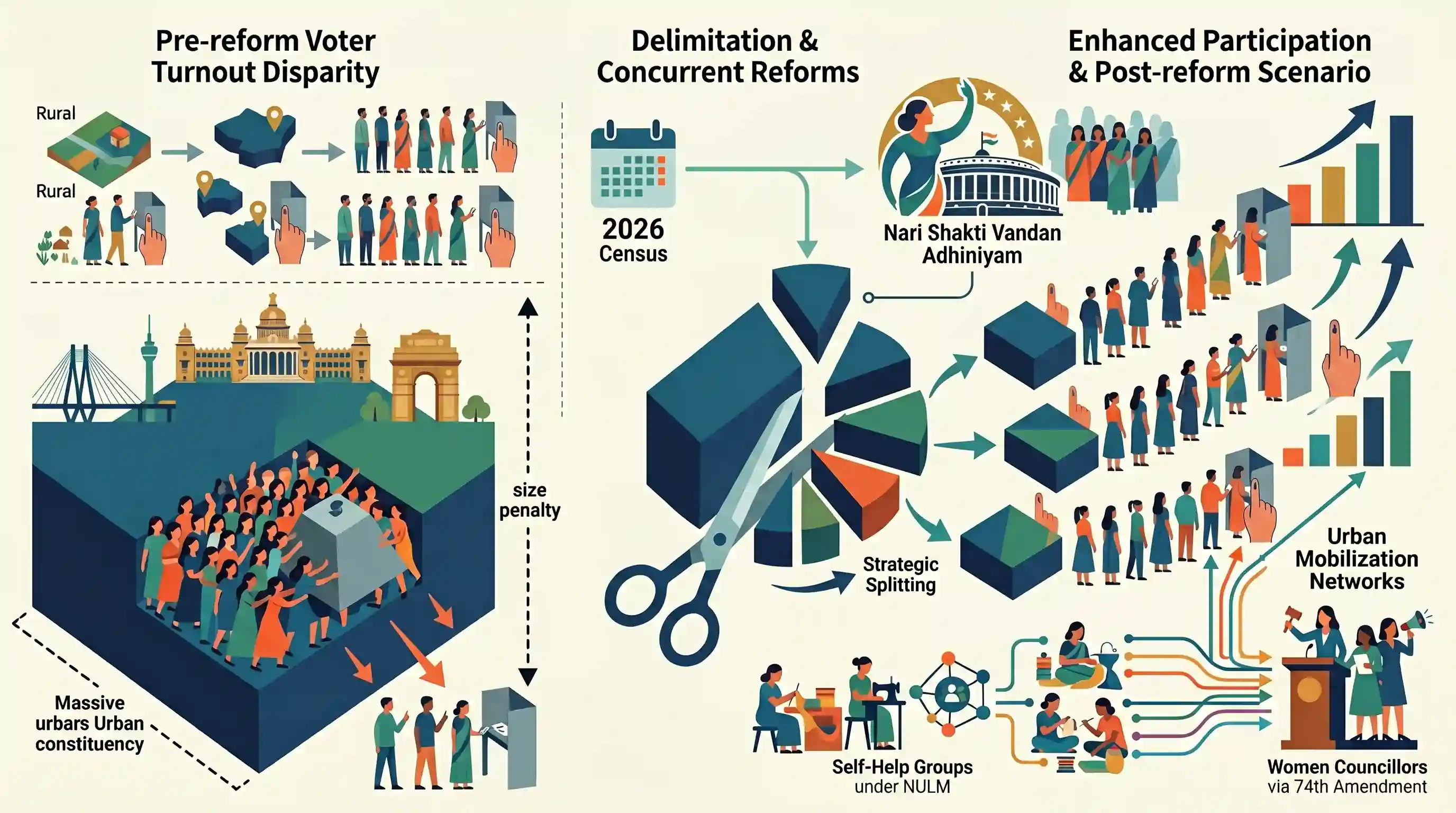
The article argues that the upcoming delimitation process, expected to follow the 2026 census, should be strategically utilized to resolve the persistent urban-rural voter turnout disparity. Large constituency sizes impose a 'size penalty' that leads to severe booth crowding and depressed turnout, predominantly impacting urban women, who are currently the least engaged electoral demographic. By strategically splitting massive urban constituencies in cities like Mumbai, Bengaluru, and NCR, electoral participation can be significantly enhanced. Furthermore, the article highlights the importance of concurrent reforms, noting that the delimitation will coincide with the Nari Shakti Vandan Adhiniyam. To capitalize on this, the author recommends utilizing urban-specific grassroots networks—such as Self-Help Groups under the National Urban Livelihoods Mission and women councillors elected via the 74th Amendment—to actively mobilize urban women voters.
Key Points
- The post-2026 delimitation exercise, which could expand the Lok Sabha to 816 seats, provides a critical opportunity to address the urban-rural voter turnout gap.
- A distinct 'size penalty' reduces voter turnout in large constituencies, affecting urban areas much more severely than rural ones, leading to extreme booth crowding.
- Urban women represent the least engaged voting demographic; while rural women in large constituencies maintain a ~75% turnout, urban women drop to ~64%.
- The upcoming delimitation will coincide with the enforcement of the Nari Shakti Vandan Adhiniyam, creating a unique synergy to boost female political representation.
- Shrinking the geographical and demographic size of massive urban constituencies (like Bengaluru, Mumbai, and NCR) can directly improve voter accessibility and participation.
- Leveraging urban-specific mobilization networks, such as women councillors empowered by the 74th Amendment and SHGs under the National Urban Livelihoods Mission, is essential to mobilize the urban female electorate.
Important Terms
Nari Shakti Vandan Adhiniyam

Enacted as the 106th Constitutional Amendment, it reserves 33% of seats in the Lok Sabha, State Legislative Assemblies, and the Delhi Assembly for women, to be implemented after the upcoming census and delimitation.
UPSC context
GS-II: Polity/Women Empowerment. Tests understanding of legislative reforms for gender-inclusive governance and their procedural dependencies.
Delimitation Commission
A statutory, high-powered body appointed by the President to redraw Lok Sabha and Assembly constituency boundaries based on census data to ensure uniform population distribution and fair representation.
UPSC context
GS-II: Polity/Elections. Tests knowledge of Article 82, electoral fairness, and the impact of demographic shifts on legislative representation.
74th Constitutional Amendment Act
This 1992 Act granted constitutional status to Urban Local Bodies (Municipalities), introducing Part IXA to the Constitution and mandating the devolution of power, regular elections, and 33% reservation for women.
UPSC context
GS-II: Polity/Decentralization. Tests understanding of the 3-tier governance structure and the constitutional framework for urban local governance.
National Urban Livelihoods Mission (NULM)
A centrally sponsored scheme launched in 2013 to alleviate urban poverty by organizing poor households into grassroots institutions and providing skill training, self-employment opportunities, and access to credit.
UPSC context
GS-II: Governance/Welfare Schemes. Evaluates knowledge of urban poverty alleviation strategies and the role of community-based empowerment.
Self-Help Groups (SHGs)
Informal, voluntary groups (usually 10-20 women) from similar socio-economic backgrounds who pool savings to provide micro-loans for members, fostering financial independence and collective social mobilization.
UPSC context
GS-II: Social Justice/Poverty Alleviation. Focuses on social capital, micro-finance as a development tool, and grassroots empowerment.
Prelims Trap
The 106th Amendment mandates immediate 33% reservation for women in the Lok Sabha and State Assemblies.
Implementation of the 106th CAA (Nari Shakti Vandan Adhiniyam) is explicitly contingent upon the completion of a delimitation exercise based on the first census taken after 2026.
Static Concepts Connected
How is the Delimitation Commission constituted and what are its powers?
- Constitutional Basis: Under Article 82, Parliament enacts a Delimitation Act, after which the President formally appoints the Delimitation Commission.
- Binding Authority: Commission orders have the force of law and cannot be challenged in any court, preventing endless litigation and electoral delays.
- Composition: It is headed by a retired Supreme Court judge and includes the Chief Election Commissioner and respective State Election Commissioners.
What are the key features of the 106th Constitutional Amendment Act (Women's Reservation)?
- 33% Quota: Reserves one-third (33%) of all seats in the Lok Sabha, State Legislative Assemblies, and the NCT of Delhi for women.
- SC/ST Inclusion: Includes a sub-quota mechanism, reserving one-third of the seats already designated for SCs and STs specifically for women.
- Sunset Clause: The reservation will initially last for 15 years from commencement, requiring parliamentary extension to continue beyond this period.
Cross-Topic Patterns
Urban SHGs as Political Catalysts
UPSC often tests SHGs in economic or rural contexts. Framing urban SHGs (DAY-NULM) as mobilizers against 'urban electoral apathy' creates a fresh Governance/Polity linkage.
Federalism vs. Urbanization in Delimitation
Post-2026 delimitation will test the balance between rewarding population control (Southern states) and adequately representing massive internal migrant populations in metropolitan clusters.

Expect a 2026 Mains question linking Delimitation, ECI's 'Urban Apathy' focus, and the 106th CAA's impact on federal and gender dynamics.
Linked PYQs · 4
Linked PYQs · 4
- 2024PrelimsGS1
How many Delimitation Commissions have been constituted by the Government of India till December 2023?
- 2019MainsGS2
“The reservation of seats for women in the institutions of local self-government has had a limited impact on the patriarchal character of the Indian Political Process.” Comment.
- 2023MainsGS2
Discuss the contribution of civil society groups for women's effective and meaningful participation and representation in state legislatures in India.
- 2024MainsGS1
Globalization has increased urban migration by skilled, young, unmarried women from various classes. How has this trend impacted upon their personal freedom and relationship with family?
