Delimitation and Women Reservation Impact on Federalism
Source:Indian Express ↗
Why It Matters
This topic sits at the intersection of federalism, parliamentary representation, and gender justice, directly addressing issues of North-South representation balance and women empowerment in governance that frequently feature in Mains GS2.
Summary
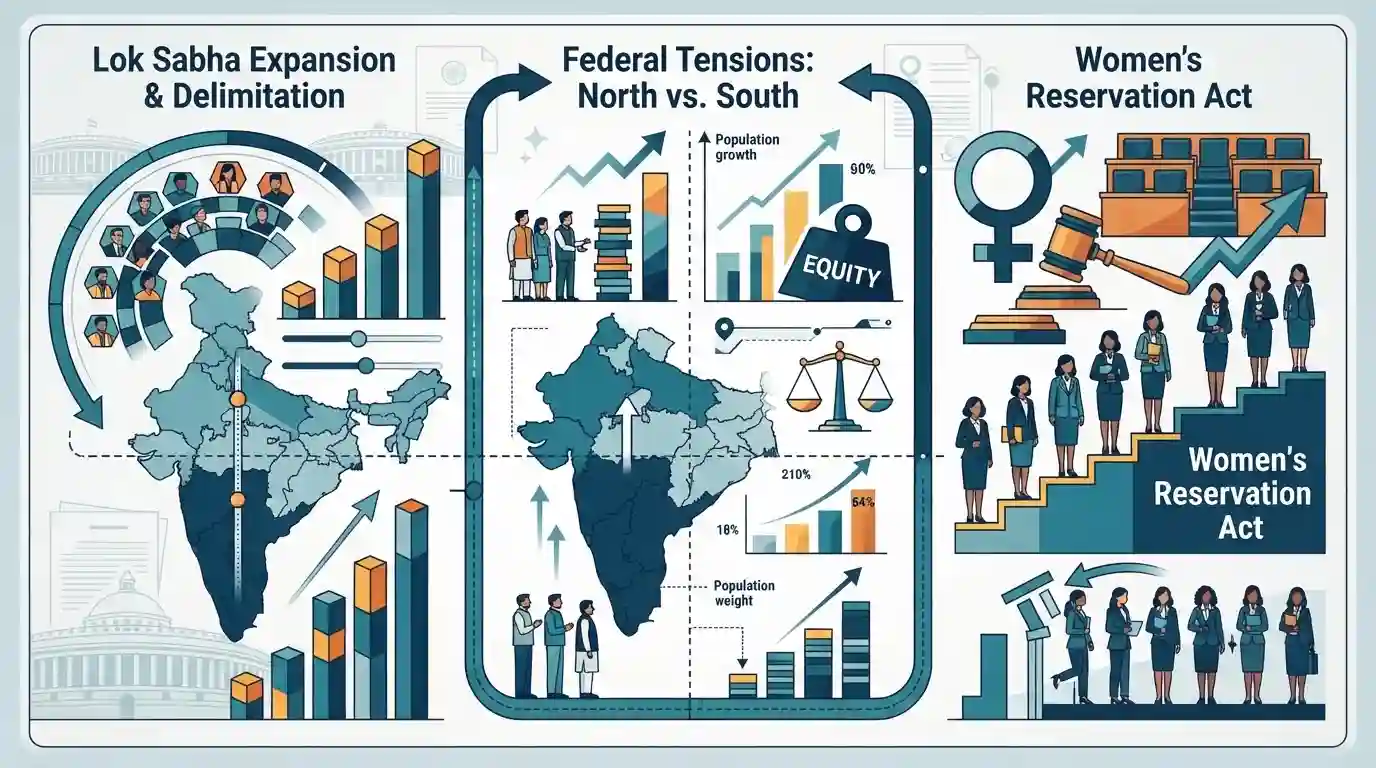
The article discusses the intersection of upcoming delimitation exercises, the expansion of Lok Sabha seats, and the operationalization of the Women's Reservation Act. It highlights the complex federal tensions between northern and southern states over population-based seat distribution and the challenges of ensuring equitable gender representation in Parliament.
Key Points
- The Delimitation Bill and upcoming redrawing of Lok Sabha constituencies present profound implications for Indian federalism, particularly regarding the demographic imbalance between Northern and Southern states.
- The freeze on delimitation based on the 1971 census was previously extended to prevent penalizing states that successfully controlled population growth.
- The implementation of the Women Reservation Act (Nari Shakti Vandan Adhiniyam) is tied to the completion of the delimitation exercise, introducing new dynamics for women's political representation.
- Increases in Lok Sabha seat numbers aim to accommodate population growth, but spark concerns about regional representation equity and legislative effectiveness.
Important Terms
Delimitation Commission

A statutory process of redrawing boundaries of Lok Sabha and state assembly constituencies based on population changes, governed by a Delimitation Commission whose orders have the force of law.
UPSC context
UPSC GS Paper II: Indian Polity - Statutory bodies, federalism, and representation of states in Parliament.
Nari Shakti Vandan Adhiniyam
The 106th Constitutional Amendment Act, 2023, which mandates one-third reservation of seats for women in the Lok Sabha and state legislative assemblies.
UPSC context
UPSC GS Paper II: Governance, women's empowerment, and inclusive representation in legislative bodies.
Delimitation Bill
A legislative proposal to increase the total number of seats in the Lok Sabha and state assemblies and operationalize gender quotas.
UPSC context
UPSC GS Paper II: Parliament and State Legislatures, structural reforms, and federal power dynamics.
Prelims Trap
Orders of the Delimitation Commission can be challenged in a court of law if they violate principles of natural justice.
Aspirants often believe the Delimitation Commission's orders can be challenged in High Courts or the Supreme Court on grounds of arbitrariness. Article 82 explicitly bars court jurisdiction.
Static Concepts Connected
What are the constitutional provisions and legal implications regarding the Delimitation Commission in India?
- Article 82: Constitutional basis: Article 82 mandates a readjustment of seat allocation after every census through a Delimitation Act enacted by Parliament.
- Immunity from Courts: Judicial bar: Section 10(4) of the Delimitation Act and constitutional bars ensure that orders of the Commission cannot be questioned in any court.
- Composition: Composition: Headed by a retired Supreme Court judge, it includes the Chief Election Commissioner and respective State Election Commissioners.
Cross-Topic Patterns
Delimitation vs Fiscal Federalism and Finance Commission
Population-based seat reallocation directly pits fiscal federalism (GST/Finance Commission devolution criteria) against political representation in Parliament.
Women's Reservation and North-South Federal Tensions
The 106th Amendment's tie-in to post-2026 census data creates a dual challenge: gender representation reform entangled with North-South demographic imbalances.

Delimitation post-2026 + 106th Amendment (Women's Quota) + Article 82 binding judicial review will be tested via analytical statements.
Linked PYQs · 2
Linked PYQs · 2
- 2024MainsGS2
What changes has the Union Government recently introduced in the domain of Centre-State relations ? Suggest measures to be adopted to build the trust between the Centre and the States and for strengthening federalism.
- 2023MainsGS2
Discuss the contribution of civil society groups for women's effective and meaningful participation and representation in state legislatures in India.
