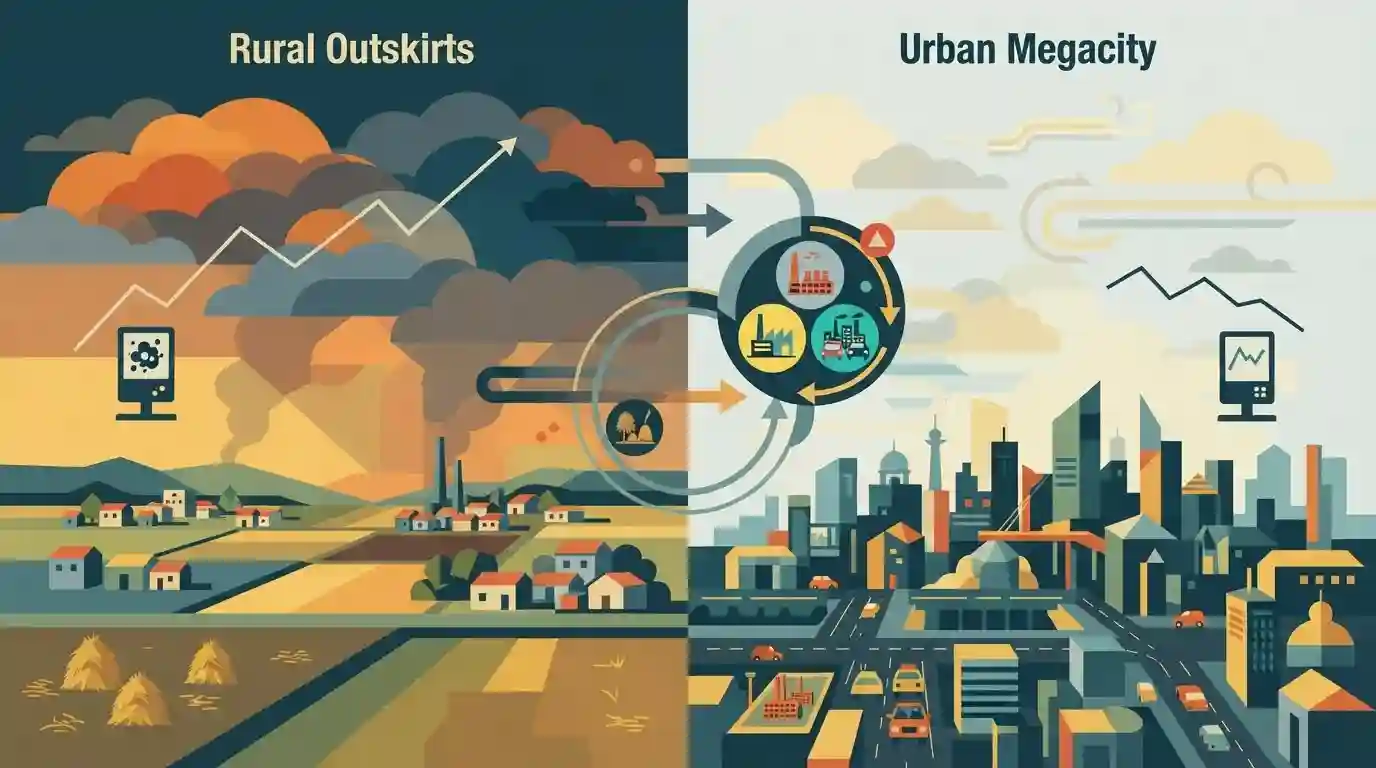
Air pollution dynamics in Delhi rural outskirts and sources
Source:The Hindu ↗
Why It Matters
Crucial for understanding nuances of air pollution governance, policy design under the National Clean Air Programme (NCAP), and debuncting common misconceptions regarding rural emission sources in Northern India.
Summary
Recent scientific findings indicate that Delhi's rural outskirts suffer from higher air pollution levels than the urban megacity itself, challenging the common assumption that crop stubble burning is the main driver of rural air degradation. The study underscores the necessity for comprehensive air quality strategies that look beyond seasonal agricultural burning and address regional, localized non-agricultural pollution sources.
Key Points
- Study findings reveal that Delhi's rural outskirts experience higher levels of air pollution than the urban megacity center.
- Crop residue burning (stubble burning) was found not to be the primary culprit behind this elevated rural pollution.
- Highlights the need to look beyond seasonal stubble burning and urban-centric monitoring to address localized rural emission sources and regional air quality dynamics.
- Emphasizes reforming air quality management frameworks under initiatives like the National Clean Air Programme (NCAP).
Important Terms
National Clean Air Programme

India's national time-bound initiative launched by the MoEFCC to reduce particulate matter concentration levels across non-attainment cities.
UPSC context
UPSC Paper III (Environment): Evaluates government policies and frameworks for mitigating urban and regional air pollution.
World Health Organisation
The specialized agency of the United Nations responsible for international public health, which sets globally recognized health-based air quality guidelines.
UPSC context
UPSC Paper III (Environment/Health): Relevant for questions on international environmental benchmarks, pollution health hazards, and policy alignment.
Static Concepts Connected
What are the core objectives and implementation framework of the National Clean Air Programme (NCAP) in India?
- Nodal Ministry: Launched in 2019 by the Ministry of Environment, Forest and Climate Change (MoEF&CC).
- Reduction Target: Targeted initial reduction of 20-30% in PM2.5 and PM10 concentrations by 2024, later revised to 40% reduction by 2025-26.
- Non-attainment Cities: Focuses on 131 non-attainment cities that fail to meet national ambient air quality standards (NAAQS) over a five-year period.
- Execution Mechanism: Collaborative approach involving the Central Pollution Control Board (CPCB), state pollution boards, and municipal authorities.
Cross-Topic Patterns
NCAP and Rural Air Pollution Blind Spots
NCAP's urban-centric design overlooks rural and peri-urban emission sources, exposing a major structural blind spot in India's decentralized environmental governance frameworks and District Environment Plans.

Air pollution questions will likely shift from stubble-burning focus to structural critiques of urban-centric NCAP monitoring frameworks.
Linked PYQs · 3
Linked PYQs · 3
- 2020MainsGS3
What are the key features of the National Clean Air Programme (NCAP) initiated by the Government of India?
- 2021MainsGS3
Describe the key points of the revised Global Air Quality Guidelines (AQGs) recently released by the World Health Organisation (WHO). How are these different from its last update in 2005? What changes in India's National Clean Air Programme are required to achieve these revised standards?
- 2019PrelimsGS1
Consider the following: 1. Carbon monoxide 2. Methane 3. Ozone 4. Sulphur dioxide Which of the above are released into atmosphere due to the burning of crop/biomass residue?
