India Recalibrates Strategic Doctrine and Deterrence against Pakistan
Source:Indian Express ↗
Why It Matters
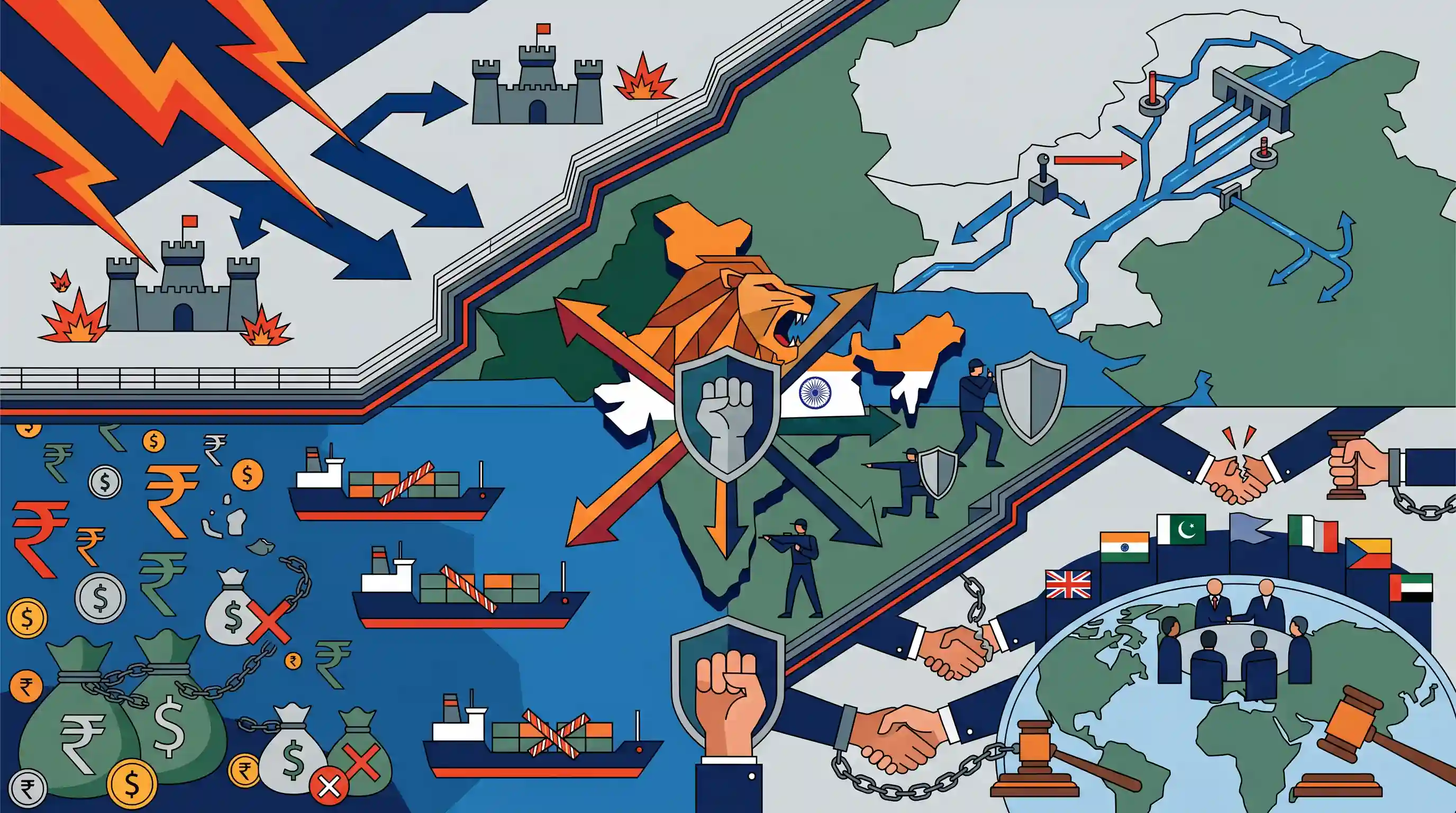
Provides a crucial framework for understanding India's modern foreign policy and security doctrine toward Pakistan. It synthesizes multiple dimensions—military (surgical strikes), diplomatic (FATF), and geo-economic (Indus Waters Treaty)—which are vital for answering GS2 (International Relations) and GS3 (Internal Security) questions comprehensively.
Summary
India has fundamentally recalibrated its strategic posture towards Pakistan, transitioning from defensive diplomacy to a multi-pronged, proactive approach. This evolving doctrine focuses on "striking deep" through cross-border military operations to neutralize terror threats, imposing severe diplomatic and economic costs on state-sponsored terrorism, and re-opening negotiations around the Indus Waters Treaty to assert its upper riparian rights. These measures collectively signify a definitive end to unconditional engagement, establishing deterrence and accountability as the new cornerstones of bilateral relations.
Key Points
- Strategic Shift: India has abandoned its historical 'strategic restraint' in favor of a proactive deterrence doctrine against Pakistan.
- Military Deterrence: The willingness to 'strike deep' using surgical and aerial strikes (e.g., Balakot) establishes a new threshold for responding to cross-border terrorism.
- Diplomatic Pressures: India has actively worked to isolate Pakistan internationally and raise the economic costs of state-sponsored terrorism, utilizing forums like the FATF.
- Water Diplomacy: Re-evaluating and fully leveraging the Indus Waters Treaty (1960) serves as a strategic tool, maximizing India's upper riparian advantages.
- The New Normal: Unconditional bilateral dialogues remain suspended; future engagement is contingent upon Pakistan taking credible action against terror networks.
Important Terms
Indus Waters Treaty (1960)

A 1960 water-sharing agreement between India and Pakistan, brokered by the World Bank, allocating the Eastern rivers (Ravi, Beas, Sutlej) to India and Western rivers (Indus, Jhelum, Chenab) to Pakistan.
UPSC context
GS-II (International Relations); critical for understanding transboundary water diplomacy and India’s strategic leverage in bilateral neighborhood relations.
Financial Action Task Force (FATF)
The global money laundering and terrorist financing watchdog that uses "Grey" and "Black" lists to pressure countries into fixing strategic deficiencies in their financial oversight.
UPSC context
GS-II (International Institutions) & GS-III (Internal Security); tests knowledge of international mechanisms used to curb terror funding and state-sponsored terrorism.
World Bank
A signatory and mediator of the Indus Waters Treaty that facilitates the appointment of "Neutral Experts" or "Courts of Arbitration" to resolve technical disputes over river projects.
UPSC context
GS-II (International Institutions); focuses on the role of global financial bodies in mediating long-standing bilateral resource treaties.
Upper Riparian State
A country located upstream on a river system. As the upper riparian, India has physical control over the headwaters of the Indus system before they flow into Pakistan.
UPSC context
GS-II (International Relations); essential for hydro-politics, territorial sovereignty, and the legal obligations of upstream nations toward downstream neighbors.
FATF Grey List
The FATF's "Increased Monitoring" list. Countries on this list must work with the FATF to address loopholes in their anti-money laundering and counter-terrorist financing frameworks.
UPSC context
GS-II & GS-III; relates to diplomatic and economic pressure tactics used in India's "raise terror cost" strategy against Pakistan.
Prelims Trap
India has no right to construct hydroelectric projects on the Western Rivers under the IWT.
While Pakistan controls the Western rivers (Indus, Jhelum, Chenab), India is explicitly allowed to build run-of-the-river (RoR) hydroelectric projects and use the water for limited agricultural purposes.
Static Concepts Connected
What are the core provisions of the 1960 Indus Waters Treaty?
- River Allocation: Eastern rivers (Ravi, Beas, Sutlej) allocated to India; Western rivers (Indus, Jhelum, Chenab) allocated to Pakistan.
- India's Rights: India can use Western rivers for domestic, non-consumptive, agricultural, and run-of-the-river hydroelectric power generation.
- Dispute Mechanism: Multi-tier process involving the Permanent Indus Commission, Neutral Expert (World Bank), and Court of Arbitration.
What is the Financial Action Task Force (FATF) mandate?
- Origin: Established in 1989 by the G7 to combat money laundering, later expanded to terror financing.
- Mechanisms: Maintains Grey (increased monitoring) and Black (call to action) lists to isolate non-compliant jurisdictions globally.
Cross-Topic Patterns
FATF + NGO terror financing
UPSC tests the nexus between non-state actors, sham NGOs, and terror financing in Mains GS3, linking directly to FATF's recent focus on state-sponsored terrorism.
Water diplomacy + Riparian rights
India’s assertive stance on the IWT highlights a shift in using geography for strategic deterrence, contrasting with its softer cooperative approach on eastern rivers like Teesta.

Expect a Prelims question mapping Indus tributaries to run-of-the-river projects (e.g., Pakal Dul, Ratle) alongside IWT legal provisions.
Linked PYQs · 4
Linked PYQs · 4
- 2012MainsGS2
The situation today is far different to that prevalent fifty years back when the Indus Water Treaty was signed." Highlight the complexity of the current challenges on both sides of the border in this regard. Do you think that a review of the Treaty is in India's best interests?
- 2015MainsGS2
Terrorist activities and mutual distrust have clouded India-Pakistan relations. To what extent the use of soft power like sports and cultural exchanges could help generate goodwill between the two countries? Discuss with suitable examples.
- 2016MainsGS3
The terms 'Hot Pursuit' and 'Surgical Strikes' are often used in connection with armed action against terrorist attacks. Discuss the strategic impact of such actions.
- 2021PrelimsGS1
With reference to the Indus river system, of the following four rivers, three of them pour into one of them which joins the Indus direct. Among the following, which one is such river that joins the Indus direct?
