Delhi Air Quality Index and Winter Weather Conditions
Source:The Hindu ↗
Why It Matters
The Air Quality Index (AQI) and its categories defined by the CPCB are crucial for UPSC Prelims (environment section) as questions have been previously asked regarding the pollutants measured. Air pollution in Delhi is also a recurring theme for Mains GS3 (Environment) concerning urbanization and pollution control measures.
Summary
Delhi experienced a minimum temperature of 11.1°C with misty morning conditions. The city's air quality remained in the 'poor' category, with the Air Quality Index (AQI) recorded at 210 according to the Central Pollution Control Board (CPCB).
Key Points
- Delhi recorded a minimum temperature of 11.1 degrees Celsius along with morning mist.
- The city's Air Quality Index (AQI) was recorded at 210, falling in the 'poor' category.
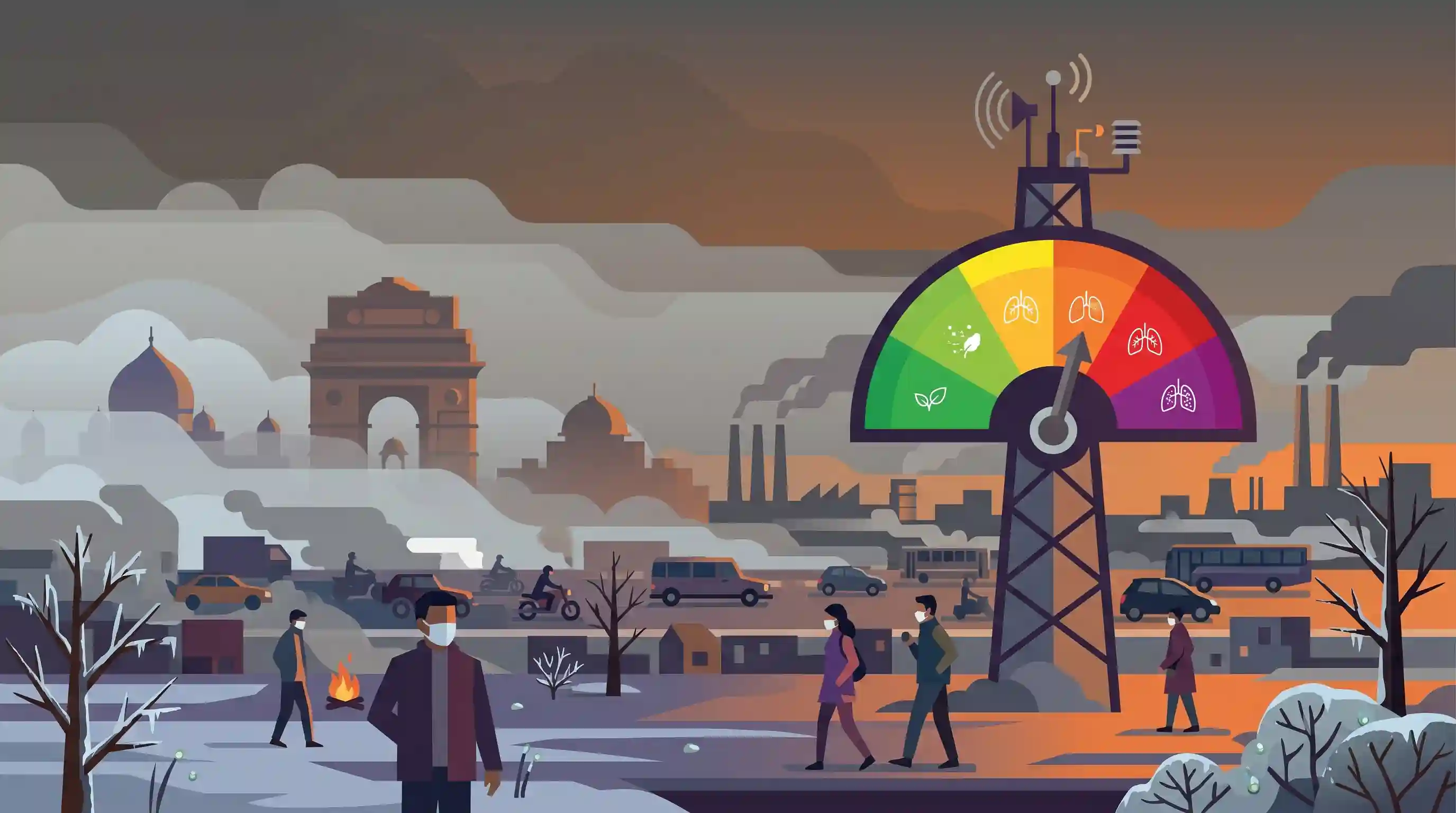
- The Central Pollution Control Board (CPCB) classifies AQI as: 0-50 (good), 51-100 (satisfactory), 101-200 (moderate), 201-300 (poor), 301-400 (very poor), and 401-500 (severe).
Important Terms
Air Quality Index (AQI)

A numerical scale (0-500) used by the government to communicate daily air quality and associated health risks, categorized from 'Good' to 'Severe' based on eight major pollutants.
UPSC context
GS Paper III (Environment); frequently tested in Prelims regarding the 'One Number, One Colour' initiative and specific pollutants measured.
Central Pollution Control Board (CPCB)
A statutory body established in 1974 under the Water Act, serving as India's apex organization for pollution control and providing technical services to the Environment Ministry.
UPSC context
GS Paper II & III; crucial for questions on environmental governance and statutory bodies involved in pollution management.
Graded Response Action Plan (GRAP)
A set of emergency measures implemented in the Delhi-NCR region to prevent further deterioration of air quality when the AQI crosses specific threshold levels.
UPSC context
GS Paper III; relevant for Delhi's winter pollution crisis and the role of the Commission for Air Quality Management (CAQM).
National Ambient Air Quality Standards (NAAQS)
National standards for outdoor air quality set by the CPCB under the Air Act, 1981, covering 12 pollutants to ensure uniform air quality across the country.
UPSC context
GS Paper III; tests the distinction between long-term regulatory standards (NAAQS) and daily public indices (AQI).
Particulate Matter (PM)
Microscopic solid or liquid droplets in the air, categorized by size (PM10 and PM2.5), that can be inhaled into the lungs and cause serious health issues.
UPSC context
GS Paper III; key pollutant in air quality discussions, particularly PM2.5's role in respiratory health and seasonal haze.
Prelims Trap
"Carbon dioxide (CO2) is one of the eight major pollutants measured under the National Air Quality Index."
Aspirants confuse greenhouse gases with AQI criteria pollutants. AQI measures 8 specific pollutants (including CO, O3, Pb, NH3) but does NOT include CO2 or Methane.
Static Concepts Connected
What is the statutory backing and mandate of the Central Pollution Control Board (CPCB)?
- Statutory origin: Established in 1974 under the Water (Prevention and Control of Pollution) Act, a frequent UPSC prelims trap.
- Air Act powers: Though born from the Water Act, it was later entrusted with powers and functions under the Air (Prevention and Control of Pollution) Act, 1981.
- Key mandate: Advises the Central Government and coordinates state pollution control board activities to prevent and control water and air pollution.
How does 'Temperature Inversion' worsen winter air pollution in North India?
- Normal vs Inversion: Usually, air temperature decreases with altitude. In winter inversions, a warm air layer aloft traps a colder, denser layer of air near the surface.
- The 'Lid' Effect: This stable atmospheric condition acts like a lid, preventing convection and the vertical mixing/dispersion of surface-level emissions.
- Smog accumulation: Because air cannot rise, pollutants like PM2.5, vehicular exhaust, and stubble smoke remain trapped close to the ground, causing severe winter smog.
Cross-Topic Patterns
Statutory powers of CAQM vs. CPCB
While CPCB sets AQI standards nationally, the Graded Response Action Plan (GRAP) for Delhi-NCR is enforced by the statutory CAQM, which overrides other pollution bodies in the region.
Climatology meets Urban Air Pollution
UPSC often links urban pollution to static geography concepts. Delhi's landlocked nature, continental climate, and winter anticyclonic conditions create meteorological traps for regional pollutants.

Expect a multi-statement question on AQI pollutants (e.g., CO2/methane trap) and CPCB's statutory origin under the Water Act, not Air Act.
Linked PYQs · 2
Linked PYQs · 2
- 2016PrelimsGS1
In the cities of our country, which among the following atmospheric gases are normally considered in calculating the value of Air Quality Index? 1. Carbon dioxide 2. Carbon monoxide 3. Nitrogen dioxide 4. Sulfur dioxide 5. Methane Select the correct answer using the code given below.
- 2021MainsGS3
Describe the key points of the revised Global Air Quality Guidelines (AQGs) recently released by the World Health Organisation (WHO). How are these different from its last update in 2005? What changes in India's National Clean Air Programme are required to achieve these revised standards?
