Delhi Urban Infrastructure Governance and Jurisdictional Friction
Source:The Hindu ↗
কেন এটি গুরুত্বপূর্ণ
It provides deep insights into the administrative complexities, overlapping jurisdictions, and friction points unique to India's national capital territory, which are central to questions on federalism, urban local bodies, and governance structures.
সারসংক্ষেপ
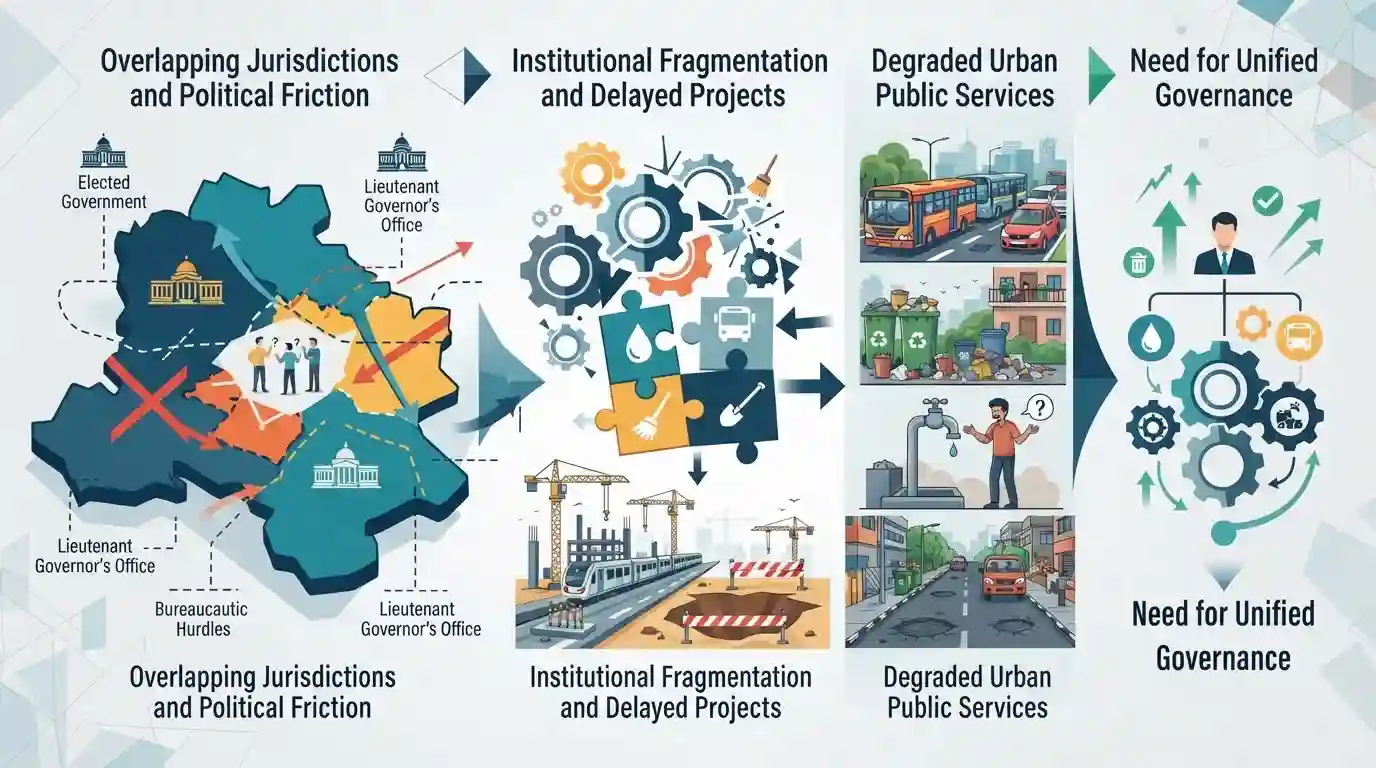
The article examines Delhi's persistent infrastructure and governance challenges, which stem from complex overlapping jurisdictions, political friction between the elected government and the Lieutenant Governor, and institutional fragmentation. It highlights how these systemic issues delay infrastructure projects and degrade urban public services in the national capital, calling for unified metropolitan governance and structural reforms.
মূল বিষয়
- Delhi suffers from systemic infrastructure and governance bottlenecks due to overlapping jurisdictions between multiple authorities like the Central government, Delhi government, MCD, and DDA.
- The friction between the elected government and the Lieutenant Governor (LG) hampers long-term infrastructure planning and timely project execution.
- Urban governance reforms are urgently required to establish a unified metropolitan governance framework rather than fragmented administrative silos.
- Financial and functional devolution to urban local bodies remains weak, affecting maintenance and creation of public assets in the capital.
গুরুত্বপূর্ণ শব্দ
69th Constitutional Amendment Act

A landmark 1991 constitutional amendment that inserted Articles 239AA and 239AB, granting Delhi a special status with a legislative assembly and council of ministers while carving out police, public order, and land.
UPSC context
GS Paper 2 - Polity & Governance; tests knowledge of federal structure, union territories, and special constitutional provisions for Delhi.
Government of National Capital Territory of Delhi Act
Statutory legislation enacted under Article 239AA to provide a framework for the administration of the National Capital Territory of Delhi, regulating executive and legislative powers.
UPSC context
GS Paper 2 - Statutory and Executive bodies; tests understanding of governance mechanics and Centre-UT legislative dynamics.
Lieutenant Governor of Delhi
The constitutional head of the National Capital Territory of Delhi appointed by the President, serving as the focal point of executive authority and administrative friction.
UPSC context
GS Paper 2 - Executive organs and Centre-State relations; tests clarity on discretionary powers and administrative accountability in UTs.
প্রিলিমস ফাঁদ
All municipal and infrastructure matters in the National Capital Territory of Delhi are under the direct legislative control of the Union government via the Lieutenant Governor.
The 69th Constitutional Amendment Act places 'land, police, and public order' under Union control, but municipal services, sanitation, and local infrastructure are under the elected government and local bodies.
সংযুক্ত স্থির ধারণা
How does Article 239AA of the Constitution structure the governance framework of Delhi?
- Constitutional Basis: Special Status: Inserted by the 69th Constitutional Amendment Act, 1991, designating Delhi as the National Capital Territory with a Legislative Assembly.
- Excluded Subjects: Legislative Scope: Empowers the Assembly to make laws for State List items, specifically excluding Public Order, Land, and Police (Entries 1, 2, and 18).
- Executive Authority: Executive Power: Executive power is co-extensive with legislative competence, vested in a Council of Ministers headed by a Chief Minister to aid and advise the LG.
- Difference of Opinion: LG Prerogative: In case of a difference of opinion between the LG and ministers, the matter is referred to the President for a final decision under Article 239AA(4).
আন্তঃবিষয় প্যাটার্ন
Delhi Governance vs. Fiscal Federalism Debates
Delhi's governance gridlock mirrors fiscal federalism disputes in other states, where central agencies or governors clash with elected state executives over administrative control and fund disbursement.
74th Amendment vs. Parastatal Institutional Fragmentation
Institutional fragmentation in metropolitan planning undermines statutory mandates of the 74th Constitutional Amendment Act, highlighting the gap between democratic decentralization and parastatal authorities.

Article 239AA and metropolitan governance reforms will likely feature in a statement-based polity question on UT administrative frameworks.
সংযুক্ত PYQ · 3
সংযুক্ত PYQ · 3
- 2018MainsGS2
Whether the Supreme Court Judgement (July 2018) can settle the political tussle between the Lt. Governor and elected government of Delhi? Examine.
- 2016MainsGS2
Discuss the essentials of the 69th Constitutional Amendment Act and anomalies, if any, that have led to recent reported conflicts between the elected representatives and the institution of the Lieutenant Governor in the administration of Delhi. Do you think that this will give rise to a new trend in the functioning of the Indian federal politics?
- 2023MainsGS2
“The states in India seem reluctant to empower urban local bodies both functionally as well as financially.” Comment.
