Delhi NCR Vehicular Pollution Bans and Clean Environment Right
Source:Indian Express ↗
Why It Matters
Urban air pollution, largely driven by vehicular emissions, is a critical governance and environmental issue in India. Understanding the interplay between statutory bodies like the NGT, judicial interventions, and government transport policies (like vehicle scrapping) is essential for addressing the GS3 syllabus on environmental pollution and degradation.
Summary
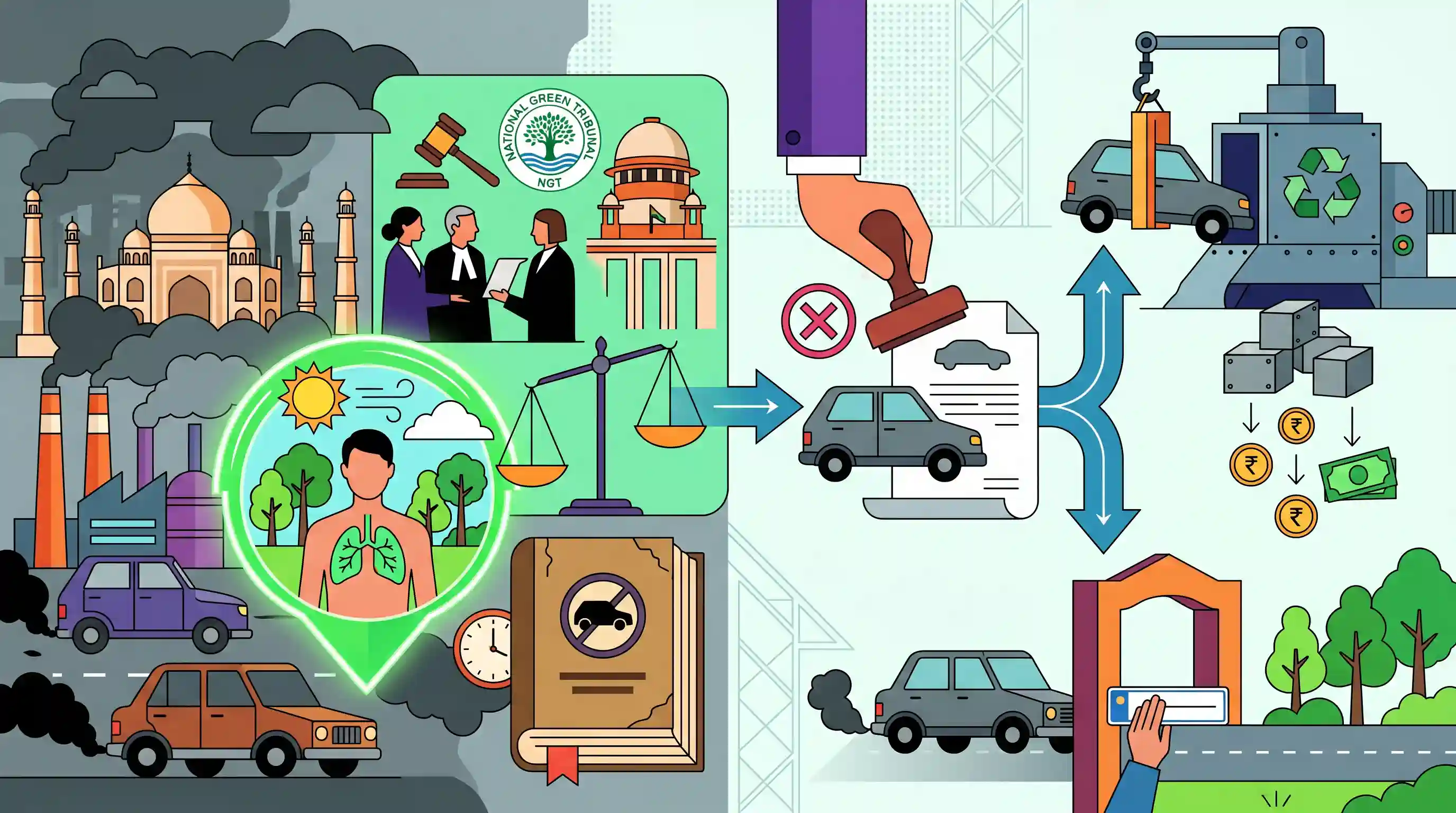
The article examines the legal framework and rationale behind the ban on 10-year-old diesel and 15-year-old petrol vehicles in Delhi-NCR. Initiated by the National Green Tribunal (NGT) and upheld by the Supreme Court, the ban prioritizes public health and the right to a clean environment over the statutory vehicle lifespan outlined in the Motor Vehicles Act. It also discusses the enforcement mechanism, where end-of-life vehicles are automatically deregistered, forcing owners to either scrap their vehicles or transfer them to other states.
Key Points
- The National Green Tribunal (NGT) mandated a ban on 10-year-old diesel and 15-year-old petrol vehicles in Delhi-NCR to curb severe air pollution.
- The Supreme Court upheld the NGT's directives, ruling that the fundamental right to a clean environment (Article 21) overrides the standard 15-year vehicle lifespan defined in the Motor Vehicles Act.
- Vehicles exceeding these age limits are deemed 'end-of-life' and face automatic deregistration by the transport authorities.
- Owners of deregistered vehicles must either scrap them at authorized scrapping facilities or obtain a No Objection Certificate (NOC) to re-register the vehicle in states with less stringent emission regulations.
Important Terms
National Green Tribunal (NGT)

A specialized judicial body established under the NGT Act (2010) for the effective and expeditious disposal of cases relating to environmental protection and forest conservation.
UPSC context
GS Papers II & III; crucial for environmental adjudication and the 'Polluter Pays' principle.
Environment (Protection) Act, 1986
An umbrella legislation enacted under Article 253, empowering the Central Government to set national standards for environmental quality and coordinate pollution-control activities across agencies.
UPSC context
GS Paper III; primary legislative framework for environmental conservation and delegated legislation.
Vehicle Scrapping Policy
A framework aimed at phasing out old, polluting vehicles by mandating fitness tests and providing incentives for scrapping, officially titled the Voluntary Vehicle-Fleet Modernization Programme.
UPSC context
GS Paper III; relevant for the circular economy, pollution reduction, and automotive sector reforms.
Motor Vehicles Act, 1988
A central legislation regulating road transport and vehicle registration. Recent NGT and Supreme Court orders in Delhi-NCR have prioritised environmental protection over its standard vehicle lifespan provisions.
UPSC context
GS Paper III; tests knowledge of urban governance and legislative-judicial conflicts.
Central Pollution Control Board (CPCB)
A statutory body under the Ministry of Environment that monitors national air quality and provides technical services for pollution prevention and control.
UPSC context
GS Paper II & III; essential for institutional monitoring of environmental degradation.
Right to Clean Environment
A fundamental right interpreted by the Supreme Court under Article 21 (Right to Life), mandating that the state ensure an ecologically balanced environment for citizens.
UPSC context
GS Paper II; key concept in Fundamental Rights and Indian environmental jurisprudence.
Prelims Trap
The Motor Vehicles Act mandates a strict 10-year operational limit for all diesel vehicles across India.
The 10-year limit for diesel vehicles applies specifically to Delhi-NCR via NGT/SC orders. It is not a pan-India rule under the Motor Vehicles Act.
Static Concepts Connected
Which laws fall under the civil jurisdiction of the NGT?
- Covered Acts: Water Act (1974), Forest Act (1980), Air Act (1981), Environment Protection Act (1986), Public Liability Insurance Act (1991), Biological Diversity Act (2002).
- Notable Exclusions: The Wildlife (Protection) Act, 1972 and Forest Rights Act, 2006 are notably excluded from NGT's direct jurisdiction.
How does Article 21 intersect with statutory environmental rules?
- Fundamental Overrides Statutory: The right to a clean environment under Article 21 is a fundamental right, superseding lesser statutory provisions like the 15-year vehicle lifespan in the Motor Vehicles Act.
- Landmark Precedent: The Supreme Court expanded Article 21 to include pollution-free air and water in landmark judgments like Subhash Kumar v. State of Bihar (1991).
Cross-Topic Patterns
Vehicle Scrapping & Circular Economy
The push for end-of-life vehicle deregistration ties directly into the National Vehicle Scrappage Policy, promoting formal metal recycling and reducing import dependency for scrap steel.
NGT directives vs. Cooperative Federalism
NGT's localized bans often force polluting assets to migrate to states with laxer norms via NOCs, creating interstate emission disparities and testing cooperative federalism.

Expect a 2026 Prelims question testing whether the 10-year diesel ban is a pan-India statutory rule vs an NGT directive for Delhi-NCR.
Linked PYQs · 4
Linked PYQs · 4
- 2018PrelimsGS1
How is the National Green Tribunal (NGT) different from the Central Pollution Control Board (CPCB)? 1. The NGT has been established by an Act whereas the CPCB has been created by an executive order of the Government. 2. The NGT provides environmental justice and helps reduce the burden of litigation in the higher courts whereas the CPCB promotes cleanliness of streams and wells, and aims to improve the quality of air in the country. Which of the statements given above is/are correct?
- 2016PrelimsGS1
In the cities of our country, which among the following atmospheric gases are normally considered in calculating the value of Air Quality Index? 1. Carbon dioxide 2. Carbon monoxide 3. Nitrogen dioxide 4. Sulfur dioxide 5. Methane Select the correct answer using the code given below.
- 2022PrelimsGS1
In the context of WHO Air Quality Guidelines, consider the following statements: 1. The 24-hour mean of PM2.5 should not exceed 15 µg/m³ and annual mean of PM2.5 should not exceed 5 µg/m³. 2. In a year, the highest levels of ozone pollution occur during the periods of inclement weather. 3. PM10 can penetrate the lung barrier and enter the bloodstream. 4. Excessive ozone in the air can trigger asthma. Which of the statements given above are correct?
- 2021MainsGS3
Describe the key points of the revised Global Air Quality Guidelines (AQGs) recently released by the World Health Organisation (WHO). How are these different from its last update in 2005? What changes in India's National Clean Air Programme are required to achieve these revised standards?
