Air Quality Monitoring and Dust Control in Delhi Clean Air Plan
Source:Indian Express ↗
Why It Matters
Delhi's severe air pollution is a recurring UPSC theme. The article bridges the technical aspects of pollution (PM 10, AQI, CPCB norms, NCAP) with administrative/governance issues (municipal service delivery, Centre vs. Delhi elected government tussle), offering a holistic perspective necessary for Mains GS2 and GS3 answers.
Summary
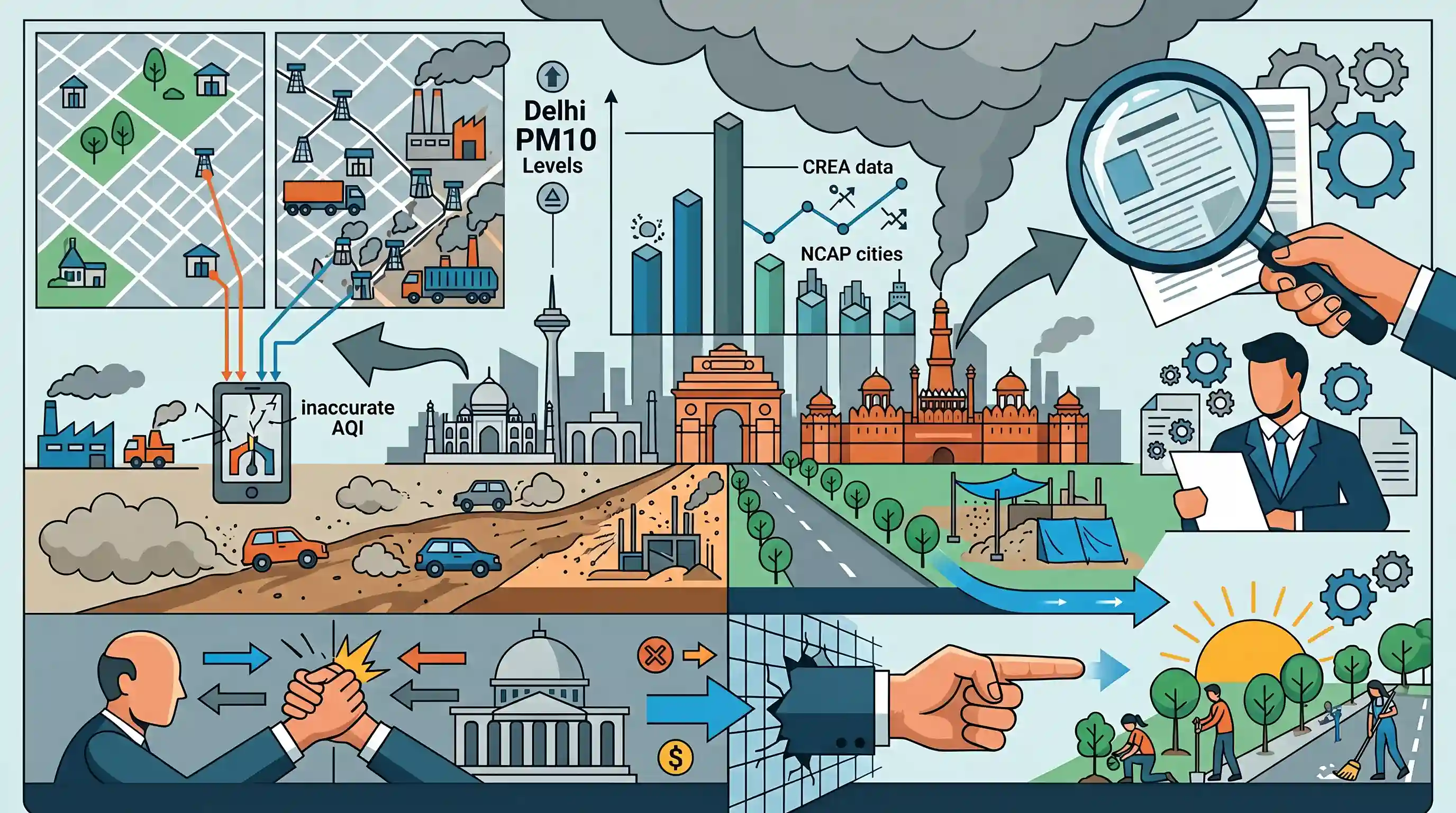
The article emphasizes that Delhi's clean air strategy must prioritize accurate air quality monitoring and the mitigation of dust emissions. A CAG report exposed deep flaws in the current monitoring system, including inaccurate AQI calculations and the misallocation of monitoring stations away from high-pollution industrial and traffic zones. Concurrently, CREA data indicates Delhi suffers from the highest PM 10 levels among NCAP cities, largely driven by road dust and construction activities. Addressing these foundational municipal tasks—such as fixing unpaved roads and covering construction areas—could drastically reduce particulate matter. The editorial argues that the previous administrative paralysis caused by political conflict between the elected government and the Lieutenant Governor is no longer a valid excuse, demanding immediate administrative action.
Key Points
- A recent CAG report revealed significant flaws in Delhi's air quality monitoring infrastructure, noting non-compliance with CPCB requirements, inaccurate AQI calculations, and poorly placed stations.
- Data from CREA highlighted that Delhi recorded the highest PM 10 levels among 130 cities under the National Clean Air Programme, exceeding WHO standards by 4-5 times.
- Studies by IIT Delhi and IIT Kanpur emphasize that relatively simple municipal interventions—such as filling potholes, fixing unpaved roads, and covering construction sites—can reduce pollution by 15-50% since road dust constitutes 60% of PM 10.
- With political alignment now established across central and municipal levels, the previous Centre-State conflicts between the L-G and the elected government can no longer excuse poor municipal service delivery.
Important Terms
National Clean Air Programme (NCAP)

A national strategy launched in 2019 to reduce particulate matter (PM2.5 and PM10) by 20-30% by 2024 (later 40% by 2026) in 131 "non-attainment" cities.
UPSC context
GS III (Environment); key for questions on national pollution targets, city-specific action plans, and collaborative governance.
Central Pollution Control Board (CPCB)
A statutory body established in 1974 under the Water Act, later empowered under the Air Act (1981) to coordinate pollution control and provide technical guidance nationwide.
UPSC context
GS II (Statutory Bodies) and GS III (Environment); vital for understanding India's regulatory framework and environmental standard-setting.
Comptroller and Auditor General (CAG)
A constitutional authority under Article 148 that audits all government accounts; in environmental contexts, it conducts "performance audits" to assess the effectiveness of pollution control schemes.
UPSC context
GS II (Polity) and GS III (Environmental Auditing); tests the role of constitutional oversight in ensuring executive accountability for public funds.
World Health Organisation (WHO)
A UN specialized agency that sets evidence-based Global Air Quality Guidelines (AQGs); its 2021 update introduced much stricter safe limits for PM2.5 and PM10.
UPSC context
GS II (International Institutions) and GS III (Health); important for comparing India’s NAAQS standards with more stringent international health benchmarks.
Centre for Research on Energy and Clean Air (CREA)
An independent research organization providing data-driven analysis on air pollution trends and energy transitions to help policymakers track emission sources and health impacts.
UPSC context
GS III (Environment); represents the role of independent think-tanks and NGOs in providing critical data for evidence-based policy critique.
Prelims Trap
"NCAP sets legally binding targets for non-attainment cities to reduce particulate matter by 40% by 2026."
NCAP targets are a collaborative framework, not legally binding. Additionally, aspirants often confuse PM sources: road dust predominantly drives coarser PM10, whereas PM2.5 is largely from combustion.
Static Concepts Connected
What are the core targets and features of the National Clean Air Programme (NCAP)?
- Target Reduction: Aims to reduce coarse (PM10) and fine (PM2.5) particulate matter concentrations by up to 40% by 2025-26.
- Baseline Year: Uses 2017 as the baseline year for comparison of concentration levels.
- Non-attainment Cities: Applies to 131 'non-attainment' cities that consistently failed to meet National Ambient Air Quality Standards (NAAQS) over a 5-year period.
How does the CAG evaluate environmental governance in India?
- Performance Audits: Under Article 149, the CAG conducts 'Performance Audits' to assess the efficiency, economy, and effectiveness of ecological initiatives, not just financial propriety.
- Compliance Checking: Evaluates executive adherence to environmental laws, international treaties, and guidelines set by bodies like the CPCB (e.g., correct AQI calculation and monitoring station placement).
Cross-Topic Patterns
Performance Auditing of Ecology
The CAG's expanding scope from financial to performance auditing increasingly exposes structural flaws in environmental schemes, linking Constitutional bodies directly to climate governance and accountability.
74th CAA and Urban Pollution
Tackling PM10 relies heavily on basic municipal functions like road maintenance, highlighting how ULB capacity and the 74th CAA are strict prerequisites for achieving national climate goals.

Expect a multi-statement question contrasting PM10 vs PM2.5 primary sources, paired with WHO's updated AQGs and NCAP's non-binding targets.
Linked PYQs · 3
Linked PYQs · 3
- 2022PrelimsGS1
In the context of WHO Air Quality Guidelines, consider the following statements: 1. The 24-hour mean of PM2.5 should not exceed 15 µg/m³ and annual mean of PM2.5 should not exceed 5 µg/m³. 2. In a year, the highest levels of ozone pollution occur during the periods of inclement weather. 3. PM10 can penetrate the lung barrier and enter the bloodstream. 4. Excessive ozone in the air can trigger asthma. Which of the statements given above are correct?
- 2021MainsGS3
Describe the key points of the revised Global Air Quality Guidelines (AQGs) recently released by the World Health Organisation (WHO). How are these different from its last update in 2005? What changes in India's National Clean Air Programme are required to achieve these revised standards?
- 2018MainsGS2
Whether the Supreme Court Judgement (July 2018) can settle the political tussle between the Lt. Governor and elected government of Delhi? Examine.
