Meteorological factors and pollutant dispersion in Delhi air quality
Source:The Hindu ↗
Why It Matters
Demonstrates the critical role that meteorology (wind speed, ventilation index) plays in urban air pollution. It provides a practical case study for GS3 (Environment) regarding the limitations of policy interventions (like GRAP) when countered by unfavourable geographic and climatic conditions.
Summary
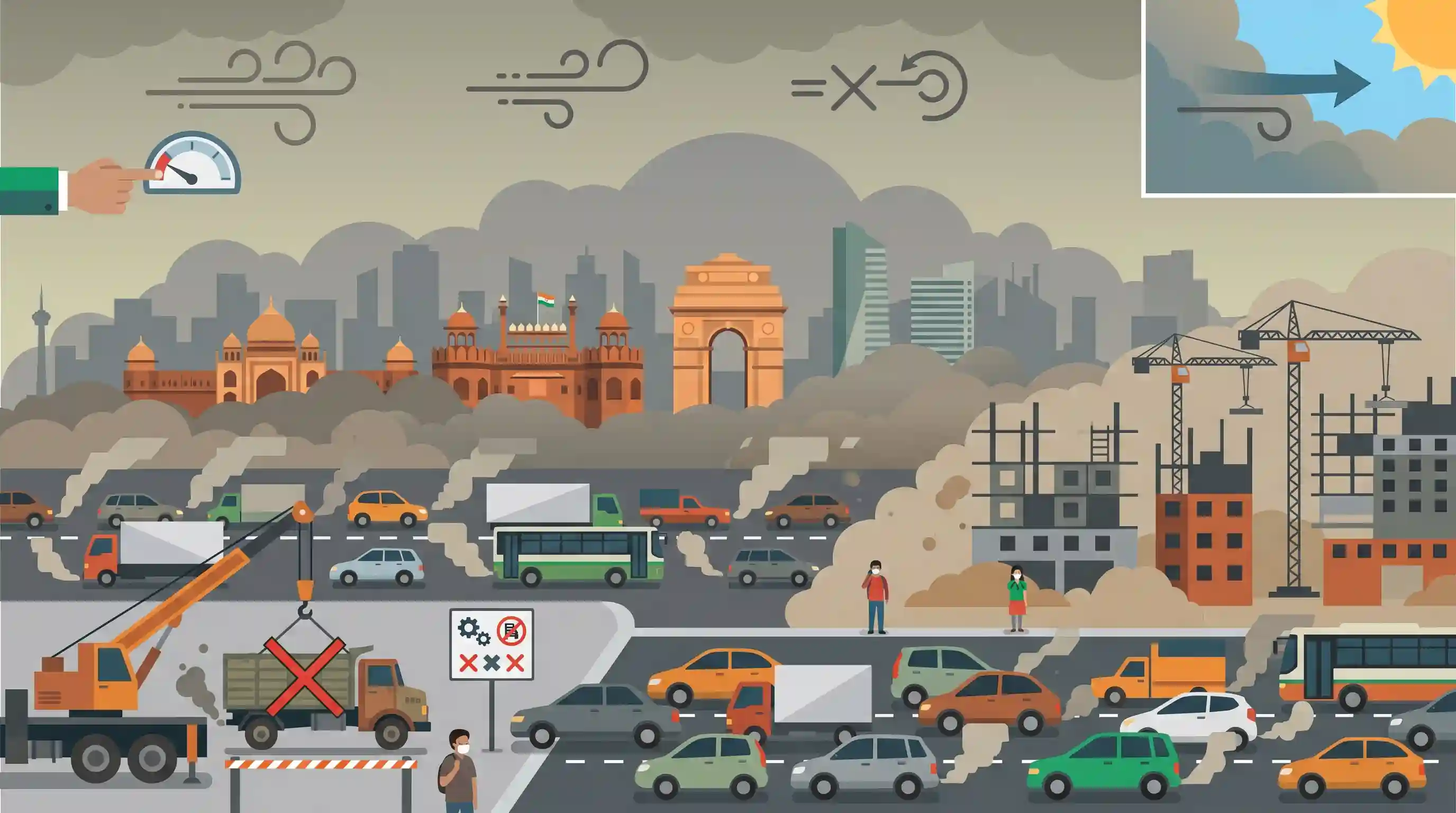
Delhi's air quality remains persistently 'very poor' primarily due to adverse meteorological factors, particularly slow wind speeds and a low ventilation index, which prevent the dispersion of locally generated pollutants. Data from the Air Quality Early Warning System (AQEWS) indicates that winds dropping below 8-10 kmph have trapped vehicle and construction emissions near the surface, resulting in a toxic smog build-up and reduced visibility. While emergency measures like Graded Response Action Plan (GRAP) Stage III have removed older, highly polluting vehicles from the roads, the sheer volume of total traffic means emissions remain high, leaving the city dependent on a change in weather patterns to clear the air.
Key Points
- Delhi's Air Quality Index (AQI) remained in the 'very poor' category (386) due to unfavourable meteorological conditions.
- Slow wind speeds (below 10 kmph) and a ventilation index lower than 6000 m²/s severely restricted the dispersion of pollutants.
- The situation is exacerbated by local pollution from vehicles and construction being trapped near the surface, leading to a toxic build-up.
- Despite the implementation of GRAP Stage III, which bans BS-III petrol and BS-IV diesel vehicles, the high volume of remaining traffic continues to contribute to the pollution load.
- Experts note that the city currently relies on strong winds to naturally disperse the smog and improve air quality.
Important Terms
Graded Response Action Plan (GRAP)

An emergency stage-wise framework of measures implemented in Delhi-NCR to prevent air quality from deteriorating further. Stages I-IV are triggered based on specific AQI thresholds.
UPSC context
GS III: Environmental Pollution & Degradation. Tests knowledge of statutory emergency response mechanisms and governance in Delhi-NCR.
Commission for Air Quality Management (CAQM)
A statutory body established in 2021 to coordinate, monitor, and improve air quality in Delhi-NCR and adjoining areas of Punjab, Haryana, Rajasthan, and Uttar Pradesh.
UPSC context
GS II: Statutory Bodies; GS III: Environment. Tests understanding of centralized environmental governance and inter-state coordination.
Central Pollution Control Board (CPCB)
The apex statutory organization for pollution control in India, established under the Water Act, 1974, and later empowered under the Air Act, 1981.
UPSC context
GS II: Statutory Bodies. Tests awareness of the primary regulatory framework for environment protection in India.
Air Quality Early Warning System (AQEWS)
A decision-support system developed by IITM Pune providing 72-hour air quality forecasts to enable preemptive pollutant management in Delhi-NCR.
UPSC context
GS III: Science & Technology (Applications); Environment. Tests tech-enabled governance for disaster/pollution mitigation.
Ventilation Index
A meteorological index (product of mixing height and average wind speed) that indicates the atmosphere's capacity to disperse or dilute air pollutants.
UPSC context
GS III: Environment/Geography. Tests technical understanding of atmospheric phenomena leading to urban smog and pollutant trapping.
Centre for Science and Environment (CSE)
A New Delhi-based non-profit public interest research and advocacy organization focused on environmental sustainability and social equity.
UPSC context
GS II: Role of NGOs/Civil Society in policy-making. Tests influence of advocacy groups on environmental regulation.
Prelims Trap
"Delhi's severe winter pollution is primarily characterized by the formation of photochemical smog."
Winter smog is particulate-heavy and driven by temperature inversions. Photochemical smog requires intense UV sunlight to react with NOx and VOCs, occurring mainly in warmer months.
Static Concepts Connected
How does temperature inversion trap urban air pollution?
- Mechanism: Reverses the normal lapse rate, creating a layer of warm air above cooler surface air.
- Pollutant Trap: Acts as an atmospheric lid, preventing vertical mixing and trapping particulate matter close to the ground.
- Ventilation Index: The product of mixing depth and wind speed. A low index (below 6000 m²/s) indicates poor dispersion conditions.
What are the primary upgrades in Bharat Stage (BS) VI emission norms?
- Sulphur Reduction: Drastically capped permissible sulphur content in both petrol and diesel to 10 parts per million (ppm), down from 50 ppm in BS-IV.
- NOx Limits: Mandates a sharp reduction in Nitrogen Oxide (NOx) emissions, particularly for diesel vehicles.
- Technology Mandate: Requires mandatory On-Board Diagnostics (OBD) and Diesel Particulate Filters (DPF) to actively monitor and control emissions.
Cross-Topic Patterns
Geography of Winter Smog
While farm fires initiate the seasonal crisis, Delhi's landlocked geography and winter temperature inversions act as a meteorological trap. UPSC often links topography directly to urban pollution severity in GS1 and GS3.
Institutional shift to CAQM
Enforcement of GRAP shifted from the Supreme Court-appointed EPCA to the statutory CAQM. Understanding CAQM's overriding powers over state pollution boards is a recurring theme for environmental governance.

Expect a multi-statement Prelims question in 2026 linking 'Ventilation Index' meteorology with the statutory powers of CAQM enforcing GRAP.
Linked PYQs · 4
Linked PYQs · 4
- 2022MainsGS3
Discuss in detail the photochemical smog emphasizing its formation, effects and mitigation. Explain the 1999 Gothenburg Protocol.
- 2021MainsGS3
Describe the key points of the revised Global Air Quality Guidelines (AQGs) recently released by the World Health Organisation (WHO). How are these different from its last update in 2005? What changes in India's National Clean Air Programme are required to achieve these revised standards?
- 2022PrelimsGS1
In the context of WHO Air Quality Guidelines, consider the following statements: 1. The 24-hour mean of PM2.5 should not exceed 15 µg/m³ and annual mean of PM2.5 should not exceed 5 µg/m³. 2. In a year, the highest levels of ozone pollution occur during the periods of inclement weather. 3. PM10 can penetrate the lung barrier and enter the bloodstream. 4. Excessive ozone in the air can trigger asthma. Which of the statements given above are correct?
- 2025PrelimsGS1
Artificial way of causing rainfall to reduce air pollution makes use of
