Supreme Court Extends IPC Cruelty Laws to Live-in Relationships
Source:Indian Express ↗
ఇది ఎందుకు ముఖ్యం
This ruling marks a major progressive step in Indian jurisprudence by legally acknowledging live-in relationships under criminal penal statutes like Section 498A IPC. It is highly relevant for UPSC GS Paper 2 (Polity and Governance, particularly Judiciary & Gender Justice) and GS Paper 1 (Social Issues and Women's Rights), as it showcases how the judiciary employs purposive interpretation to adapt colonial-era laws to contemporary social realities, ensuring comprehensive protection for women.
సారాంశం
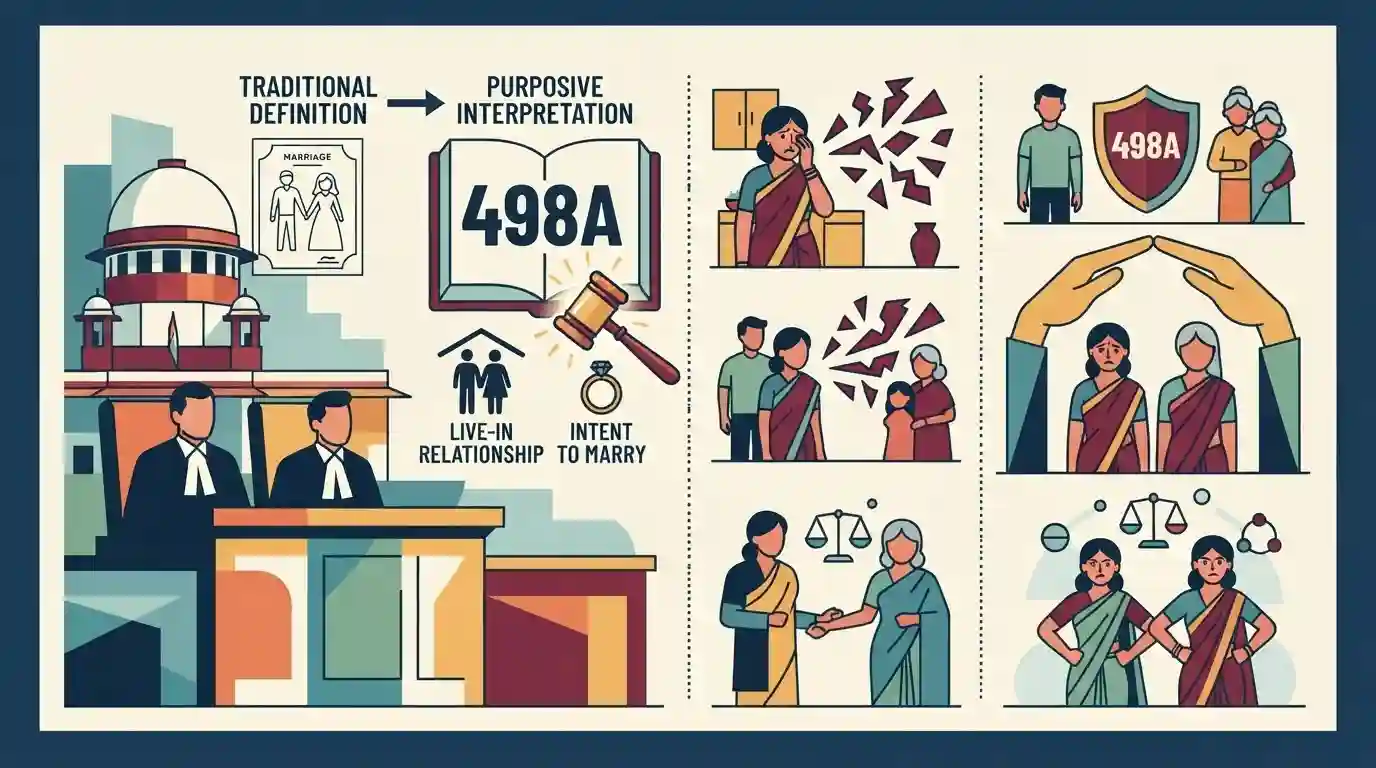
In a landmark judgment, the Supreme Court of India ruled that men in live-in relationships and their relatives can be prosecuted under Section 498A of the Indian Penal Code (IPC) for cruelty to their partners, provided the relationship qualifies as being 'in the nature of marriage' with an intrinsic intent to marry. The bench, comprising Justices Sanjay Karol and NK Singh, emphasized that live-in relationships are a contemporary social reality and that domestic cruelty's propensity to destroy is the same whether a woman is legally married or not. Giving a 'purposive interpretation' to the term 'husband', the ruling extends crucial criminal-law protection to women in non-formalized unions, moving beyond traditional definitions to uphold gender justice.
ముఖ్య అంశాలు
- The Supreme Court of India ruled that men in live-in relationships (and their relatives) can be prosecuted for cruelty under Section 498A of the Indian Penal Code (IPC).
- The bench of Justices Sanjay Karol and NK Singh observed that live-in relationships are today a reality and domestic cruelty destroys a woman's life regardless of whether she is legally married or not.
- For Section 498A to apply, the live-in relationship must qualify as a 'relationship in the nature of marriage', with 'the intent to marry being established as an intrinsic part thereof' between two consenting adults.
- The Court gave a 'purposive interpretation' to the word 'husband' under Section 498A, aligning with the reformative, corrective, and socially beneficial intent of the legal provision.
- This judgment significantly broadens the legal safety net for women in non-traditional/live-in unions, elevating their protection under criminal law parallel to the civil remedies available under the Domestic Violence Act, 2005.
ముఖ్యమైన పదాలు
Section 498A of the Indian Penal Code (IPC)

Introduced in 1983, it is a criminal provision penalizing a husband or his relatives for subjecting a woman to physical or mental cruelty, or dowry harassment, punishable by up to three years' imprisonment.
UPSC context
Critical for GS-II (Social Justice). Evaluates statutory safeguards for women, debates on gender justice, and prevention of domestic cruelty.
Protection of Women from Domestic Violence Act 2005
A comprehensive civil law offering immediate relief—such as protection orders, shelter, and residency rights—to women facing physical, emotional, sexual, or economic abuse within a domestic household.
UPSC context
GS-I (Society) and GS-II (Social Justice). Tests knowledge of civil remedies, women's empowerment, and statutory frameworks against domestic violence.
Bharatiya Nyaya Sanhita (BNS)
India's updated criminal code replacing the IPC. Its Section 85 directly corresponds to Section 498A IPC, retaining the legal framework that criminalizes domestic cruelty and harassment against women within matrimonial or marriage-like relationships.
UPSC context
GS-II (Governance). Essential for understanding India's recent criminal justice reforms, transition from colonial laws, and continuity of gender protections.
Supreme Court of India
The apex judicial body in India. It recently expanded criminal protections against domestic cruelty by ruling that women in marriage-like live-in relationships can prosecute abusive partners under Section 498A IPC or Section 85 BNS.
UPSC context
GS-II (Judiciary). Highlights the Court's role in progressive jurisprudence, upholding Article 14 (Equality), and adapting laws to contemporary social realities.
Purposive Interpretation
A judicial approach where courts interpret a law based on its core legislative intent and broader social objectives, rather than strictly adhering to its literal wording.
UPSC context
GS-II (Polity). Crucial for questions on judicial activism and how courts dynamically adapt traditional statutes to cover modern issues.
ప్రిలిమ్స్ ఉచ్చు
Every live-in relationship recognized under the Domestic Violence Act, 2005 is automatically covered under Section 498A of the IPC.
The Supreme Court explicitly clarified that criminal prosecution under Section 498A IPC is more restrictive than civil remedies under the Domestic Violence Act (PWDVA) 2005; it requires a strict proof of 'intent to marry' as an intrinsic element, which is not required for all live-in relationships under the PWDVA.
అనుసంధానమైన స్థిర భావనలు
What is 'Purposive Interpretation' vs 'Strict Construction' of statutes?
- Purposive Interpretation: Focuses on the legislative intent, social mischief to be corrected, and constitutional values rather than adhering strictly to the literal dictionary definition of terms.
- Strict Construction: A rule traditionally applied to penal/criminal statutes, stating that any ambiguity must be resolved in favor of the accused, restricting courts from expanding liability.
- Judicial Synthesis: The Supreme Court bypassed strict construction of 'husband' in penal law to prevent a legislative vacuum that violates Article 14's guarantee of equal protection.
What is the difference between domestic abuse remedies under Civil vs Criminal law?
- Civil Redressal: Provides protection, residence, and maintenance orders. Governed by the PWDVA, 2005, which broadly covers relationships 'in the nature of marriage'.
- Criminal Prosecution: Governed by Section 498A IPC (Section 85 BNS), entailing imprisonment. It is highly restrictive, requiring strict standards of proof and specific relationship characteristics.
- Arnesh Kumar Safeguards: Mandates that no immediate arrests can be made under Section 498A without preliminary inquiries, protecting against the misuse of criminal provisions.
అంతర-అంశ నమూనాలు
Judicial interpretation vs Legislative silence
The SC expanding 'husband' to cover live-in partners shows the judiciary filling functional gaps where the legislature has hesitated to codify non-traditional civil unions.
Evolving Article 21 and Personal Autonomy
Linking the constitutional right to choose a partner (Puttaswamy) with the state's criminal law duty to protect women from domestic violence in non-marital relationships.

2026 exam may test the constitutional validity of expanding penal liability via judicial interpretation vs the literal rule of criminal law.
అనుసంధాన PYQలు · 2
అనుసంధాన PYQలు · 2
- 2023MainsGS2
Explain the constitutional perspectives of Gender Justice with the help of relevant Constitutional Provisions and case laws.
- 2020MainsGS2
Judicial Legislation is antithetical to the doctrine of separation of powers as envisaged in the Indian Constitution. In this context justify the filing of large number of public interest petitions praying for issuing guidelines to executive authorities.
