Kulgam Security Review and DGFT Import Curbs on S-PVC Resin
Source:Indian Express ↗
ఇది ఎందుకు ముఖ్యం
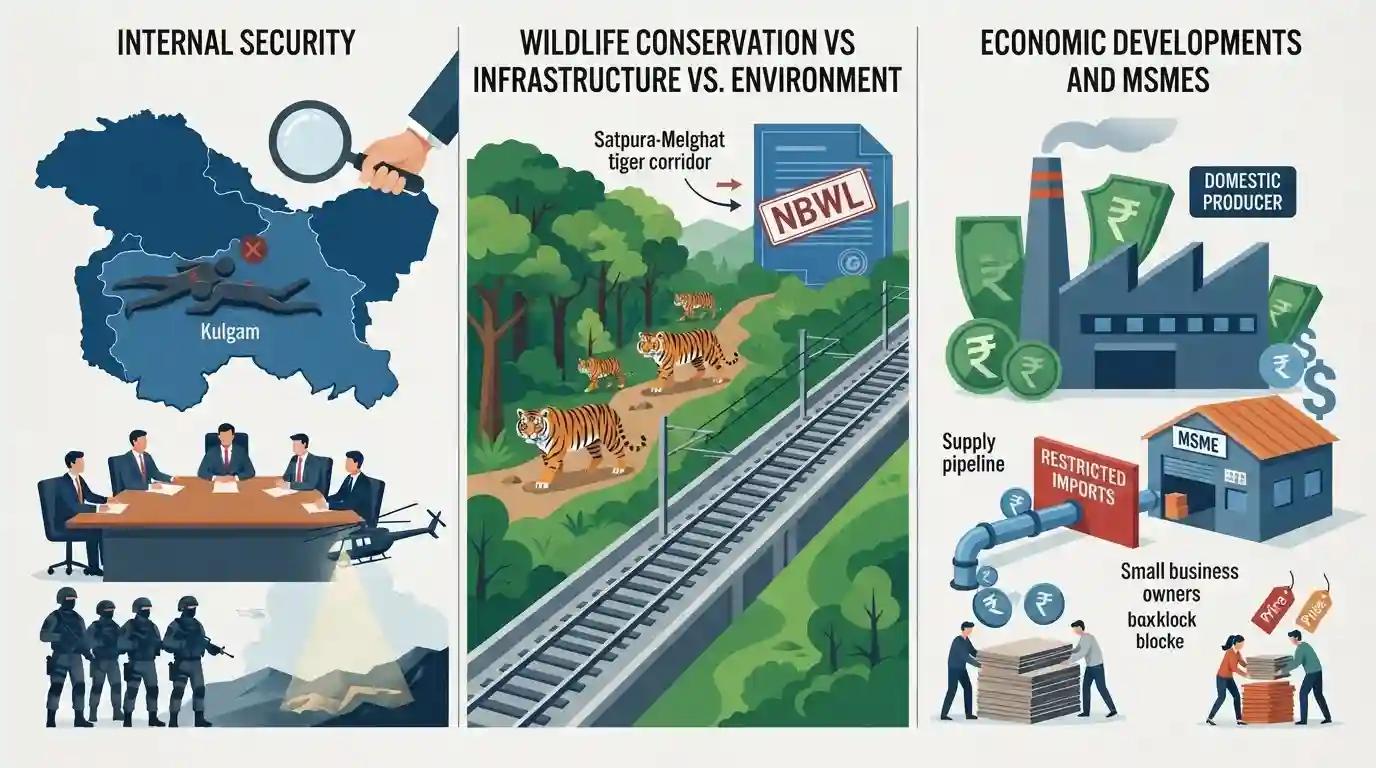
Highlights the evolving tactics of terrorists in J&K targeting vulnerable migrant workers, illustrates the regulatory mechanisms (NBWL) used to balance infrastructure projects with the conservation of fragile wildlife corridors, and demonstrates the complex downstream effects of trade protectionism where policies intended to curb cheap foreign dumping can inadvertently hurt import-dependent MSMEs.
సారాంశం
The front page covers multiple critical developments across security, environment, and economy. In Jammu and Kashmir, targeted killings of two migrant workers in Kulgam have reignited internal security concerns, prompting a high-level review by the LG and massive search operations. On the environmental front, the National Board for Wildlife (NBWL) has conditionally approved a third railway line through the crucial Satpura-Melghat tiger corridor, highlighting the ongoing infrastructure versus conservation debate. Economically, MSMEs are grappling with sudden price hikes after the DGFT restricted imports of Suspension Polyvinyl Chloride (S-PVC) resin—a move that protects large domestic players from cheap Chinese dumping but penalizes small firms dependent on imports due to a massive domestic supply gap.
ముఖ్య అంశాలు
- Targeted killings in Kulgam, J&K have claimed the lives of two seasonal migrant workers from Chhattisgarh, prompting high-level security meetings and cordon-and-search operations.
- The Standing Committee of the National Board for Wildlife (NBWL) gave in-principle approval for a railway line through the eco-sensitive Satpura-Melghat tiger corridor, conditional upon wildlife mitigation structures.
- MSMEs manufacturing PVC pipes are protesting a recent DGFT import restriction on Suspension Polyvinyl Chloride (S-PVC) resin, implemented after the Finance Ministry rejected anti-dumping duties on cheap Chinese imports.
- The import curb, while protecting large domestic manufacturers from dumping, has spiked input costs for MSMEs facing a 70% domestic supply-demand gap for S-PVC.
ముఖ్యమైన పదాలు
National Board for Wildlife (NBWL)

A statutory organization constituted under the Wildlife (Protection) Act, 1972. Chaired by the Prime Minister, it serves as India’s apex advisory body on wildlife conservation, approving projects in and around protected areas.
UPSC context
GS Paper 3 (Environment & Biodiversity). Tests understanding of statutory conservation bodies, environmental governance, and infrastructure-conservation conflicts.
Directorate General of Foreign Trade (DGFT)
An attached office of the Ministry of Commerce and Industry. It administers and formulates India's Foreign Trade Policy, acting as a trade facilitator to promote and regulate exports and imports.
UPSC context
GS Paper 3 (Indian Economy & Trade). Tests awareness of regulatory authorities managing international trade, export promotion, and import restrictions.
Suspension Polyvinyl Chloride (S-PVC)
A high-grade thermoplastic resin produced through suspension polymerization, widely used to manufacture pipes and cables. It is a critical, heavily imported raw material for the Indian plastic manufacturing and MSME sectors.
UPSC context
GS Paper 3 (Industrial Development & Trade Policy). Tests understanding of raw material supply chains, trade tariffs, and economic impacts of import restrictions on MSMEs.
Eco-Sensitive Zone (ESZ)
Ecologically fragile areas notified around national parks and sanctuaries by the environment ministry under the Environment (Protection) Act, 1986. They act as "shock absorbers" to regulate harmful human activities and preserve biodiversity.
UPSC context
GS Paper 3 (Environmental Conservation). Tests knowledge of buffer-zone regulations, ecological preservation frameworks, and developmental conflicts around protected areas.
Anti-Dumping Duty (ADD)
A protectionist tariff imposed on foreign imports that are priced below their normal market value or production cost in the exporting country, aiming to safeguard domestic industries from material injury and unfair competition.
UPSC context
GS Paper 3 (Indian Economy & Trade). Tests knowledge of protectionist measures, trade remedies, dumping margins, and international trade policy under WTO guidelines.
The Resistance Front (TRF)
A militant organization designated as a terrorist group under India's UAPA. Active in Jammu and Kashmir, it emerged in 2019 as a front and proxy for Pakistan-based Lashkar-e-Taiba to project an indigenous image.
UPSC context
GS Paper 3 (Internal Security). Tests awareness of non-state actors, proxy warfare, terrorism in J&K, and statutory frameworks like UAPA.
ప్రిలిమ్స్ ఉచ్చు
The Directorate General of Trade Remedies (DGTR) has the statutory power to levy and impose anti-dumping duties.
In India's trade remedy architecture, the DGTR is only an investigating and recommending body. The actual legal authority to levy and enforce anti-dumping duties rests solely with the Ministry of Finance.
అనుసంధానమైన స్థిర భావనలు
How is the trade remedy administrative framework split in India?
- DGTR Role: DGTR under the Ministry of Commerce & Industry conducts dumping investigations and officially recommends duties.
- Finance Ministry Power: The Department of Revenue under the Ministry of Finance has final authority to accept or reject the recommended duties.
- DGFT Mandate: DGFT under the Commerce Ministry administers quantitative restrictions, import licensing, and foreign trade policy directives.
What is the statutory setup of the National Board for Wildlife (NBWL)?
- Statutory Origin: It is a statutory body constituted under Section 5A of the Wildlife (Protection) Act, 1972.
- Chaired by PM: The Prime Minister of India serves as the Chairperson, while the Minister of Environment, Forest and Climate Change is the Vice-Chairperson.
- Boundary Approvals: No alteration of boundaries in National Parks and Wildlife Sanctuaries can occur without the recommendation of the NBWL's Standing Committee.
అంతర-అంశ నమూనాలు
Linear infrastructure vs Ecological corridors
Infrastructure projects in tiger corridors highlight the friction between national logistics goals (GS3 Infrastructure) and wildlife genetic connectivity requirements under the Wildlife Protection Act (GS3 Environment).
Upstream protection vs Downstream MSMEs
Restricting intermediate raw materials to protect domestic monopolies harms downstream MSMEs, highlighting the clash between trade protectionism (GS3 Trade) and MSME cost-competitiveness (GS3 Manufacturing).

The division of power between DGTR (recommends duties) and Finance Ministry (imposes duties) is a high-probability target for 2026 Prelims.
అనుసంధాన PYQలు · 4
అనుసంధాన PYQలు · 4
- 2023MainsGS3
What are the internal security challenges being faced by India? Give out the role of Central Intelligence and Investigative Agencies tasked to counter such threats.
- 2023MainsGS3
Winning of 'Hearts and Minds' in terrorism-affected areas is an essential step in restoring the trust of the population. Discuss the measures adopted by the Government in this respect as part of the conflict resolution in Jammu and Kashmir.
- 2017PrelimsGS1
The term 'M-STRIPES' is sometimes seen in the news in the context of
- 2020PrelimsGS1
Among the following Tiger Reserves, which one has the largest area under "Critical Tiger Habitat"?
