Delhi Winter Smog Spreads Antimicrobial Resistant Superbugs
Source:Indian Express ↗
Why It Matters
It establishes a critical link between two major global crises—air pollution and antimicrobial resistance (AMR). For UPSC aspirants, it provides a powerful, interdisciplinary example of how environmental issues (GS3 Environment) directly impact public health and disease spread (GS3 Science & Tech/Health), which is highly relevant for Mains answers on pollution impacts and AMR containment.
Summary
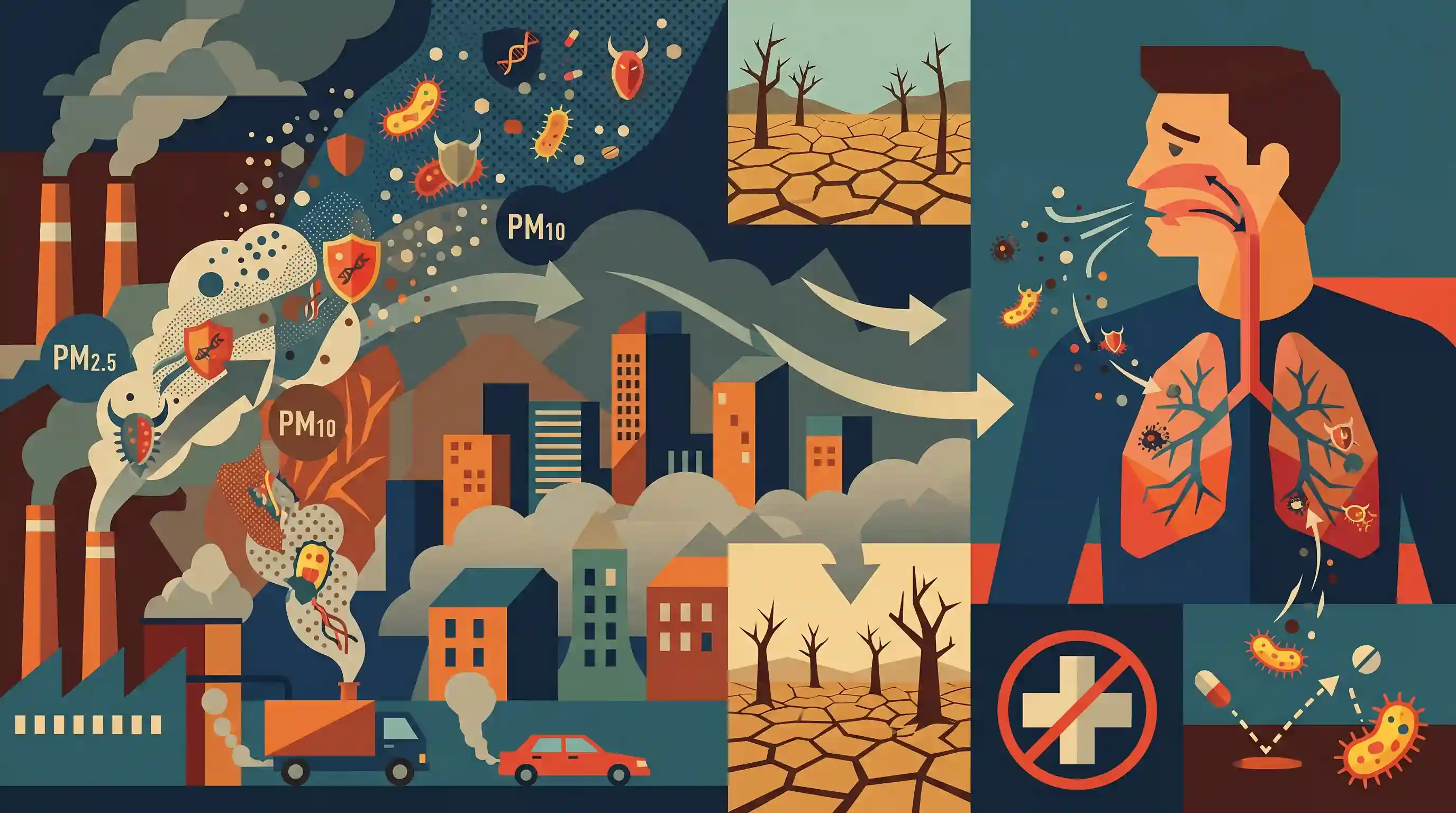
A recent study conducted by Jawaharlal Nehru University (JNU) reveals a concerning intersection between environmental pollution and public health, showing that Delhi's winter smog acts as a breeding ground and vector for antibiotic-resistant bacteria. The research indicates that particulate matter (like PM2.5 and PM10) can carry 'superbugs' and their resistant genes, facilitating their widespread dispersal. This exacerbates the health risks of winter pollution, as individuals are not only exposed to respiratory irritants but also to pathogens that cannot be easily treated with standard antibiotics, highlighting the need for integrated environmental and health policies.
Key Points
- A recent JNU study links Delhi's severe winter air pollution to the increased spread of antibiotic-resistant bacteria (superbugs).
- Particulate matter (PM2.5 and PM10) in the smog acts as a carrier, harboring and transporting resistant bacteria and resistance genes across the environment.
- The combination of poor air quality and airborne superbugs creates a dual public health crisis, exacerbating respiratory diseases with infections that are harder to treat.
- The findings indicate that mitigating air pollution is also a critical step in containing the silent pandemic of Antimicrobial Resistance (AMR).
Important Terms
Antimicrobial Resistance (AMR)

The ability of microorganisms (bacteria, viruses, fungi) to resist drugs that once killed them, making common infections harder to treat.
UPSC context
GS Paper II (Health) and GS Paper III (Science & Tech); tests understanding of global health threats and policy responses.
National Clean Air Programme (NCAP)
A 2019 national-level strategy aimed at a 20-30% (later 40%) reduction in particulate matter concentrations by 2026 across polluted Indian cities.
UPSC context
GS Paper III (Environment); key for questions on pollution mitigation, air quality standards, and urban governance.
Non-attainment Cities
Cities that do not meet the National Ambient Air Quality Standards (NAAQS) for five consecutive years, specifically targeted under the NCAP.
UPSC context
GS Paper III (Environment); relevant for understanding localized pollution challenges and specific central government interventions.
Particulate Matter (PM2.5 & PM10)
Microscopic solid or liquid particles suspended in air; PM2.5 (fine) is particularly dangerous as it can penetrate deep into the lungs and bloodstream.
UPSC context
GS Paper III (Environment); fundamental to topics on air pollution, respiratory health, and environmental standards.
Superbugs
Strains of bacteria, viruses, or fungi that have developed resistance to multiple antimicrobial drugs, rendering standard medical treatments ineffective.
UPSC context
GS Paper III (Science & Technology); focuses on emerging biological threats, public health crises, and the limits of modern medicine.
One Health Approach
An integrated, unifying approach that recognizes the fundamental interdependence between the health of people, animals, and their shared environment.
UPSC context
GS Paper II (Health Governance) and GS Paper III (Environment); crucial for addressing zoonotic diseases and antimicrobial resistance holistically.
Prelims Trap
AMR spread in India is exclusively driven by waterborne vectors, untreated sewage, and agricultural runoff.
Aspirants may assume AMR genes only travel via water, soil, or direct consumption. This study establishes that airborne particulate matter acts as a physical vector for superbugs.
Static Concepts Connected
What is the 'One Health' approach?
- Core philosophy: An integrated strategy recognizing that human health is inextricably linked to the health of animals and the shared environment.
- Key focus areas: Addresses critical global health threats including Antimicrobial Resistance (AMR), zoonotic disease spillovers, vector-borne infections, and food safety.
- Global governance: Spearheaded by the 'Quadripartite' alliance comprising the WHO, FAO, UNEP, and the World Organisation for Animal Health (WOAH).
How does PM2.5 physiologically differ from PM10?
- Size and classification: PM10 (≤10 micrometers) are inhalable particles trapped in the upper respiratory tract. PM2.5 (≤2.5 micrometers) are fine particles.
- Deep penetration: Due to its tiny size, PM2.5 can bypass the nose and throat, penetrate deep into the alveolar regions of the lungs, and even enter the bloodstream.
- Biological vector role: Beyond chemical toxicity, PM2.5 surfaces act as substrates for biological agents like bacteria and resistance genes to form protective biofilms during atmospheric transport.
Cross-Topic Patterns
Air Pollution + AMR (One Health)
Urban smog acting as an AMR vector means clean air programs (NCAP, GRAP) are now critical public health interventions for mitigating superbug transmission under the broader One Health framework.
Bioaerosols vs. Current NAAQS standards
India's National Ambient Air Quality Standards (NAAQS) focus on chemical/physical parameters (SO2, NOx, PM) but currently lack metrics for biological payloads like resistant bacteria piggybacking on particulate matter.

Expect a 2026 prelims question testing PM2.5's role as a biological vector for AMR genes, blending environmental pollution with health.
Linked PYQs · 5
Linked PYQs · 5
- 2019PrelimsGS1
Which of the following are the reasons for the occurrence of multi-drug resistance in microbial pathogens in India? 1. Genetic predisposition of some people 2. Taking incorrect doses of antibiotics to cure diseases 3. Using antibiotics in livestock farming 4. Multiple chronic diseases in some people Select the correct answer using the code given below.
- 2022PrelimsGS1
Consider the following statements: 1. Biofilms can form on medical implants within human tissues. 2. Biofilms can form on food and food processing surfaces. 3. Biofilms can exhibit antibiotic resistance. Which of the statements given above are correct?
- 2014MainsGS3
Can overuse and free availability of antibiotics without Doctor's prescription, be contributors to the emergence of drug-resistant diseases in India? What are the available mechanisms for monitoring and control? Critically discuss the various issues involved.
- 2021MainsGS3
Describe the key points of the revised Global Air Quality Guidelines (AQGs) recently released by the World Health Organisation (WHO). How are these different from its last update in 2005? What changes in India's National Clean Air Programme are required to achieve these revised standards?
- 2022MainsGS3
Discuss in detail the photochemical smog emphasizing its formation, effects and mitigation. Explain the 1999 Gothenburg Protocol.
