Delhi Winter Air Pollution Action Plan and GRAP Implementation
Source:Indian Express ↗
हे का महत्त्वाचे आहे
Urban air pollution in the National Capital Region is a critical annual environmental crisis requiring coordinated administrative frameworks like GRAP, making policy responses and mitigation strategies vital for GS3.
सारांश
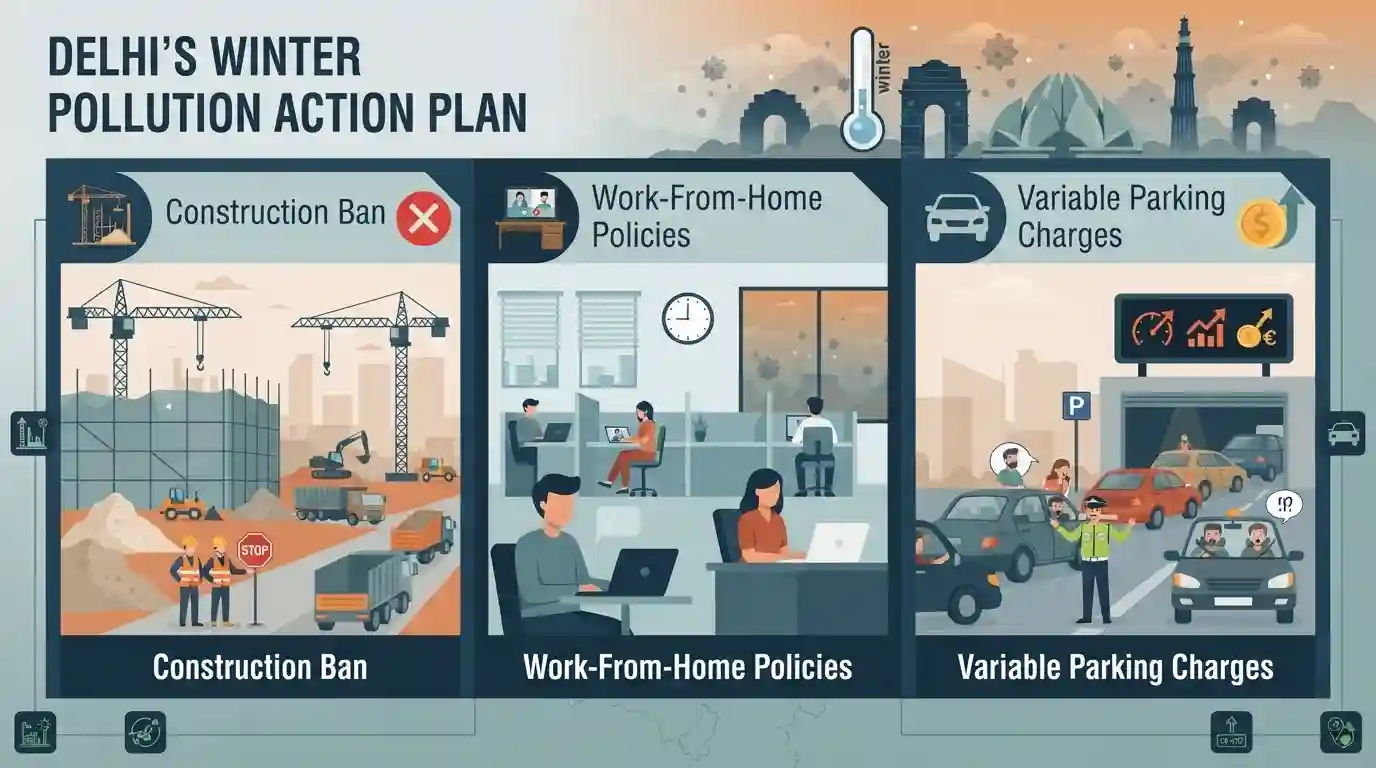
The article details Delhi's winter pollution action plan, which features strict regulatory interventions including construction bans, work-from-home policies, and variable parking charges to curb hazardous air quality spikes during winter months.
मुख्य मुद्दे
- Delhi government outlines its winter action plan to combat severe air pollution, incorporating stringent measures like construction bans, work-from-home (WFH) mandates, and increased parking fees.
- The multi-pronged strategy relies on implementing the Graded Response Action Plan (GRAP) stages dynamically depending on air quality index (AQI) thresholds.
- The measures balance administrative clampdowns on emissions with public transport incentives and anti-dust drives across the capital region.
महत्त्वाच्या संज्ञा
Graded Response Action Plan (GRAP)

A set of emergency anti-air pollution measures implemented in stages across the National Capital Region based on worsening Air Quality Index thresholds.
UPSC context
GS Paper III (Environmental Pollution and Degradation) — tests understanding of institutional mechanisms and emergency regulatory frameworks for tackling urban smog.
Commission for Air Quality Management (CAQM)
A statutory body established by an Act of Parliament in 2021 for better coordination, research, identification, and resolution of air quality problems in the NCR and adjoining areas.
UPSC context
GS Paper III (Conservation and Environmental Management) — tests knowledge of statutory environmental bodies, governance structures, and regional coordination.
संबंधित स्थिर संकल्पना
What is the statutory mandate and structural framework of the Commission for Air Quality Management (CAQM)?
- Statutory Origin: Established via the Commission for Air Quality Management in National Capital Region and Adjoining Areas Ordinance, later enacted as an Act in 2021.
- Overriding Powers: Supersedes all state-level bodies (like DPCC, Haryana/Up pollution boards) in the NCR on matters of air pollution policy and enforcement.
- Penal Authority: Empowered to issue binding directions, impose environmental compensation, and penalize violators with up to 5 years imprisonment or fines up to ₹1 crore.
आंतर-विषय नमुने
Statutory Regulators vs Judicial Activism in Pollution
The statutory shift from judicial monitoring to the CAQM mirrors institutional changes seen in river basins and disaster management authorities.

Expect a statement-based question linking CAQM statutory powers, GRAP AQI thresholds, and Supreme Court jurisprudence.
संबंधित PYQ · 2
संबंधित PYQ · 2
- 2020MainsGS3
What are the key features of the National Clean Air Programme (NCAP) initiated by the Government of India?
- 2022PrelimsGS1
In the context of WHO Air Quality Guidelines, consider the following statements: 1. The 24-hour mean of PM2.5 should not exceed 15 µg/m³ and annual mean of PM2.5 should not exceed 5 µg/m³. 2. In a year, the highest levels of ozone pollution occur during the periods of inclement weather. 3. PM10 can penetrate the lung barrier and enter the bloodstream. 4. Excessive ozone in the air can trigger asthma. Which of the statements given above are correct?
