Early Heatwave Onset and Extreme Weather Patterns in India
Source:Indian Express ↗
Why It Matters
The increasing frequency, intensity, and earlier onset of heatwaves point to shifting climatic patterns. For UPSC aspirants, understanding IMD warning systems, the mechanisms of extreme weather events, and phenomena like urban heat islands is crucial for Geography, Environment, and Disaster Management modules.
Summary
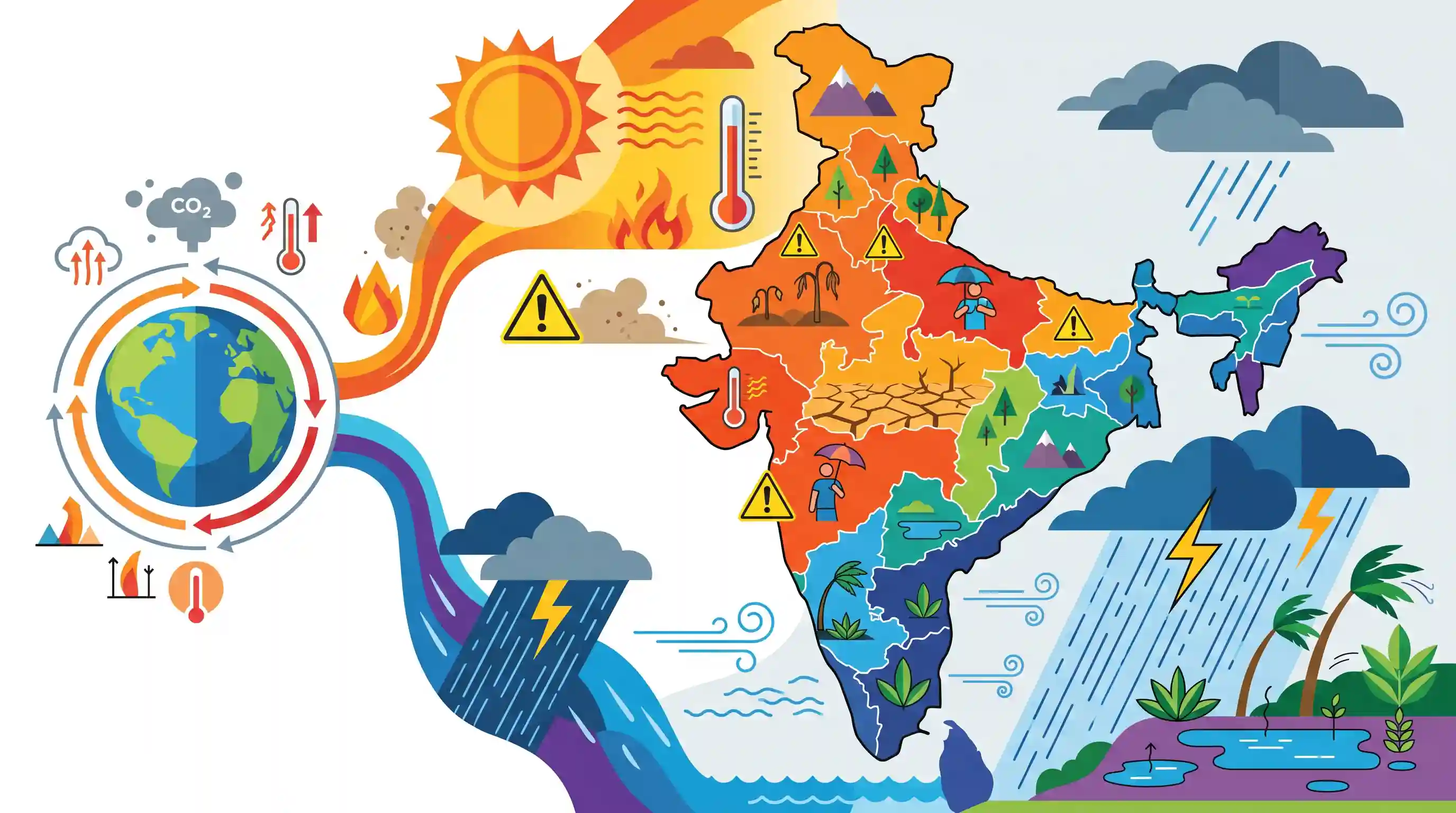
The India Meteorological Department (IMD) has issued a yellow alert for Delhi as the city, along with several states in North, Central, and West India, experiences an unusually early onset of severe heatwave conditions in April. Delhi's temperatures breached 40°C in the first week of April, a rare occurrence in the last 15 years, while Mumbai recorded scorching highs of 44°C. Conversely, IMD forecasts heavy pre-monsoon rainfall and thunderstorms for the Southern and Northeastern states, highlighting extreme and contrasting weather patterns across the Indian subcontinent.
Key Points
- Delhi and several North, Central, and Western Indian states experienced an unusually early summer and severe heatwave conditions in April 2025, prompting the IMD to issue 'yellow' alerts.
- Temperatures breached the 40°C mark in the first week of April for only the second time in 15 years in Delhi, while Mumbai recorded extreme highs of 44°C.
- The IMD predicts a potential respite for Northwest India after April 10 due to anticipated strong winds and thunderstorms.
- In sharp contrast to the Northern heatwave, Southern and Northeastern states (including Kerala, Tamil Nadu, Assam, and Arunachal Pradesh) received forecasts for heavy pre-monsoon rainfall and thunderstorms.
Important Terms
India Meteorological Department (IMD)

The principal government agency under the Ministry of Earth Sciences responsible for meteorological observations, weather forecasting, and seismology.
UPSC context
Relevant for GS Paper 1 (Geography) and GS Paper 3 (Disaster Management) regarding institutional frameworks for climate monitoring.
Heatwave Criteria
Declared when a station's maximum temperature reaches 40°C (Plains) or 30°C (Hills), with a departure from normal of 4.5°C to 6.4°C for two consecutive days.
UPSC context
Tested in Prelims (Geography) and Mains (GS Paper 1/3) as a specific climatological phenomenon and disaster.
Yellow Alert
The second level of IMD's color-coded alert system meaning 'Be Aware' or 'Be Updated,' signaling potentially bad weather that could cause minor disruptions.
UPSC context
Important for GS Paper 3 (Disaster Management) regarding early warning systems and public safety protocols.
Pre-monsoon Showers
Convectional rainfall occurring from March to May; regionally known as Mango Showers (South India), Kal Baisakhi (Bengal), and Tea Showers (Assam).
UPSC context
Key topic in GS Paper 1 (Indian Geography) regarding seasonal rainfall patterns and their agricultural significance.
Urban Heat Island (UHI) Effect
A phenomenon where urban areas experience significantly higher temperatures than surrounding rural areas due to heat-trapping concrete, asphalt, and lack of vegetation.
UPSC context
Discussed in GS Paper 1 (Geography/Urbanization) and GS Paper 3 (Environment/Climate Change) as an anthropogenic climate impact.
Kal Baisakhi (Nor'westers)
Violent, localized thunderstorms in West Bengal and Odisha during the pre-monsoon season, known for bringing both destruction and beneficial rain for jute and rice.
UPSC context
Frequently asked in UPSC Prelims and GS Paper 1 under regional climatic variations of India.
Prelims Trap
"A heatwave is declared in India whenever the maximum temperature in coastal areas crosses 40°C."
The IMD threshold for coastal areas is 37°C, whereas 40°C applies to the plains. Additionally, a departure of at least 4.5°C from normal is generally required for a declaration.
Static Concepts Connected
What are the exact IMD criteria for declaring a heatwave in India?
- Base Threshold: Maximum temperature must reach at least 40°C in plains, 37°C in coastal areas, and 30°C in hilly regions.
- Departure Condition: The baseline temperature must be accompanied by a departure from normal temperatures of at least 4.5°C to 6.4°C.
- Severe Heatwave: Declared when the departure from normal is >6.4°C, or when the absolute maximum temperature hits >=47°C in plains.
What are the local names of pre-monsoon showers and their economic significance?
- Mango Showers: Occur in Kerala and Karnataka towards the end of summer, helping in the early ripening of mangoes.
- Cherry Blossom: Common in Kerala and Karnataka; crucial for the flowering of coffee plantations. Also known as Coffee Showers.
- Kal Baisakhi: Violent thunderstorms in Bengal and Assam, known as Nor'westers. Though destructive, they are useful for tea, jute, and rice.
Cross-Topic Patterns
Wet-bulb limits & labor productivity
Rising wet-bulb temperatures (combined heat and humidity) severely impact outdoor labor efficiency in agriculture and construction, linking climatology directly to GS3 economic contraction and public health.
Urban Heat Islands & microclimates
Extreme highs in Mumbai and Delhi are exacerbated by low albedo and high thermal mass of concrete infrastructure, making urban microclimates a recurring theme in GS1 urban planning.

IMD heatwave criteria (plains vs coastal) and physiological limits of wet-bulb temperatures are high-probability 2026 Prelims targets.
Linked PYQs · 2
Linked PYQs · 2
- 2025PrelimsGS1
The World Bank warned that India could become one of the first places where wet-bulb temperatures routinely exceed 35 °C. Which of the following statements best reflect(s) the implication of the above-said report? I. Peninsular India will most likely suffer from flooding, tropical cyclones and droughts. II. The survival of animals including humans will be affected as shedding of their body heat through perspiration becomes difficult. Select the correct answer using the code given below.
- 2013MainsGS1
Bring out the causes for the formation of heat islands in the urban habitat of the world.
