Delhi Air Pollution and Diwali Toxic Haze Crisis
Source:The Hindu ↗
Why It Matters
Essential for understanding urban environmental management, the limitations of air quality governance frameworks like GRAP, and the public health crisis in the Indo-Gangetic plains.
Summary
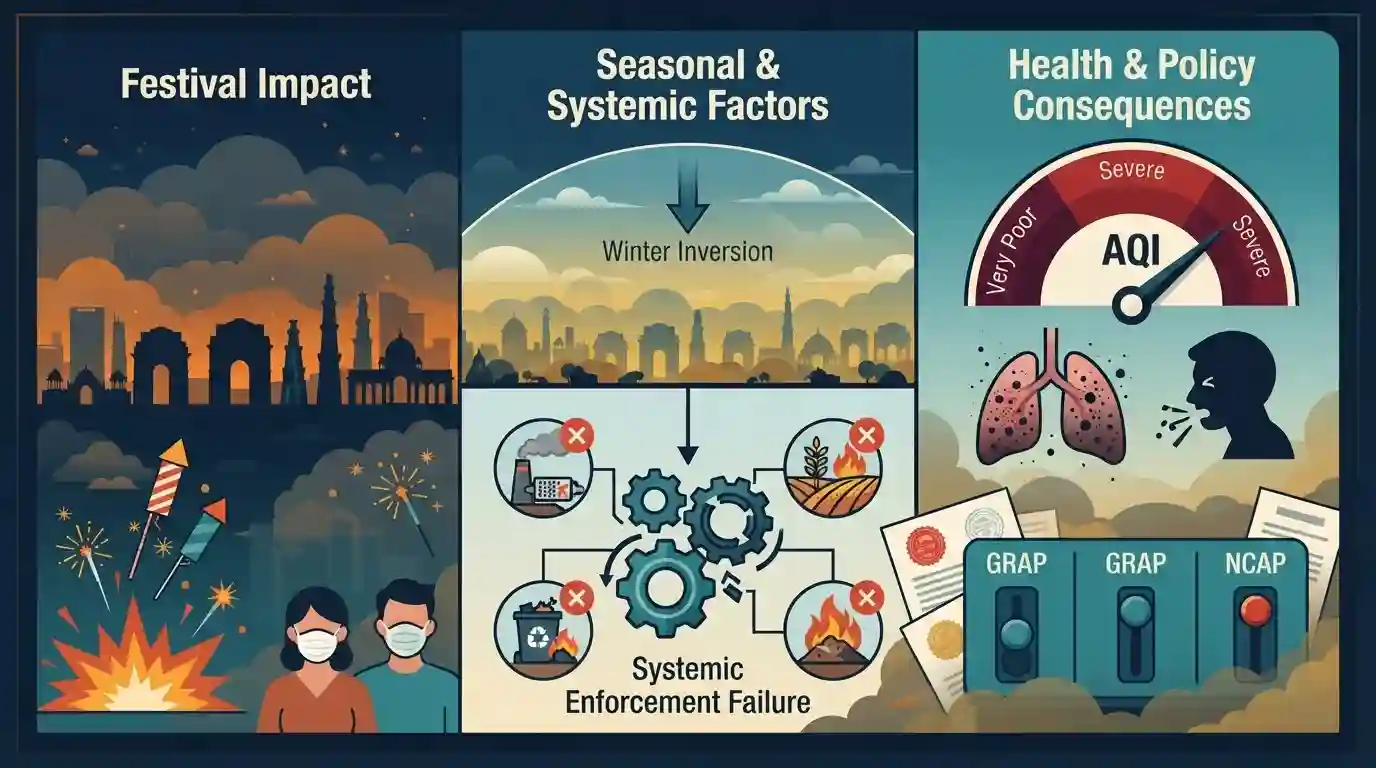
Delhi's air quality deteriorated sharply following Diwali, reaching very poor to severe levels, underscoring the recurring challenges of festival-related pollution, winter inversion, and systemic enforcement failures of environmental guidelines like GRAP and NCAP.
Key Points
- Delhi woke up to a severe toxic haze following Diwali celebrations, with the Air Quality Index (AQI) touching very poor to severe levels in several areas.
- Firecracker bans and restrictions often fail to curb peak winter pollution episodes due to local stubble burning, meteorological conditions, and seasonal factors.
- The Graded Response Action Plan (GRAP) is frequently invoked to restrict industrial activity, construction, and vehicular movement during high-pollution phases.
- Chronic air pollution in the Indo-Gangetic plain highlights structural governance gaps in cross-state environmental coordination.
Prelims Trap
GRAP is a round-the-year preventative framework implemented uniformly across all Indian states to check baseline pollution.
Aspirants often assume GRAP is a round-the-year static prevention policy, whereas it is strictly an emergency-response mechanism triggered progressively based on AQI thresholds.
Static Concepts Connected
What are the key operational features and stages of the Graded Response Action Plan (GRAP) in Delhi-NCR?
- Emergency nature: Emergency Nature: It is an emergency-response action plan, not a continuous year-round pollution control policy.
- Stage criteria: AQI Thresholds: Actions are categorized into four distinct stages based on PM2.5 and PM10 concentrations (Stage I to IV).
- Statutory body: Statutory Backing: Implemented by the Commission for Air Quality Management (CAQM) in NCR and adjoining areas.
Cross-Topic Patterns
Air Pollution + Federal Governance in IGP
Winter pollution spikes in the IGP combine festival emissions, paddy stubble burning, and meteorological inversion, demonstrating how federal geography overrides municipal-level bans and enforcement.
NCAP Targets vs. GRAP Emergency Actions
The operational failure of GRAP stages during peak winter mirrors systemic implementation gaps in national mission-mode climate targets.

IGP winter pollution + GRAP mechanism + NCAP targets frequently converge in multi-statement prelims or analytical mains questions.
Linked PYQs · 2
Linked PYQs · 2
- 2021MainsGS3
Describe the key points of the revised Global Air Quality Guidelines (AQGs) recently released by the World Health Organisation (WHO). How are these different from its last update in 2005? What changes in India's National Clean Air Programme are required to achieve these revised standards?
- 2020MainsGS3
What are the key features of the National Clean Air Programme (NCAP) initiated by the Government of India?
