Security Alert Issued in Uttarakhand over Intelligence Inputs
Source:theweek ↗
Why It Matters
This article links key geographic locations in Uttarakhand (Rudraprayag and Karnaprayag, part of the sacred Panch Prayag) with regional internal security and cultural groups (the Nihang Sikhs, who trace their origins to the Khalsa Panth established by Guru Gobind Singh). Understanding the rivers of these districts (such as the Mandakini and Alaknanda confluences) and the historical-religious evolution of Sikh warrior groups are highly recurrent themes in the UKPSC PCS Prelims.
Summary
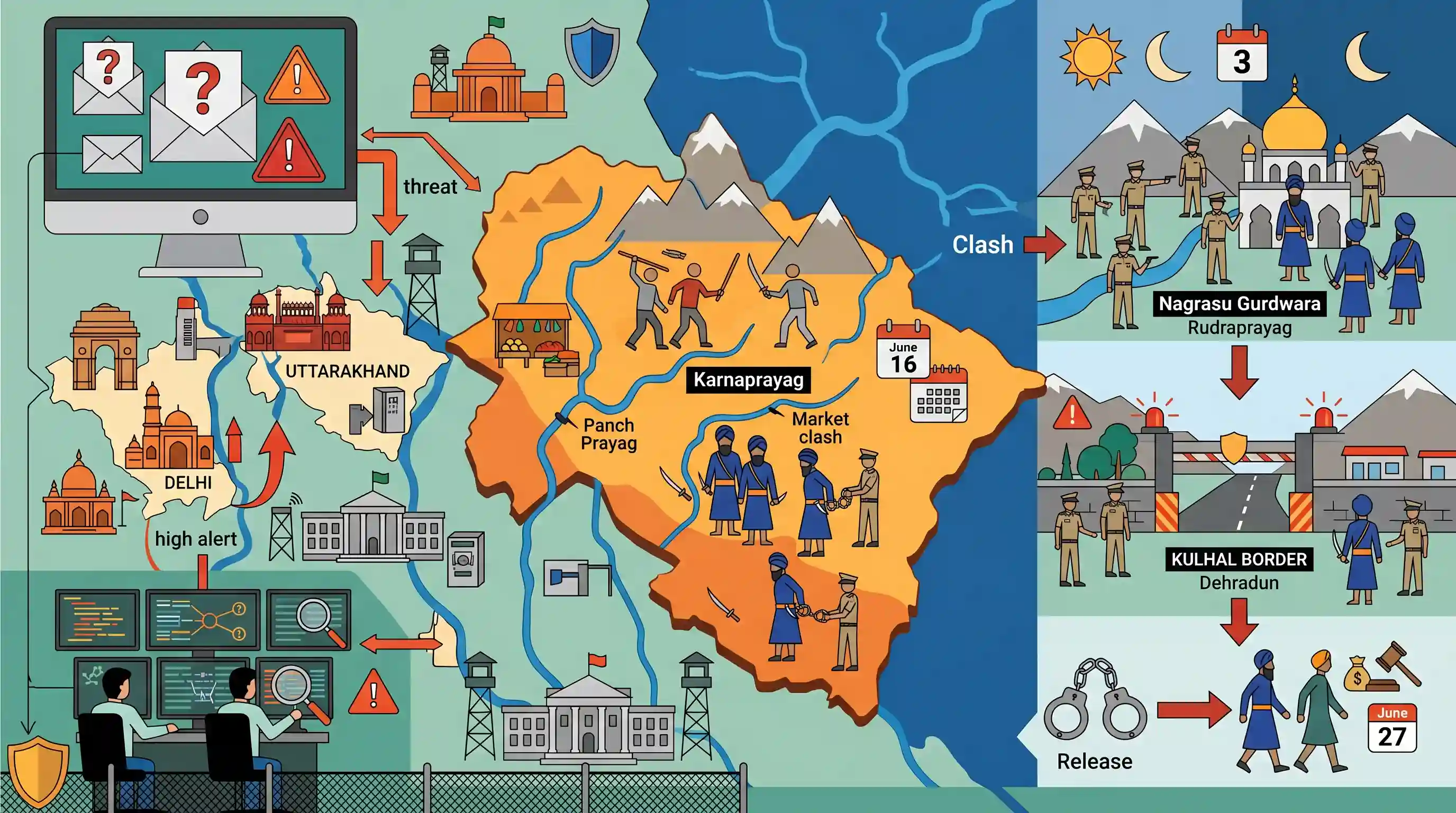
Following an email-based terror threat targeting major religious sites, government offices, and police installations, security agencies have placed Delhi and Uttarakhand on high alert. The alert coincides with recent tensions in Uttarakhand involving Nihang Sikhs. This dispute began with a clash at Karnaprayag market in Chamoli on June 16, leading to the arrest of four Nihangs and a subsequent three-day standoff at Nagrasu Gurdwara in Rudraprayag. Tensions also briefly flared at the Kulhal border in Dehradun before the arrested individuals were granted bail on June 27, 2026. Cyber experts and intelligence agencies are presently verifying the legitimacy of the threat email.
Key Points
- Delhi and Uttarakhand have been placed on high alert following intelligence inputs about a potential terror threat received via an email.
- The threat email targeted key religious sites, government establishments, and police installations, prompting increased vigilance and cyber-forensic analysis to determine its credibility.
- The security alert comes shortly after a series of law-and-order incidents in Uttarakhand involving a group of Nihang Sikhs.
- A clash between Nihangs and locals occurred at Karnaprayag market on June 16, leading to the arrest of four Nihangs.
- Following the arrests, Nihangs staged a three-day standoff at the Nagrasu Gurdwara in Rudraprayag district, which ended on June 23 after mediation.
- On June 25, another group of Nihang Sikhs tried to cross into Dehradun district via the Kulhal border but was turned back toward Paonta Sahib (Himachal Pradesh).
- The four arrested Nihang Sikhs were subsequently granted bail by an Uttarakhand district and sessions court on June 27, 2026.
Important Terms
Nihang Sikhs

A distinct warrior order within the Sikh community, characterized by blue attire, high turbans with steel quoits, and traditional weapons, originating from the 10th Guru, Gobind Singh.
UPSC context
GS Paper I (Art & Culture) and GS Paper III (Internal Security); tests warrior traditions and socio-religious security dynamics.
Panch Prayag
The five sacred river confluences along the Alaknanda River in Uttarakhand—Vishnuprayag, Nandaprayag, Karnaprayag, Rudraprayag, and Devprayag—that merge to form the Ganges.
UPSC context
GS Paper I (Indian Geography); tests Himalayan river systems, drainage patterns, and cultural geography of northern India.
Khalsa
The collective community of initiated, baptized Sikhs established in 1699 by Guru Gobind Singh, characterized by a strict code of conduct and the Five Ks.
UPSC context
GS Paper I (Medieval Indian History & Culture); tests the evolution of Sikhism and historical socio-religious movements.
Karnaprayag
One of the five sacred river confluences (Panch Prayag) in Uttarakhand, representing the holy junction where the Alaknanda River meets the Pindar River.
UPSC context
GS Paper I (Indian Geography); tests key river tributaries, confluences, and mapping locations in the Garhwal Himalayas.
central intelligence agencies
India's federal intelligence organs, such as the Intelligence Bureau (IB) and Research and Analysis Wing (RAW), tasked with gathering, analyzing, and coordinating domestic and external security intelligence.
UPSC context
GS Paper III (Internal Security); tests national security architecture, mandates, and inter-agency coordination mechanisms.
Prelims Trap
The Nihangs hoist a traditional saffron-colored Nishan Sahib over their shrines, aligning with mainstream Khalsa practices.
Nihangs uniquely hoist a dark blue Nishan Sahib (flag) instead of the standard saffron/yellow flag used by mainstream Sikh Gurdwaras.
Static Concepts Connected
What are the five sacred confluences (Panch Prayag) of the Alaknanda River?
- Vishnuprayag: Confluence of the Alaknanda and Dhauliganga rivers in Chamoli district.
- Nandaprayag: Confluence of the Alaknanda and Nandakini rivers.
- Karna & Rudraprayag: Karnaprayag is the Alaknanda-Pindar confluence; Rudraprayag is the Alaknanda-Mandakini confluence.
- Devprayag: Final confluence of Alaknanda and Bhagirathi, from where the river is called Ganga.
What is the historical significance of the Nihang Sikh warrior order?
- Khalsa Genesis: Formed during the creation of the military-spiritual Khalsa Panth by Guru Gobind Singh in 1699.
- Distinctive Attire: Famous for carrying antiquated steel weapons, blue robes, and high turbans decorated with steel quoits.
- Sovereign Identity: Hoist blue Nishan Sahib flags instead of saffron and historically held administrative custody of Akal Takht.
Cross-Topic Patterns
River Valleys & Pilgrimage Corridors
The alignment of historical Sikh shrines and Hindu pilgrimage sites along major Himalayan river confluences shapes the strategic physical-cultural geography of India's borders.
Hybrid Warfare & Civic Tensions
Adversaries utilize cyber-threat vectors, such as mass emails, to exploit localized law-and-order friction points, turning civic disputes into national security alerts.

Panch Prayag confluences and Guru Gobind Singh's literary/military sites are likely to appear in physical-cultural matching questions in 2026.
Linked PYQs · 2
Linked PYQs · 2
- 2007UKPSC_PRELIMSGS1
Name the river which flows between Kedarnath | Rudra Prayag?
- 2016UKPSC_PRELIMSGS1
Under which Sikh Guru the Sikhs were transformed into the 'Khalsa'?
