Delhi Winter Air Pollution Crisis and GRAP Implementation
Source:The Hindu ↗
Why It Matters
Urban air pollution is a persistent challenge in India, particularly in the Indo-Gangetic plain. Understanding institutional responses like GRAP, the role of the CAQM, and the meteorological drivers of air pollution is crucial for the Environment and Ecology syllabus in GS-III.
Summary
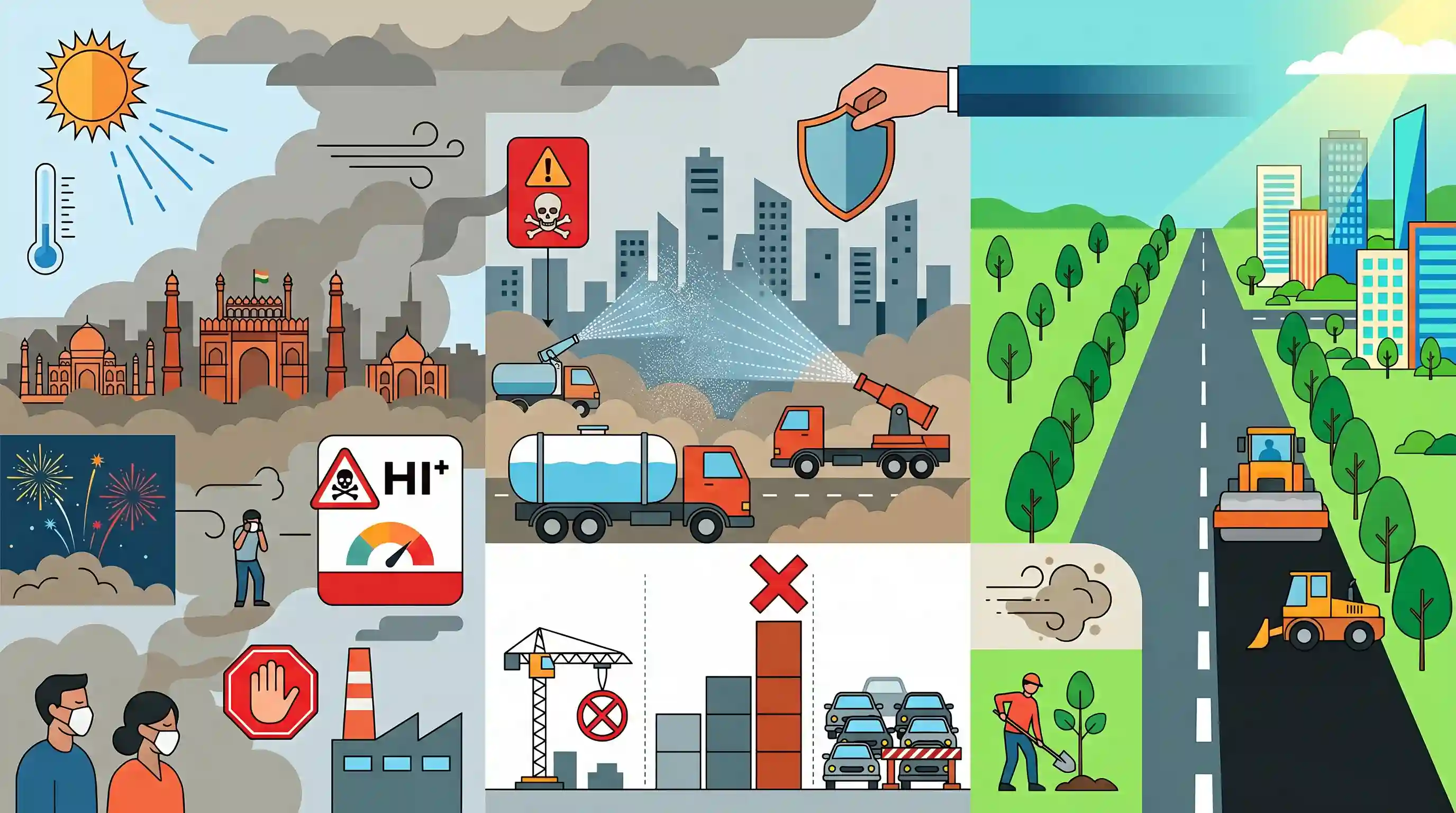
The article outlines the recurring problem of severe winter air pollution in Delhi and the National Capital Region (NCR), with the Air Quality Index (AQI) expected to cross the 400 mark during New Year. This spike is attributed to adverse meteorological conditions, such as low temperatures and calm winds, compounded by firecracker usage. Authorities have implemented Stage-3 of the Graded Response Action Plan (GRAP) and deployed mist spray systems to manage the crisis. Additionally, the Delhi government plans to construct 400 km of roads to reduce dust emissions once GRAP restrictions are eased, highlighting the need for both immediate and long-term infrastructural interventions.
Key Points
- Delhi's air quality is predicted to deteriorate to the 'severe' category (AQI > 400) during New Year due to falling temperatures, calm winds, and anticipated firecracker emissions.
- To combat the pollution, Stage-3 of the Graded Response Action Plan (GRAP) has been enforced, alongside the deployment of mist spray systems and mechanised road sweeping.
- The Delhi government has announced a long-term plan to construct nearly 400 km of roads to curb dust emissions, which will commence once GRAP restrictions are lifted.
Important Terms
Graded Response Action Plan (GRAP)

An emergency response framework for Delhi-NCR that applies escalating, stage-wise restrictions based on AQI thresholds to prevent extreme pollution episodes. Notified by the Ministry of Environment in 2017.
UPSC context
GS Paper III (Environment); focuses on urban pollution control strategies and emergency environmental protocols.
Commission for Air Quality Management (CAQM)
A statutory body established in 2021 to oversee, research, and coordinate air quality management in Delhi-NCR and adjoining states, replacing previous ad-hoc committees.
UPSC context
GS Paper II & III; tests knowledge of statutory environmental bodies and interstate coordination.
Air Quality Index (AQI)
A communication tool developed by CPCB to simplify air quality data into a single number/color, monitoring eight key pollutants to indicate potential health impacts.
UPSC context
GS Paper III (Environment); essential for understanding environmental monitoring indicators and public health impacts.
Particulate Matter (PM 2.5/10)
Inhalable microscopic particles with diameters under 2.5 or 10 micrometers. These are primary pollutants driving the AQI and linked to severe respiratory issues.
UPSC context
GS Paper III (Environment); focuses on specific pollutants, their sources, and impact on health.
National Capital Region (NCR)
A multi-state planning region centered on Delhi, including parts of Haryana, Uttar Pradesh, and Rajasthan, designed for coordinated regional development and environmental governance.
UPSC context
GS Paper I & II; relevant for urban geography and multi-state governance challenges.
Prelims Trap
The National Air Quality Index (NAQI) includes Carbon Dioxide (CO2) and Methane (CH4).
NAQI measures Carbon Monoxide (CO), not Carbon Dioxide (CO2), and does not measure greenhouse gases like Methane. It strictly tracks 8 specific pollutants affecting human health.
Static Concepts Connected
How does 'Temperature Inversion' aggravate winter smog?
- Mechanism: The normal lapse rate reverses; a layer of warm air settles above colder surface air, acting as an atmospheric lid.
- Trapping effect: This prevents the vertical mixing and dispersal of pollutants, trapping particulate matter and firecracker emissions close to the ground.
What is the statutory mandate of the CAQM?
- Statutory origin: Established via the CAQM Act 2021, it replaces the Supreme Court-mandated EPCA, functioning as a statutory body for the NCR and adjoining areas.
- Overriding powers: Its orders override the State Pollution Control Boards of Delhi, Punjab, Haryana, Rajasthan, and UP in matters of air quality management.
Cross-Topic Patterns
Agri-water policies & Urban Smog
State groundwater conservation acts delayed paddy sowing in Punjab, pushing harvests to late autumn. This aligns stubble burning perfectly with the onset of winter temperature inversions, linking water policy to air pollution.
Urban infrastructure vs. Geographic traps
Delhi's landlocked geography and continental climate exacerbate anthropogenic emissions, demonstrating how lack of sea breeze and natural geographic vulnerabilities magnify the impacts of urban infrastructure deficits.

Expect a 2026 Prelims question contrasting CAQM's statutory mandate with CPCB, mixed with trick options on NAQI vs WHO pollutant parameters.
Linked PYQs · 3
Linked PYQs · 3
- 2021MainsGS3
Describe the key points of the revised Global Air Quality Guidelines (AQGs) recently released by the World Health Organisation (WHO). How are these different from its last update in 2005? What changes in India's National Clean Air Programme are required to achieve these revised standards?
- 2025PrelimsGS1
Artificial way of causing rainfall to reduce air pollution makes use of
- 2022PrelimsGS1
In the context of WHO Air Quality Guidelines, consider the following statements: 1. The 24-hour mean of PM2.5 should not exceed 15 µg/m³ and annual mean of PM2.5 should not exceed 5 µg/m³. 2. In a year, the highest levels of ozone pollution occur during the periods of inclement weather. 3. PM10 can penetrate the lung barrier and enter the bloodstream. 4. Excessive ozone in the air can trigger asthma. Which of the statements given above are correct?
