Delhi Imposes Entry Ban on Non BS VI Commercial Vehicles
Source:The Hindu ↗
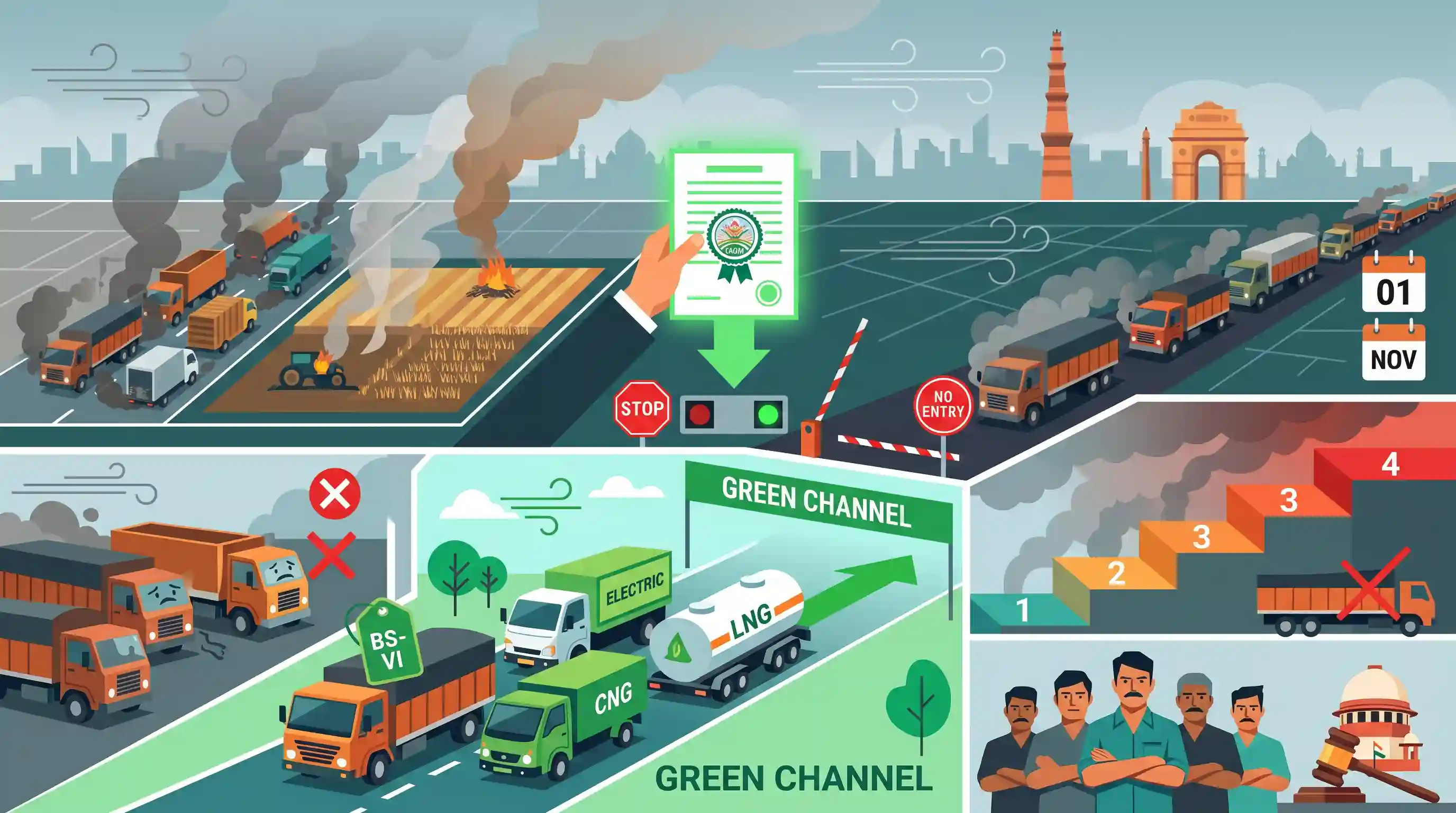
Why It Matters
Highlights the administrative and environmental strategies employed to mitigate Delhi's chronic winter air pollution crisis, emphasizing the transition to cleaner emission standards (BS-VI/EVs) and the tension between strict environmental regulations and interstate commerce.
Summary
The Delhi government has mandated a ban on the entry of non-BS-VI compliant commercial goods vehicles registered outside Delhi, effective November 1. Dictated by directives from the Commission for Air Quality Management (CAQM), the move serves as a preemptive measure against severe winter air pollution, which is worsened by vehicular emissions and stubble burning. While exemptions are provided for cleaner alternative fuels (CNG, LNG, EV) and BS-VI diesel vehicles, the Graded Response Action Plan (GRAP) restrictions will continue to dictate entry when specific pollution stages are reached. Transporters face significant operational hurdles and may seek judicial relief from the Supreme Court.
Key Points
- The Delhi government will ban the entry of non-BS-VI compliant commercial vehicles registered outside the city from November 1 to curb winter pollution.
- The directive aligns with strategies from the Commission for Air Quality Management (CAQM) targeting emissions before the onset of the smog season.
- Vehicles running on cleaner fuels like CNG, LNG, and electricity, along with BS-VI diesel and temporarily some BS-IV diesel vehicles, are exempt from this restriction.
- Transporters indicate potential economic and logistical challenges, planning to seek an extension or approach the Supreme Court.
Important Terms
Commission for Air Quality Management (CAQM)

A statutory body established in 2021 to coordinate, monitor, and implement air quality management strategies in the National Capital Region (NCR) and its adjoining states.
UPSC context
GS Paper 3: Environmental Governance. Tests knowledge of statutory bodies and their role in regional environmental regulation.
Graded Response Action Plan (GRAP)
An emergency response framework that implements stage-wise restrictive measures (Stage I to IV) in Delhi-NCR based on Air Quality Index (AQI) thresholds.
UPSC context
GS Paper 3: Environment. Tests understanding of administrative responses to seasonal pollution crises and urban governance.
Bharat Stage Emission Standards (BS-VI)
India's current mandatory emission norms (equivalent to Euro VI) that significantly reduce Particulate Matter and Nitrogen Oxide compared to the previous BS-IV standards.
UPSC context
GS Paper 3: Environment/S&T. Tests knowledge of vehicular technology upgrades and policy shifts to mitigate air pollution.
Air Quality Index (AQI)
A color-coded numerical scale (0-500) used by agencies like CPCB to communicate daily air quality and its health impacts based on eight key pollutants.
UPSC context
GS Paper 3: Environment. Tests technical knowledge of environmental monitoring and public health indicators.
Supreme Court
The highest judicial body, which has historically driven air pollution policy in Delhi through landmark environmental jurisprudence, such as the M.C. Mehta cases.
UPSC context
GS Paper 2: Judiciary/Governance. Tests the doctrine of 'Judicial Activism' and the court's role in enforcing the Right to Life (Art 21).
Prelims Trap
CAQM is an executive body regulating air pollution across all major Indian metropolitan cities.
CAQM is a statutory body (CAQM Act 2021) and its jurisdiction is strictly limited to Delhi-NCR and adjoining areas, not all Indian metros.
Static Concepts Connected
What are the key technical differences between BS-IV and BS-VI emission standards?
- Sulphur Content: Drastically reduced from 50 parts per million (ppm) in BS-IV to just 10 ppm in BS-VI.
- Leapfrogging: India skipped BS-V entirely, directly transitioning from BS-IV to BS-VI nationwide in April 2020.
- On-Board Diagnostics (OBD): BS-VI mandates OBD systems to continuously monitor real-time emission control performance, a feature absent in BS-IV.
How is the National Air Quality Index (AQI) calculated in India?
- Eight Pollutants: It measures the concentration of eight key pollutants: PM10, PM2.5, NO2, SO2, CO, O3, NH3, and Lead (Pb).
- Notable Exclusions: Carbon Dioxide (CO2) and Methane (CH4) are major greenhouse gases but are explicitly NOT included in the AQI calculation.
- Health Linkage: AQI transforms complex air quality data into a single number, color code, and nomenclature (Good to Severe) tied to GRAP stages.
Cross-Topic Patterns
Interstate commerce vs. Environmental mandates
Banning inter-state commercial vehicles invokes Article 301 (Freedom of Trade) debates, typically resolved by treating environmental protection as a reasonable restriction in the public interest under Article 302.
Energy transition in logistics
While EV and LNG trucks get exemptions from GRAP bans, the lack of robust highway charging and dispensing infrastructure severely hinders the heavy-duty logistics sector's transition away from diesel.

Expect a 2026 prelims statement mixing CAQM's specific statutory powers with the 8 pollutants tracked under the National AQI.
Linked PYQs · 4
Linked PYQs · 4
- 2016PrelimsGS1
In the cities of our country, which among the following atmospheric gases are normally considered in calculating the value of Air Quality Index? 1. Carbon dioxide 2. Carbon monoxide 3. Nitrogen dioxide 4. Sulfur dioxide 5. Methane Select the correct answer using the code given below.
- 2022PrelimsGS1
In the context of WHO Air Quality Guidelines, consider the following statements: 1. The 24-hour mean of PM2.5 should not exceed 15 µg/m³ and annual mean of PM2.5 should not exceed 5 µg/m³. 2. In a year, the highest levels of ozone pollution occur during the periods of inclement weather. 3. PM10 can penetrate the lung barrier and enter the bloodstream. 4. Excessive ozone in the air can trigger asthma. Which of the statements given above are correct?
- 2021MainsGS3
Describe the key points of the revised Global Air Quality Guidelines (AQGs) recently released by the World Health Organisation (WHO). How are these different from its last update in 2005? What changes in India's National Clean Air Programme are required to achieve these revised standards?
- 2023MainsGS3
The adoption of electric vehicles is rapidly growing worldwide. How do electric vehicles contribute to reducing carbon emissions and what are the key benefits they offer compared to traditional combustion engine vehicles?
